


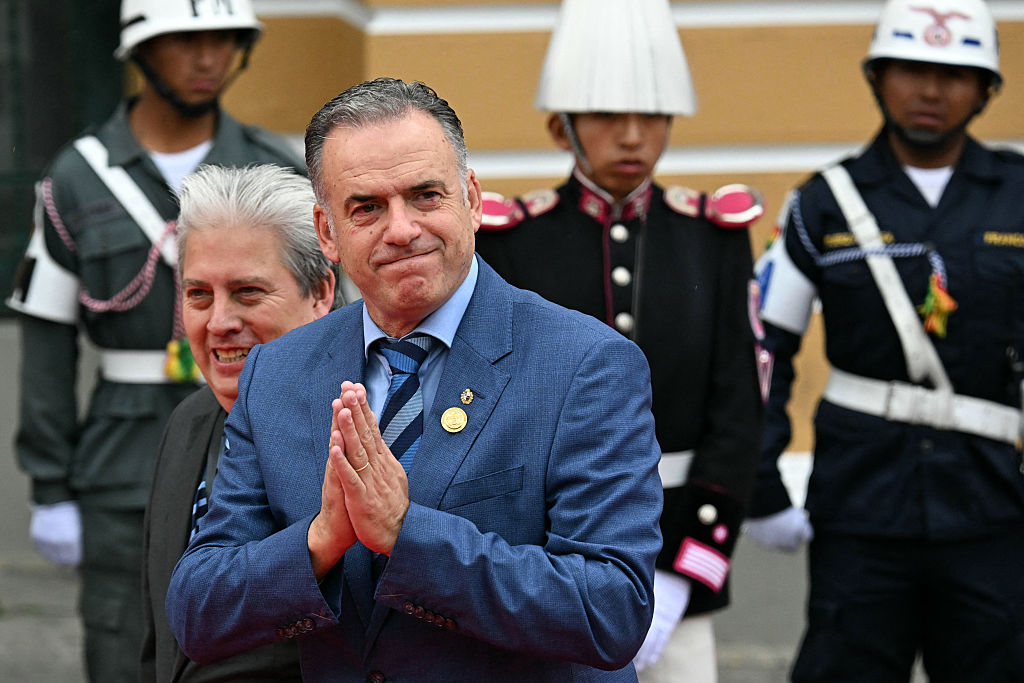
Uruguay’s left-wing president, Yamandú Orsi, recently surprised the public and startled members of his own party with comments that seemed favorable to El Salvador’s President Nayib Bukele and his draconian security policies.
“We need to talk about security, and I think the example is Bukele … It’s an example of a process that should be analyzed,” Orsi said. His statement revealed just how far the appeal of Bukele’s radical approach to crime has spread—all the way to Uruguay, with its longstanding reputation for peace and tranquility, and its strong left bloc.
With strong democratic institutions—it is one of just two full democracies in the region, according to the EIU’s Democracy Index—Uruguay has a living memory of authoritarian rule. This makes it very unlikely the country would attempt to import Bukele’s tactics. Even so, Orsi’s comments underscored how sensitive security policy has become even in Uruguay. Its crime rate is still well below regional averages, but it is grappling with a growing perception that crime is rising.
Before these statements, Orsi acknowledged that the left in Latin America has struggled to discuss security issues, instead focusing on “coexistence” due to a fear of being labeled “reactionary.” However, he argued that the left no longer has these prejudices, opening space for more policy options.
The reaction to his comments was mixed. From the right-wing opposition, former presidential candidates celebrated his stance or argued that it showed a government that lacked a clear orientation on the issue of crime. The secretary of the presidency, Alejandro Sánchez, sought to clarify that from the government’s perspective, “the population has a security problem, and it needs to be addressed from within democracy.” Orsi then offered an additional explanation, saying that the Bukele model “is impossible and unacceptable” in Uruguay.
Orsi’s unexpectedly candid comments touched a nerve for the left in the region. Latin America is lurching rightward due in large part to voter concern over the issue of crime. Even in Chile and Costa Rica, for example, conservatives appear likely to win upcoming elections with tough-on-crime messaging.
Now, Orsi seems determined to build an alternative model that meaningfully reduces crime while also upholding democratic norms. His administration is already developing a National Public Security Plan set to become operational in March 2026. Those who see Bukele-style security populism as a growing problem will hope that Orsi’s plan can provide an effective antidote.
A crime-weary public
Much like in Chile and Costa Rica, Uruguay’s reputation as safe and laid-back is under strain. Uruguay’s homegrown cartel network is increasingly advanced and transnational. The number of drug interceptions is rising as Uruguay increases its patrols of porous land and air borders. Perceptions of a worsening quality of life are also on the rise as homelessness, petty theft, and drug use become more common, along with rare but startling acts of violence. The most vivid recent example was the unprecedented and nearly fatal shooting and grenade attack that targeted the home of Attorney General Mónica Ferrero in late September.
As a result of all this, polls show that crime is the overriding concern for Uruguayan voters. In a recent survey, 49% of respondents cited crime as the most important issue facing the country, with unemployment a distant second at 29%. Although the percentage of Uruguayans citing crime as the most important issue is down from a high of 64% in August 2024, it has ticked up in recent months. More worrisome for the government is that the public’s evaluation of its handling of the issue has worsened.
Against this backdrop, Orsi’s approval rating has fallen to 36% from 41% in April, a month after his inauguration. Orsi’s comments about Bukele likely speak to uncertainty over how best to address the politics of crime amid growing calls for mano dura policies. Data from Latinobarómetro shows that 34.4% of Uruguayans held a favorable opinion of Bukele in 2024, up from 15.6% in 2023.
The wider geopolitical context is also getting trickier for the government. Orsi has only held office since March, and his administration may become increasingly isolated as the region swings to the right.
It seems likely that conservative candidates will continue to do well in next year’s elections, thanks in large part to tough-on-crime stances. They will also seek greater cooperation with the U.S. as the superpower reorients its foreign policy rhetoric around tackling organized crime and aggressively opposing left-wing authoritarian regimes like Venezuela and Cuba. Uruguay could even become the only left-leaning government in Spanish-speaking South America. Even Orsi’s key neighbor in Brazil, President Luiz Inácio Lula da Silva, is at risk.
Patience is a virtue
Uruguay still has the advantages of having a strong party system and a well-organized, engaged civil society. Political polarization is on the rise, but it is still manageable. To channel these advantages, the Orsi administration is hurrying to enact its new National Public Security Plan.
The plan is an all-of-government push, supported by multilateral organizations, to fight crime directly and also address its causes. Its success will test Uruguay’s democracy, its ability to deliver security, and its capacity to reverse perceptions of declining quality of life. It will require cooperation from opposition parties, but given the public mood, obstruction could backfire. All eyes will be on how well the government balances civil liberties with force to quell crime and reestablish a sense of normalcy in everyday life.
ABOUT THE AUTHOR

Nicolás Saldías
Reading Time: 3 minutesSaldías is a Latin America and Caribbean senior analyst at the Economist Intelligence Unit and received his Ph.D. in political science from the University of Toronto.