


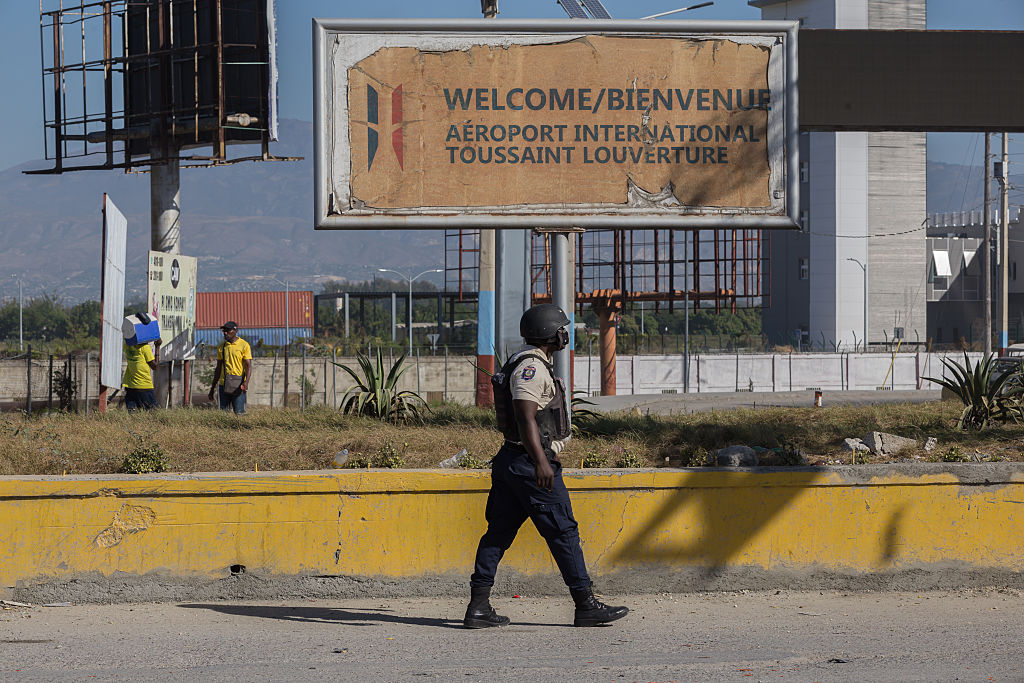
Haiti has long been shorthand for crisis. Yet even by the standards of the Western Hemisphere’s poorest country, the past few years mark a sharp deterioration. Gangs that once held a few blocks of poor neighborhoods now operate as coalitions that control much of Port-au-Prince and reach into key routes and towns outside the capital.
These networks do not just terrorize; they govern. They tax residents, settle disputes, control access to markets, and decide who may work, trade, or leave. This is criminal governance, armed rule over territory and services the state cannot reliably provide. Haitian police, backed by a U.S.-approved task force, have notched some symbolic but real gains. The progress is real, but fragile, and the methods are controversial.
Haiti’s democratic politics have weakened as gang rule has strengthened. The country has had no elected national officials since January 2023. A Transitional Presidential Council holds nominal executive authority. Its mandate ends on February 7, 2026, with no clear succession plan and no elected president in place. The provisional electoral calendar points to a first round later in 2026 and a presidential inauguration in 2027. Even this timeline feels optimistic.
The Council has been plagued with infighting since its inception. In late January, five of its members backed removing Prime Minister Alix Didier Fils-Aimé and replacing him within 30 days. But the move requires publication in the official gazette to take legal effect, and reporting flagged significant procedural and constitutional hurdles. Opponents argue the vote is unlawful and lacks binding force.
International partners pushed back quickly. European ambassadors urged the Council to act responsibly and in the “public interest.” The U.S. took a harder line. Secretary of State Marco Rubio called the prime minister to reaffirm U.S. support and underscored that the Council’s mandate ends on February 7. Soon after, Washington imposed visa restrictions on four council members and a cabinet minister, citing alleged involvement with gangs and other criminal organizations.
Council leaders insisted they have the authority to replace the prime minister and name a new government. Despite U.S. pressure, they proposed a short pause for political groups to agree on a succession plan before the Council decides unilaterally. The confrontation is not only a battle over leadership. It is a test of whether the transition narrows the space for gang rule or widens it.
The Council’s dysfunction matters to the wider Caribbean and the U.S. because Haiti’s government is already operating on a thin layer of authority. Political paralysis can freeze decisions, weaken legitimacy and disrupt coordination with security forces and external partners. Those gaps create openings for gangs to deepen control. When insecurity grows, more people flee, including to nearby islands and toward the U.S. by sea.
This is unfolding as Washington treats the Caribbean as a de facto third border, prioritizing interdiction, arms controls, and migration enforcement. Temporary Protected Status (TPS) is set to end in early February, a change that could put up to 350,000 people at risk of deportation unless they secure another status. Nearby states already receiving more Haitians, including the Dominican Republic, The Bahamas, and Turks and Caicos, face pressure to tighten enforcement against smugglers and reduce onward movement. The result is a regional security-first posture focused on containment.
From local crews to national coalitions
To see why the political crisis matters, it’s essential to understand how gangs became a system of power. Several shocks accelerated Haiti’s slide into criminal governance. One was the massacre of dozens of people in La Saline in November 2018, involving a coordinated attack linked to multiple gangs. The second was the assassination of President Jovenel Moïse in July 2021, which widened the vacuum and expanded space for criminal entrepreneurs.
Since then, gangs have fused into larger blocs such as the G9 Family and Allies, the G Pep alliance and, more recently, Viv Ansanm. Real power now runs through federations that knit local crews into networks. They share weapons and intelligence and also plan joint operations. Since scale brings leverage, gangs use it to control access to ports and fuel, as well as tax buses and trucks.
Criminal rule relies on firepower. Arms and ammunition flows have steadily strengthened gangs’ tactical advantage, with some groups having access to more advanced weapons than the police. Most of their firearms are sourced from the U.S. via air, sea and land.
Crime as a system economy and governance
Gangs finance themselves through diversified criminal markets. Extortion, kidnapping, and drug trafficking remain central. Networks also profit from illicit fuel, protection rackets at ports and customs, migrant smuggling and human trafficking, money laundering, and even niche exports such as eels.
In effect, gangs and criminal intermediaries operate as multi-commodity businesses whose comparative advantage lies in violence and political leverage. The gunmen are the most visible symptom. The system depends on brokers and financiers who move money, procure supplies, and protect leaders.
The human toll is severe. At least 5,600 people were killed in 2024. UN briefings reported at least 8,100 killings between January and November 2025. Displacement has also reached record levels. More than 1.4 million people were reportedly displaced by late September 2025, including almost 750,000 children.
Large portions of the capital’s health system are shuttered or barely functioning, and insecurity has degraded the access to schooling, clinics and basic markets. Sexual and gender-based violence has also surged. Evidence points to growing recruitment of children and adolescents, with large numbers of minors uprooted or living under gang control.
From policing support to gang suppression
The international response has hardened. Since 2022, the UN sanctions regime has imposed an arms embargo, travel bans, and asset freezes on entities and individuals believed to threaten Haiti’s peace and security. Washington has layered Security Council sanctions with its own measures, including Global Magnitsky tools and terrorism-related designations.
In parallel, Canada, the Dominican Republic, the United Kingdom, and the European Union have expanded their own measures, targeting gang leaders and dozens of figures alleged to bankroll them.
The Security Council has also called for bolstering Haiti’s threadbare security forces. A Kenya-led Multinational Security Support mission authorized in 2023 began deploying in 2024, but was underfunded and understaffed. In September 2025, the Security Council authorized a transition toward a Gang Suppression Force, envisioned at roughly 5,550 personnel operating under a more forceful mandate that includes arrest authority. The U.S. and Panama co-sponsored the resolution.
The rise of private and outsourced security
As multilateral efforts struggle to scale, private security options are gaining traction. The most prominent example is the new drone task force recruited by the Prime Minister and operating under Vectus Global, a firm founded by Erik Prince. UN reporting suggests that drone strikes between March and December 2025 killed 934 alleged gang members and 39 residents, including 16 children.
A separate strand of privatization is emerging around border and revenue control. A consortium involving Evergreen, Alex Stewart International, Ense Group and SecuriPort reportedly signed a 10-year deal to fortify land borders, seaports and airports in exchange for a share of increased revenues. The contract is currently under review by Haiti’s Superior Court of Auditors.
Human rights experts warn that the expansion of private security in fragile settings can blur chains of command, weaken accountability, and erode the state’s already thin monopoly on force. Whether or not these private initiatives persist, they highlight the growing tendency toward outsourcing security functions when the state is weak and multilateral missions struggle to scale.
Challenges ahead
Haiti’s crisis is extreme, but it is not isolated. Across the Americas, criminal groups have moved into politics, legal markets and local rule. Haiti sits at the far end of that continuum, where criminal coalitions do not only pressure the state, but often replace it in daily life.
Force will be part of any near-term response. But force without accountable and effective governance can widen the very space it aims to close. Haiti’s central challenge is not only to weaken gang rule. It is to rebuild the minimum rules and institutions that make armed rule unnecessary, and make law a lived reality.
ABOUT THE AUTHOR
Robert Muggah
Reading Time: 5 minutesMuggah is a co-founder and research director of the Igarapé Institute, a leading think tank in Brazil. He is also the co-founder of the SecDev Group and SecDev Foundation, digital security and risk analysis groups with global reach.