





This article is adapted from AQ’s special report
In Latin America and around the world, today’s satellites do so much more than before. They help monitor illegal deforestation, expand broadband access to remote communities, improve disaster response, and strengthen maritime awareness. Governments across the hemisphere increasingly view space capabilities as essential infrastructure for economic development, resilience, and national security.
But as space technologies become more integrated into critical sectors, countries are also pursuing something larger than access to orbit: They are seeking the institutional and technical capacity to participate meaningfully in the emerging space economy.
That ambition is reshaping international cooperation. Rather than simply seeking satellites or launch services from external powers, Latin American countries are pursuing partnerships that strengthen sovereign capabilities through workforce development, research collaboration, technology transfer, and commercial integration. In short, the region increasingly seeks partnership, not dependency.
Broader changes in the global space economy are accelerating this shift. Falling launch costs, increased availability of technology, expanding low Earth orbit satellite networks, and the growing strategic value of geospatial data have lowered barriers to entry. The challenge is no longer simply acquiring space technology. It is developing the expertise needed to govern, integrate, and benefit from these systems over the long term.
Across much of the region, shortages of engineers, geospatial analysts, cybersecurity specialists, and space policy professionals remain major barriers to building homegrown capabilities.
This is where universities and research institutions become essential. They train the workforce needed to manage increasingly complex systems while supporting innovation, entrepreneurship, and policy development. Just as importantly, universities create durable relationships that extend beyond traditional government-to-government engagement. In a sector increasingly shaped by the relationships, services and capabilities of private companies, strengthening these knowledge flows is critical.
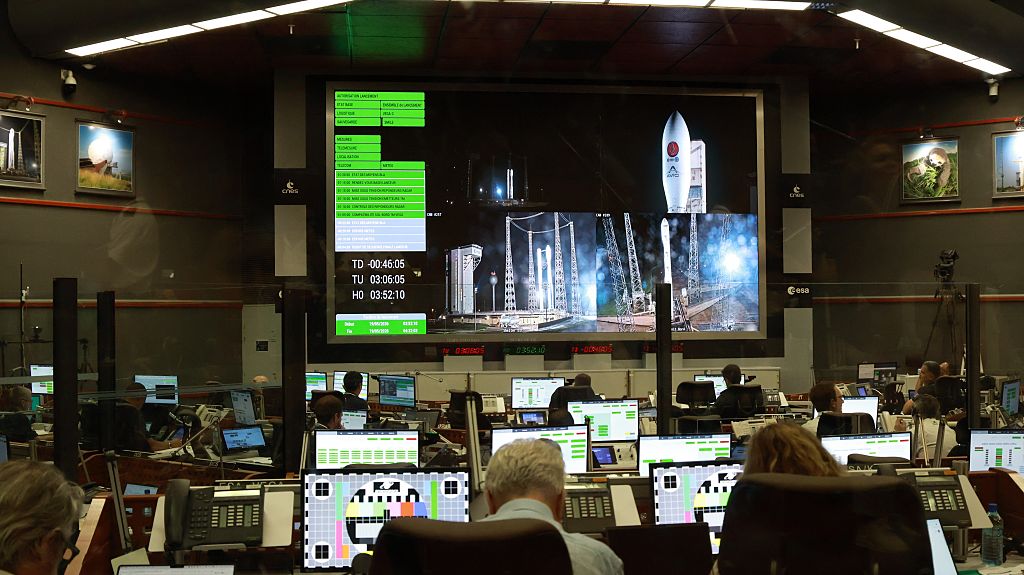
Ricardo Montoya/Xinhua via Getty Images
The demand for a space-ready workforce also presents an opportunity for the United States to distinguish itself. China has expanded its regional footprint not only by offering infrastructure, but by pairing satellite cooperation with financing, technical training, and research partnerships. Russia has pursued its own initiatives, including establishing a GLONASS ground station, its equivalent to GPS, in Venezuela.
The U.S. can remain the preferred partner in the hemisphere’s emerging space sector, but doing so will require a strategy that extends beyond traditional security cooperation. Washington should continue to prioritize education, workforce development, research collaboration, technology transfer, and public-private partnerships that strengthen local capacity.
U.S. universities are uniquely positioned to support that effort. We train the engineers, policymakers, entrepreneurs, scientists, and legal experts who sustain national space ecosystems, while serving as hubs for international collaboration.
Universities play a critical role in advancing U.S. interests across the Western Hemisphere. Institutions such as Florida International University demonstrate how academia can connect governments, industry, and civil society across borders. In an era of intensifying geopolitical competition, these institutions strengthen the networks, knowledge flows, and trusted relationships that support both U.S. national security and long-term prosperity.
The future of space cooperation in the Americas will depend not on who launches the most satellites, but on who helps build the people and institutions capable of using them effectively. In a region seeking greater autonomy, the partner that invests in those foundations will be the partner that endures.
ABOUT THE AUTHOR

Jeanette Nuñez
Reading Time: 3 minutesNuñez the seventh president of Florida International University and its first alumna president. A former lieutenant governor of Florida and current chair of Space Florida, she is focused on student success, expanding research and innovation, and advancing FIU among the nation’s top public universities.

The Space Race Comes to Latin America
The region wants to be not just a battleground, but a protagonist in the burgeoning space economy.
Latin America’s Quest for Space Sovereignty
The region’s pursuit of autonomy in the growing space sector will be complicated. The U.S. can be an important partner.
Latin America Has a Space Agency. Now Comes the Hard Part
ALCE held its first general assembly in Mexico in February, but faces questions about funding and political buy-in.