



As the ongoing war in Iran has pushed energy prices worldwide to near historic highs, Latin American countries have adopted markedly different approaches to cope with the ensuing crisis. While major oil producers like Brazil, Guyana, and Argentina benefit from increased exports and tax revenues that help to offset the cost of fuel subsidies, importers such as Chile and countries in the Caribbean and Central America are feeling the fiscal pressure.
However, one net importer, Uruguay, is better placed to manage the current energy crisis than most. Over a decade of policies to encourage investment in renewable energy has weaned its power grid off reliance on fossil fuels. This is the result of years of forward-thinking by governments on both the left and the right—a rare phenomenon in Latin America. A recent boom in electric vehicle (EV) adoption has further helped limit the negative fallout from the Iran war on the economy.
The conflict is likely to create incentives for the current and future governments to double down on policies to make Uruguay as energy independent as possible. However, the shift toward renewable energy and EVs carries its own risks. The most important is the increased reliance on Chinese supply chains, which may provoke ire in the U.S. as it seeks hemispheric dominance.
Even so, Uruguay’s energy resilience can serve as a reference for the rest of the region on the importance of building policy consensus to prepare for another energy crisis.
Renewable energy investment is paying dividends
Uruguay’s first wind farm began operating in 2008, with a small 10 MW project to demonstrate the energy source’s viability. In that same year, almost 39% of Uruguay’s electricity production came from fossil fuels. By 2025, 89.5% of Uruguay’s electricity production came from renewable energy sources, with wind accounting for almost 40%. A growing share of the energy matrix comes from solar power. Given the greater reliability of sunshine, an increase in the share of solar power helps to offset periods of low wind that affect the productivity of wind turbines, or drought that hinders hydropower production.
As the renewable share of Uruguay’s energy increased, gross oil consumption decreased from a high of over 65,000 barrels a day in 2012 to 49,800 barrels a day in 2023. The latest data from the state-owned oil company, ANCAP, puts the figure at 45,000 barrels a day. Using Economist Intelligence Unit (EIU) estimates for the Brent oil price in 2026 ($95.2 per barrel), if Uruguay had maintained its 2012 consumption level, it would have spent almost $700 million more on oil imports than it does at current consumption levels.
The result has been transformative for Uruguay, as the economy has become greener and more efficient. Uruguay’s GDP per unit of energy use, measured by purchasing power parity dollars per kilogram of oil equivalent, reached $19.5 in 2023, up from $12.3 in 2008. In this metric, Uruguay even outperformed Paraguay, where almost all electricity production is from hydroelectric power.
The EV boom
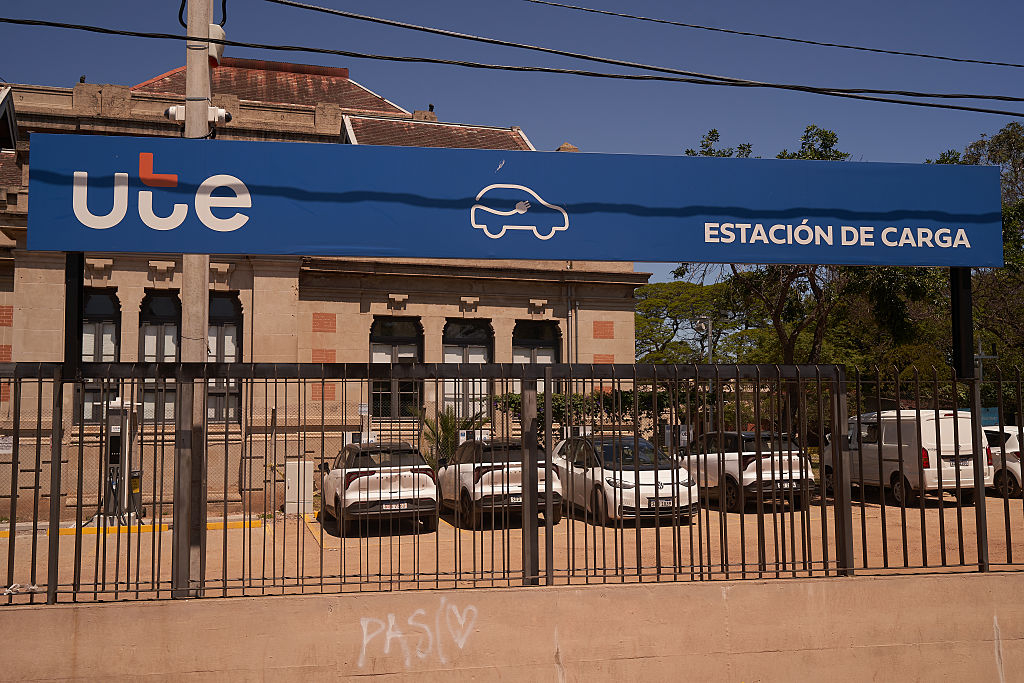
Uruguay’s declining fossil fuel consumption is also due to a rapid increase in EV adoption. Last year, 14,000 EVs were sold, accounting for 21% of all car sales. In the first four months of 2026, EV sales surged by 133% compared to the same period last year. Generous tax incentives and heavy investment by the state-owned electricity company, UTE, in charging stations nationwide (437 as of 2026) as well as private sector investment (150 chargers) have also contributed to greater sales.
Against this backdrop, it comes as no surprise that Uruguay has the highest adoption rate in the region. Another incentive is relevant: Uruguayans pay the highest gasoline prices in Latin America. This is because Uruguay imports all its oil, has high refining costs (Uruguay refines most of its oil), and the government imposes very high sales and excise taxes on gasoline.
The growth in EV use is so rapid that the chamber representing gas stations (Unvenu) argues that it is causing a decline in fuel sales in the Montevideo metropolitan area, where EV charging infrastructure is strongest.
To remain resilient, diversification is key
Looking ahead, a vulnerability for Uruguay is that China is, by far, the main supplier of its EVs, accounting for a staggering 96%. China is also the world’s largest manufacturer of wind turbines and produces 80% of the world’s solar panels. This poses a risk to Uruguay’s economy because any potential conflict affecting the long supply chain from China could hinder, or, in an extreme case, halt, the supply of these critical inputs.
Another factor that has become more salient for Latin America’s policymakers in recent years is the pressure from the U.S. for countries in the region to reduce their dependence on China. The Orsi administration has so far sought to balance Uruguay’s relations with the great powers. President Yamandú Orsi recently visited China, meeting President Xi Jinping and signing trade agreements. He also visited a U.S. aircraft carrier in the Atlantic, to the chagrin of members of his own party.
The good news is that the U.S. and China are not the only players available to Uruguay. The EU-Mercosur free trade deal could facilitate diversification and help European firms gain greater access to the Uruguayan market. Another important development is the growth of EV manufacturing within Mercosur. In particular, investments in EV production by U.S. and European car firms in Brazil will help Uruguayan consumers access a new series of affordable EVs.
Toward self-sufficiency
Despite Uruguay’s progress in reducing its dependence on fossil fuels, complete independence is not yet feasible. Gaining self-sufficiency in oil production would further shield the economy from global headwinds.
Uruguay currently does not produce oil, but there is hope that it has potentially sizable offshore oil and gas reserves due to the country’s geological similarities to recent offshore oil discoveries made in Namibia. Since 2019, ANCAP has licensed seven offshore oil blocks for exploration, which is currently ongoing.
Commercially viable discoveries would take years to develop, but offshore oil production could conceivably cover Uruguay’s entire oil consumption needs and become a major source of export income. In this upside scenario, Uruguay would achieve full energy independence at some point in the near future, drawing on both its renewable energy production and its offshore oil and gas output.
Although Uruguay is not totally exempt from the consequences of the Iran war, its strategy to reduce dependence on fossil fuels has made the economy more resilient than it otherwise would have been. The rapid adoption of renewables and now EVs speaks to Uruguayan policymakers’ forward-looking and sober-minded view of the country’s vulnerabilities. This approach is one that other countries in the region could emulate, leveraging their natural endowments to build economic resilience.
Uruguay’s openness to exploring for offshore oil and gas also demonstrates a willingness to avoid black-and-white thinking about energy security. The next step for Uruguay is to ensure it diversifies its suppliers of renewable energy infrastructure and EVs as much as possible.
ABOUT THE AUTHOR

Nicolás Saldías
Reading Time: 4 minutesSaldías is a Principal Economist for the Americas at the Economist Intelligence Unit and received his Ph.D. in political science from the University of Toronto.