
btn_subscribe-top
btn_give-a-gift
btn_login
btn_signup
btn_rss

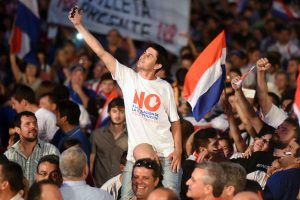
Paraguay to Elect a New President on Sunday

April 19, 2013

by AQ Online

Paraguayans head to the polls this Sunday to elect their next president amid a tightening in the race between the two main candidates, Horacio Cartes of the Partido Colorado (The Colorado Party–PC) and Efraín Alegre of the Partido Liberal Radical Auténtico (The Liberal Party—PLRA).  Cartes leads Alegre by nearly six percentage points (37.6 percent support versus 31.7 percent) in an April 5 public opinion survey conducted by First Análisis y Estudios. This is the last poll to be released prior to the election as election law prohibits voter surveys within 15 days of a vote.

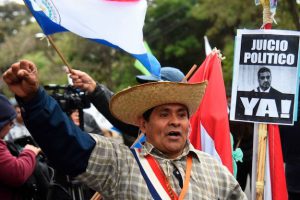
Either candidate would inherit a country still trying to move past the impeachment last year of former President Fernando Lugo.

Cartes is a political newcomer and millionaire who is trying to put the Colorado Party back in power after its six decades of uninterrupted rule was broken by the 2008 election of former President Lugo.  Despite having lost in 2008, the Colorado Party still maintains a strong grip on the three branches of government.  Alegre is a long-time politician and attorney who served as Lugo’s public works minister. 

Throughout the campaign both candidates have been accused of corruption, however no charges have been formally brought against them. Cartes faces accusations of tax evasion, money laundering and trafficking contraband, and Cartes claims that Alegre embezzled $25 million upon his departure from the ministry of public works and “handles public money as it were private.” Both deny the allegations.

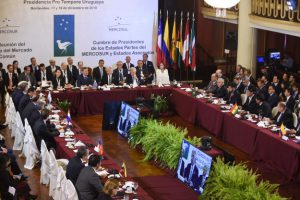
Paraguay’s membership in Mercosur and Unasur was suspended last year after Lugo’s impeachment, saying there was a “rupture in the democratic process.”  Both candidates would look to quickly rejoin both blocs. Although nearly 40 percent of Paraguayans live in poverty, the economy is projected to increase by 13 percent—due to record soybean production—after having contracted by 1.2 percent last year.

According to data from the Justicia Electoral (Electoral Justice), approximately 3.6 million Paraguayans are eligible to vote in the general elections this Sunday, of which 21,981 are enrolled abroad.

Tags: 2013 elections, Paraguay

Monday Memo: Raúl Castro to Retire in 2018 – Venezuela Awaits News on Chávez – Bolivian Soldiers Face Hearing in Chile – Oscar Arias visits Paraguay – Mining Strike Continues in Colombia

February 25, 2013

by AQ Online

Top stories this week are likely to include: Cuba prepares for political successors in 2018; Venezuela’s opposition protests lack of information on Chávez; Tensions between Chile and Bolivia rise over Bolivian soldiers’ arrest; Oscar Arias visits Paraguay for OAS elections observations; and Cerrejón strike continues after explosives destroy trucks.

Raúl Castro Says he'll Step Down in 2018: On Sunday, Cuban President Raúl Castro told the Cuban National Assembly that he will step down at the end of his upcoming five-year term as president in 2018. Revolutionary icon Fidel Castro, whose public appearances are now rare, was present when his brother made the announcement putting an official end-date on an era of Castro rule that began in 1959. Raúl Castro then named Miguel Diaz-Canel Bermúdez, 52, his first vice-president. The younger Castro had indicated on Friday that he was thinking of retiring and might name a successor from among the next generation of Cuban politicians.

Venezuelan Opposition Demands Information as Chávez' Health Remains Uncertain: Hundreds of government opponents marched in Caracas on Saturday as part of the opposition’s new political offensive to protest the current political stasis in Venezuela as President Hugo Chávez remains out of sight in a military hospital.  Since returning from Cuba on February 18, the Venezuelan government has shared limited information about the president’s cancer treatment and prognosis. On Friday, Venezuelan Vice-President Nicolás Maduro said that Chávez was “energetic” and had participated in a five-hour meeting with government leaders, though he acknowledged that the president can't speak because he is breathing through a tracheal tube. Meanwhile, Chávez supports held candlelit vigils outside the presidential palace to pray for the president’s recovery.

Hearing for Bolivian soldiers in Chile begins Monday: Three Bolivian soldiers arrested in Chile for crossing the border with weapons on January 25 will face a judicial hearing today in the northern Chilean city of Iquique to determine whether they'll remain in prison. The arrest of the soldiers has increased the diplomatic strain between Bolivia and Chile after Bolivia denounced Chile's actions via a letter to the UN on February 18. On Sunday, Bolivian President Evo Morales compared Chile’s imprisonment of the soldiers with Bolivia’s lost access to the Pacific Ocean since 1879, another source of recent tension. Chilean Minister of Foreign Affairs Alfredo Moreno said that Bolivia is blocking a swift resolution to the soldiers’ cases.

Oscar Arias Visits Paraguay to Prepare for April Elections: Former Costa Rican President Oscar Arias is visiting Asunción, Paraguay, until February 27 as head of the Electoral Observation and Political Accompaniment Mission of the Organization of American States (OAS).  The mission aims to facilitate and monitor Paraguay’s presidential elections on April 21 to ensure that they are free and fair. It will be setting up elections observers and meeting with members of the Paraguayan government for the next two months. A number of the country’s neighbors view Paraguayan President Federico Franco as illegitimate due to the controversial impeachment of his predecessor, former Paraguayan President Fernando Lugo, in June 2012. Members of Mercosur and Unasur elected to suspend Paraguay from regional membership until the elections are held.

Explosives Destroy Trucks at Cerrejón while Mining Strike Continues: Unknown assailants detonated explosives at the Cerrejón coal mine in Colombia on Sunday as a strike that began on February 7 continued into its seventeenth day. Both Cerrejón and the leader of Sintracarbon, the coal miners' union, denounced the attack, which damaged four trucks but reportedly did not result in casualties. Cerrejón workers initially demanded a 7 percent pay raise, but they have since decreased that amount to 5.8 percent. According to the World Coal Association, Cerrejón’s coal accounted for 80 percent of Colombia’s coal exports last year. Union leader Igor Diaz said that the workers will meet with Cerrejón today to restart wage negotiations despite the attack.

Watch a recent AQ documentary on Cerrejón. http://www.americasquarterly.org/rio-rancheria-documentary

Tags: Cuba, Bolivia, Chile, Paraguay, Venezuela, Cerrejón

Franco Announces Paraguay Election Observers

October 30, 2012

by AQ Online

La Unión de Naciones Sudamericanas (Union of South American Nations—Unasur) was notably excluded from Paraguay’s list of observers for the 2013 presidential election announced by President Federico Franco on Monday. The European Union (EU), Organization of American States (OAS) and The Carter Center, all prestigious and internationally renowned organizations according to Franco, will be allowed to monitor the elections on April 21, 2013. However, he refused to comment on Unasur, which temporarily suspended Paraguay after former President Fernando Lugo was unanimously impeached in January.

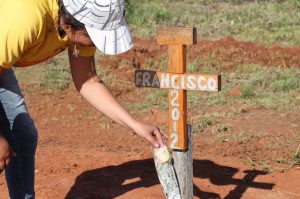
Monday’s announcement comes one month after President Franco denounced Paraguay’s suspension from Mercosur during his remarks at the United Nation General Assembly. Despite the fact that much of the international community viewed President Fernando Lugo’s ouster as a coup d’état, President Franco has consistently defended the nearly unanimous congressional impeachment process that took place last January. Former President Lugo was voted out of office by the opposition-controlled senate for his ties to officers responsible for the June 15 massacre at Curuguatay in which 17 peasants were killed by police who were attempting to evict them from private property near the Brazilian border.

President Franco, who is not allowed to run in next year’s election, has emphasized that the participation of the EU, OAS, and The Carter Center will ensure a transparent election.

Tags: Elections, Federico Franco, Paraguay

Latin American Presidents to Address UN General Assembly

September 25, 2012

by AQ Online


General debate of the 67th Session of the UN General Assembly began today with presidents from across the region scheduled to address world leaders. A number of high-level meetings will also take place throughout the week, covering topics like the rule of law, sustainable energy, nutrition, countering nuclear terrorism, and the chemical weapons convention.

Brazilian President Dilma Rousseff delivered the first address this morning for the second year in a row. In her speech, she addressed poverty and gender equality as well as security in Syria and the rest of the Middle East. She also defended policies to protect domestic industries, emphasizing that it unfair for “legitimate trade defense initiatives by developing countries to be unfairly classified as protectionism.”

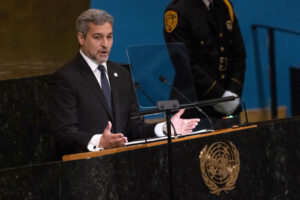
On Thursday, Paraguayan President Federico Franco will speak out against Paraguay’s suspension from Mercosur and condemn Venezuela’s incorporation into the trade bloc—decisions which he called “illegitimate and illegal.” Franco also plans to defend the nearly unanimous congressional impeachment process that ousted former President Fernando Lugo in January.

In addition to President Rousseff, other Latin American heads of state that are addressing the General Assembly today include President Danilo Medina of the Dominican Republic, President Porfirio Lobo of Honduras, President Cristina Fernández de Kirchner of Argentina, and President Mauricio Funes of El Salvador. On Wednesday President Juan Manuel Santos of Colombia, President Otto Pérez Molina of Guatemala, President Michel Martelly of Haiti, and President Evo Morales of Bolivia will address the body. Mexican President Felipe Calderón will give his final address. President Ollanta Humala will join President Franco in speaking on Thursday, while Chilean President Sebastian Piñera and Uruguyan President José Mujica will speak Friday and Saturday respectively. On the final day of general debate Costa Rican President Laura Chinchilla, Nicaraguan President Daniel Ortega and Ecuadorean President Rafael Correa will end the session.

Tags: Dilma Rouseff, Paraguay, United Nations General Assembly

Monday Memo: AQ’s Top Expected Stories for the Week of September 17

September 17, 2012

by AQ Online

Top stories this week are likely to include: Enrique Peña Nieto tours Latin America; United Nations General Assembly gets underway; Venezuela’s presidential election intensifies; European Union continues free-trade talks with Canada; and Paraguay seeks reparations from Mercosur. 

Peña Nieto Visits Latin America: Mexican President-elect Enrique Peña Nieto departed yesterday evening for his six-country Latin America tour, which will take him to Guatemala, Colombia, Chile, Argentina, Brazil, and Peru this week. Eduardo Sánchez, spokesperson for Peña Nieto, says that the trip’s purpose is to strengthen “the position that Mexico has in the region and the possibilities that it has as a country to build itself as a facilitator” in Latin American relations. Issue topics that are expected to dominate the agenda include security, migration and trade. AQ Senior Editor Jason Marczak adds, “each visit will highlight how a Peña Nieto government will seek to elevate Mexico’s role in the region and in working with each country bilaterally. Strengthened cooperation with Guatemala is critical for improving security and migration flows, Colombia has important lessons learned in security, the Chile and Peru visits are linked to trade and the Trans-Pacific Partnership, and the Brazil visit will likely seek to set the two countries on a path toward trade collaboration rather than trade competition.” Peña Nieto told Brazil’s Época magazine that “free trade, far from protectionism, is the path that we should take to make Latin America a thriving actor in the global economy.” 

UNGA Gets Underway: The sixty-seventh session of the United Nations General Assembly opens debate tomorrow afternoon at 3:00p.m. in the New York secretariat. Access the agenda here. Heads of state are expected to arrive next week, where they will make their plenary addresses. 

Venezuela's Presidential Election: In the lead-up to Venezuela’s October 7 presidential contest, it was revealed over the weekend that incumbent President Hugo Chávez would not select a running mate in spite of his widely speculated deteriorating health. Chávez’ challenger, Henrique Capriles, has not selected a likely vice presidential candidate either. Further, Venezuelan polling firm Consultores21 released a poll over the weekend putting Capriles Radonski two percentage points ahead of Chávez – 48 percent to 46 percent.

RelatedAmericas Society and Council of the Americas will host a discussion on September 18, titled “The Road to Venezuela’s Elections: A Look at the Media, Public Opinion, and the Economy.” The president of Consultores21 will speak on the panel.

EU - Canada Trade Talks Continue: Officials from the European Union will arrive in Ottawa this week for the penultimate round of negotiations with Canada on a free-trade pact. An agreement is farther behind schedule. As Americas Quarterly reported in early 2011, the Comprehensive Economic and Trade Agreement was anticipated to be signed in the middle of last year. 

Paraguay to Demand Reparations from Mercosur: The Paraguayan foreign ministry filed grievances with the Argentine, Brazilian and Uruguayan embassies in Asunción a few days ago on the charge of “grave arbitrariness” since its suspension from Mercosur following the ouster of former President Fernando Lugo. In a separate release, the foreign ministry noted that “Paraguay has the right to demand moral reparation for the offences infringed upon the dignity of the Republic, as a State and as a member of the international community, as well as claim compensation for the economic losses and damages suffered.” President Federico Franco has charged Mercosur as an “ideological club of friends,” and is intensifying his rhetoric against the South American trade bloc that does not recognize his presidency as legitimate. Expect Argentine, Brazilian and Uruguayan responses from the grievances this week. 

ExtraToday begins the first full week of National Hispanic Heritage Month in the U.S., which lasts from September 15 to October 15. 

Read More

Tags: Canada, Enrique Peña Nieto, European Union, Federico Franco, Fernando Lugo, Free Trade, Mercosur, Mexico, Paraguay

Venezuela to Formally Enter Mercosur

July 31, 2012

by AQ Online

The presidents of Argentina, Brazil and Uruguay will meet Venezuelan President Hugo Chávez in Brasilia today to formalize Venezuela’s full admission into Mercosur, the largest trade bloc in South America.

Venezuela’s entry was approved in 2006 and recognized in subsequent years by the parliaments of Argentina, Uruguay and Brazil, but failed to materialize due to opposition by the Paraguayan Congress. Paraguay’s suspension from Mercosur after Fernando Lugo’s impeachment on June 22, 2012 opened the door for Venezuela to formally join.

Paraguayan President Federico Franco—who was not permitted to attend the meeting—asserted that Chávez’s goal in joining was to give him an electoral push in the upcoming October elections. The visit to Brazil will be the Venezuelan president’s first official trip abroad since he was diagnosed with cancer in June 2011. Chávez, who turned 58 last Saturday, has lately appeared in more rallies and public events after declaring himself free of cancer earlier this month.

Chávez claims that Venezuela finally joining Mercosur is a sign of the United States’ failure in South America, as he claims that Paraguayan resistance is a product of American diplomacy. However, due to its tight exchange controls and high dependency on imports, Venezuela will benefit the least from participation in the regional bloc. The country will also have to meet a series of conditions, which might include resuming diplomatic relations with Israel that have been broken since 2009.

Tags: Brazil, Venezuela, Mercosur, Argentina, Uruguay, Paraguay, Hugo Chavez, United States, Fernando Lugo, Federico Franco

Paraguay Out, Venezuela In: What Do Mercosur’s Changes Mean for Brazil?

July 17, 2012

by Lucy Jordan

Late last month, the Mercosur alliance met, suspended Paraguay and ushered in Venezuela as a full member in almost as little time as it took the Paraguayan congress to impeach their former president, Fernando Lugo, the preceding week.

Venezuelan President Hugo Chávez’ bid to join the South American trade bloc had spent the past three years languishing in the Paraguayan congress, where lawmakers cited fears that Venezuela would violate Mercosur’s democracy clause.

With Paraguay’s new government suspended from the summit as a punishment for its own democratic misbehavior, the other full members—Brazil, Argentina and Uruguay—were quick to invite Venezuela in.

Since then, reports have been circulating that Brazilian President Dilma Rousseff was the driving force behind this decision. Soon after the summit, Uruguayan Foreign Minister Luis Almagro caused considerable diplomatic unease in saying that Uruguay had opposed Venezuela’s immediate entry, and only relented under pressure from Brazil.

Almagro maintained that although Paraguay was suspended, it was not expelled, and therefore retained its right to accept or veto a new member. Uruguayan Vice President Danilo Astori agreed, calling Venezuela’s entry during Paraguay’s suspension “the worst institutional wound” to Mercosur since its inception in 1991. Uruguayan President José Mujica publicly criticized his deputy for this outburst, and insisted that although Dilma had requested a meeting of the heads of state (without their deputies or foreign ministers) the decision to let Venezuela in had been unanimous.

Read More

Tags: Brazil, Venezuela, Mercosur, Paraguay, International relations

Monday Memo: AQ’s Top Expected Stories for the Week of July 16

July 16, 2012

by AQ Online

Top stories this week are likely to include: López Obrador files a legal challenge to Peña Nieto’s win; cholera spreads in Cuba; standoff between Bolivia and a multinational Canadian mining firm; the Chávez factor in the U.S. presidential election; and Unasur sends a delegation to Paraguay.

López Obrador Contests Peña Nieto’s Victory: Although Enrique Peña Nieto won the July 1 presidential election according to the independent electoral authority Instituto Federal Electoral (Federal Electoral Institute—IFE) earlier this month by over 6 percentage points, runner-up Andrés Manuel López Obrador (AMLO) has now filed a legal challenge to the ruling, claiming fraud on the part of Peña Nieto’s Partido Revolucionario Institucional (Institutional Revolutionary Party—PRI). AMLO’s team says it will prove that “illicit money” was used to buy votes. Despite IFE having recounted over half the ballots and still upholding its verdict of Peña Nieto’s win, AMLO’s legal challenge submitted to IFE will now be forwarded to the Federal Electoral Court; in turn, the Court will deliver a ruling before early September.

AQ Editor-in-Chief Christopher Sabatini notes, “While fraud remains a problem in Mexican elections and with it people's trust in the results, AMLO is going to have an uphill battle explaining the direct, logical connection between any allegations of fraud and 3 million plus votes of difference between him and the winner, Enrique Pena Nieto."

Cuba and Cholera:
According to the Cuban health ministry in a release over the weekend, there have been no new cholera-related deaths since the three ones reported earlier this month in the eastern city of Manzanillo. However, the health ministry has reported 158 cases of the disease, a significant increase from the 56 initially disclosed. Given that the health ministry has remained rather quiet, leading to rumors about a wider problem with the outbreak, pay attention this week to growing concerns about the spread of cholera. 

Read More

Tags: Canada, Cuba, Bolivia, Paraguay, Hugo Chavez, UNASUR, Andrés Manuel López Obrador, 2012 Mexico elections, 2012 elections, Enrique Peña Nieto

Paraguay Avoids OAS Suspension

July 11, 2012

by AQ Online

Organization of American States (OAS) Secretary-General José Miguel Insulza rejected a request yesterday to suspend Paraguay as a member state over the impeachment of former President Fernando Lugo. During an emergency meeting of the OAS Permanent Council in Washington DC, Insulza explained that Paraguay’s suspension would negatively affect the country politically and economically while doing little to strengthen democratic institutions.

Bolivia and Venezuela were among the 20 member countries to demand Paraguay’s suspension after Lugo was quickly removed from office by the Paraguayan Congress last month. Lugo called the impeachment a “parliamentary coup” and said the unpopularity of his social programs among legislators was responsible for his ouster. Questioning the democratic nature of the impeachment, regional organizations like Mercosur and UNASUR suspended Paraguay’s membership and Venezuelan President Hugo Chávez said his government would cut off fuel sales.

Insulza’s response to the episode was more tempered. Shortly after Lugo’s ouster, he recommended that the OAS Permanent Council send a mission to Paraguay to monitor the executive management of the current administration until the general elections in April 2013. The mission would "strengthen governance, to avoid new crises and observe respect for political guarantees," Insulza said.

While bolstered by the OAS decision, Federico Franco, Paraguay’s new president, still faces the daunting task of repairing diplomatic relations damaged by Lugo’s removal.

Tags: OAS, Jose Miguel Insulza, Paraguay, President Fernando Lugo, Paraguay Impeachment

Monday Memo: AQ’s Top Expected Stories for the Week of July 9

July 9, 2012

by AQ Online

Top stories this week are likely to include: post-election protests in Mexico; OAS to issue its report on Fernando Lugo’s ouster; anti-mining protests continue in Peru; Raúl Castro arrives in Vietnam; and ASEAN-Latin America Business Forum gets underway.

PRD Alliance Questions Peña Nieto’s Victory: Although officially declared the winner on Friday by the autonomous Instituto Federal Electoral (Federal Electoral Institute—IFE), Mexican President-elect Enrique Peña Nieto still faces criticism of fraud by second-place candidate Andrés Manuel López Obrador (AMLO) of the Partido de la Revolución Democrática (Party of the Democratic Revolution—PRD) . Ricardo Monreal, AMLO’s campaign manager, accused the PRI of vote-buying at a press conference this morning. In addition, tens of thousands of demonstrators claiming to belong to no political party protested over the weekend in Mexico City decrying the IFE result. Will the situation turn to a repeat of 2006?  AQ Senior Editor Jason Marczak notes there’s a clear difference between the 2012 election and what happened six years ago: “With only a few hundred thousand votes separating López Obrador and Calderón in 2006, AMLO saw an opening for a recount through protests and pressure on a still fragile electoral process. But this time, in losing by about 3.5 million votes, AMLO will only serve to discredit his nationwide appeal by crying foul and once again being a sore loser.”

Updates on Lugo’s Ouster: The Organization of American States (OAS) is expected to release its report today on its fact-finding mission last week to Paraguay to investigate former Paraguayan President Fernando Lugo’s removal from office. The delegation was headed by OAS Secretary-General José Miguel Insulza. The U.S. has said it would wait for the OAS verdict to issue a formal statement on the legality of the ouster—a move that has drawn criticism. With Venezuelan Foreign Minister Nicolás Maduro reportedly endorsing a military coup to restore Fernando Lugo to power, the situation in Paraguay is still contentious and perhaps the OAS report will provide more clarity on the issue.

Peruvian Anti-Mining Protests Heat Up: After police clashed with protesters demonstrating against natural resource extraction in northwest Peru, the death toll has climbed to five. A state of emergency has been imposed in the Cajamarca region, and Peruvian President Ollanta Humala has come under fire for his administration’s handling of the demonstrations. Nevertheless, tensions are still high and this week could very likely see a new wave of protests. AQ Editor-in-Chief Christopher Sabatini, who is in Huaraz, Peru this week, notes, “President Humala will have to do something to address the protests, including trying to verify claims of pollution and improving overall access to social services in mining communities—while not appeasing some of the more extreme groups.”

Raúl Castro in Vietnam: After wrapping up a trip to China last week, Cuban President Raúl Castro arrived in Vietnam yesterday for a four-day official visit aimed to strengthen bilateral relations. This is Castro’s first visit to Vietnam as Cuba’s president, and he is scheduled to meet with Vietnamese Prime Minister Nguyen Tan Dung, Community Party General Secretary Nguyen Phu Trong and Vietnamese President Truong Tan Sang. Sabatini observes, “The purpose of the trip is twofold: First, to help Raúl and the group better understand the process of economic and limited political reform that has taken place in Vietnam as a model for Cuba—though the comparison is thin. But second, Cuba—in this and other efforts it has made—is trying to diversify its economic relations and lifeline beyond Venezuela.” 

ASEAN, Latin America Deepen Commercial Ties: The third annual business forum between Latin American nations and ASEAN (Association of Southeast Asian Nations) members takes place today and tomorrow in Jakarta, Indonesia. The theme of the forum is: “Towards a Sustainable Future.” ASEAN is comprised of Brunei, Burma, Cambodia, Indonesia, Laos, Malaysia, Philippines, Singapore, Thailand, and Vietnam. For more information on the forum, including programs, speakers, organizers, and partners, access its website.

Tags: Peru, Cuba, Mexico, Organization of American States, Raul Castro, Paraguay, mining, Andrés Manuel López Obrador, Fernando Lugo, Nicolás Maduro, Ollanta Humala, Enrique Peña Nieto

Pages


Connect with AQ


Twitter YouTube Itunes App Store


WEB EXCLUSIVES

Most Popular

MOST POPULAR ON AQ ONLINE

  • Most Viewed
  • Past:
  • 1 day
  • 1 week
  • 1 month
  • 1 year

NOW ON AS/COA ONLINE

Loading...

AQ MEDIA PARTNER

Loading...