
![]() |
Former Haitian Dictator Jean-Claude “Baby Doc” Duvalier’s trial continued Thursday, as another alleged victim testified about human rights abuses during his 15-year regime. Dr. Nicole Magloire said in court that she was unjustly arrested by the Tonton Macoutes, Duvalier’s infamous private police, and was imprisoned for five days. When asked by Defense Attorney Fritzo Canton if she could have been arrested by mistake, Magloire replied, “If I was arrested by mistake, I was imprisoned by mistake and forced into exile by mistake.”
Magloire was the third person this month to testify in appellate court against the former president-for-life, who inherited power from his father, Francois “Papa Doc” Duvalier at age 19. Now 61, the younger Duvalier was charged with human rights abuses and embezzlement in 2011 when he ended his 25-year exile and returned to Haiti. Though a lower Haitian court dismissed both charges, the appellate court is considering reinstituting the rights abuse charge.
Duvalier failed to make his first three court dates, and finally made a surprise appearance on February 28 in a room packed with those who claim they were tortured or imprisoned by his regime. The prosecutors aim to prove that violence perpetrated by Haitian officers under Duvalier’s command were not occasional or rogue acts, but part of a widespread and systematic campaign to terrorize Haitians, constituting “crimes against humanity.”
![]() |
Former Haitian dictator Jean-Claude Duvalier snubbed a judge's order to attend a court hearing yesterday to determine if he will be indicted on human rights violations committed under his ruthless 15-year regime.
Reynold Georges, Duvalier's defense attorney and former senator, claimed that he filed an appeal of the judge's order and asserted that he was confident that the Supreme Court would overturn the decision to force Duvalier to appear in court as well as put a stop to accusations brought forth by countless victims of Duvalier's rule. Georges boasted, "We're waiting for the Supreme Court decision and we're going to win, I don't lose. I'm Haiti's Johnnie Cochran."
The victims' attorneys urged the judge to arrest the former leader for not being present in court. Judge Jean Joseph Lebrun of Haiti's Court of Appeals responded that Duvalier had no grounds to appeal to the Supreme Court at this juncture and demanded that the prosecutor bring the former leader to court "without delay." It was not clear whether there would be any consequences for not adhering to court orders.
Duvalier inherited power from his father, François "Papa Doc" Duvalier in 1971 and ruled Haiti until he was overthrown in 1986. Thousands of people were murdered or tortured in prison during this time. Duvalier made an unexpected return to his earthquake-stricken homeland in January 2011 after nearly 25 years in exile in France, opening himself up to possible prosecution. Duvalier was also charged with embezzling between $300 million and $800 million of assets during his presidency however a court dismissed the embezzlement charge, which would carry a maximum of five years in prison.
The human rights community is in an uproar. UN High Commissioner for Human Rights Navi Pillay declared in Geneva that "the State has an obligation to ensure that there is no impunity for serious violations of human rights which occurred in the past."Pillay stressed that there are no statute of limitations of any kind in international law for grave violations of human rights which include murder, torture, extrajudicial executions, and enforced disappearances, among others.
This is not the first time Duvalier has skipped his court hearing. He has done so twice this year and continues to travel the country freely despite a court ruling placing him under house arrest.
![]() |
Top stories this week are likely to include: the United States heads to the polls; Puerto Rico decides on status; Michel Martelly requests emergency aid; and Rafael Correa gets re-nominated for president.
Elections in the United States: On Tuesday, voters across the United States will go to the polls to vote for the next president as well as all congressional representatives and select governors and senators. A poll of polls from Real Clear Politics has President Barack Obama maintaining a razor-thin edge—0.5 percentage points—over Governor Mitt Romney. The difference-maker could be the turnout of Latinos, a demographic that supports Obama by 52 percentage points over his Republican challenger according to a poll released last week by Latino Decisions. AQ Senior Editor Jason Marczak observes: “The question is the degree to which Latino political preferences will translate into votes, especially in battleground states. Beyond Election Day, Latino turnout tomorrow will shape the extent to which their concerns will factor into policymaking in the next four years.”
Puerto Rico's Referendum: Voters in Puerto Rico will decide on Tuesday about the future of the island’s status. Currently it is a semi-autonomous “unincorporated territory” of the United States that—since it is not a state—plays no role in the U.S. presidential general election. Puerto Ricans will decide whether they want the island to gain more autonomy as a “sovereign free association,” or whether Puerto Rico should become a U.S. state or independent altogether. Tuesday’s vote will be the fourth time in 45 years that Puerto Ricans have formally weighed in at the ballot box on the status of the island. A poll last month found that a slim majority—51 percent—want to keep the island’s current status intact, according to AS/COA Online. “This is probably the most complicated ballot used for a referendum on Puerto Rico’s status and will likely split the vote for those opposing the commonwealth’s status quo,” observes AQ Editor-in-Chief Christopher Sabatini.
Haiti Rebuilds After Superstorm Sandy: Sandy, which took on many forms including tropical storm, hurricane and post-tropical storm, left much damage in its wake—including in Cuba, Jamaica, the Dominican Republic, Puerto Rico, the Bahamas, and the United States. But a country that appears to have suffered the most long-term damage is Haiti. According to the Associated Press, 70 percent of crops in the south of the country were destroyed and livestock killed—significantly damaging the agricultural industry. President Michel Martelly is appealing to the international community for emergency aid as his country adds the superstorm damage to the loss inflicted by a devastating earthquake outside of Port-au-Prince in 2010. Will Martelly’s request be granted this week?
Correa to be Nominated at Party Convention: Ahead of Ecuador’s presidential election in February, the Alianza País incumbent party will hold its convention on Saturday and re-nominate President Rafael Correa to represent the party on the ballot. Foreign Minister Ricardo Patiño affirmed this past Wednesday that Correa, first elected in December 2006, will run for another full term. If he wins, the populist leader will remain in power into 2017. Early polls show Correa with a huge advantage over potential challengers, bringing in 56 percent of votes versus Guillermo Lasso, an ex-banker of the opposition who garners 23 percent.
![]() |
Top stories this week are likely to include: impact of the Amuay refinery tragedy in Venezeula; aftermath in the Caribbean of Tropical Storm Isaac; YPF and Chevron move toward an alliance; fallout of a cabinet shift in Colombia; and Canada seeks to strengthen commercial ties with Southeast Asia.
Disaster at Amuay Refinery Continues: After Saturday’s deadly explosion at the Amuay oil refinery in Venezuela’s Falcón state, much remains up in the air. Flames were still burning as of this morning, and President Hugo Chávez has ordered an investigation and declared three days of mourning. However, as the death toll remains unpredictable—it already climbed to 41 from 39 overnight, with 20 of the dead belonging to Venezuela’s National Guard—pay attention to any developments in the aftermath of the worst accident in Venezuela in recent memory.
Isaac Causes Damage: Over the weekend, Tropical Storm Isaac slammed Hispaniola, killing 10 total—eight in Haiti and two in the Dominican Republic—and displacing thousands. Haiti’s Civil Protection Office reported 14,000 had fled their homes and another 13,500 were living in temporary shelters. How will the island rebound? And what lies in store for Isaac? It is picking up speed in the Gulf of Mexico and will likely turn into a hurricane early this week, with projected landfall near New Orleans, Louisiana, on Wednesday—six years to the day after Hurricane Katrina ravaged the coastal city. (Donate to the American Red Cross.)
YPF, Chevron in Advanced Talks for Alliance: YPF, Argentina’s state-controlled energy company, is mulling a strategic accord with Chevron, Latin America’s leading private energy investor. YPF CEO Miguel Galuccio held a meeting on Friday with Ali Moshiri, Chevron’s Latin America chief, and noted that YPF needs more experienced partners to help develop Argentina’s massive shale reserves, which are the world’s third largest. Of particular interest is the Vaca Muerta field in the Nequén province, and Chevron is already involved in three wells in Vaca Muerta. Galuccio will present a five-year plan this Thursday.
Cabinet Shakeup in Colombia: Having recently crossed the halfway threshold into his four-year term, Colombian President Juan Manuel Santos decided to reshuffle his cabinet last Thursday when he asked all 16 of his ministers to resign. Some posts have been reassigned; former mines minister Mauricio Cardenas has assumed the finance portfolio. However, Cardenas’ replacement, as well as other vacant posts, has not yet been named. This week will likely see movement in Santos’ cabinet.
Canada Seeks Increased Trade Ties in Asia: Canadian Trade Minister Ed Fast begins a trade mission today to Southeast Asia, where he will conduct official visits to Vietnam, Thailand and Cambodia followed by the first Canada-ASEAN Economic Ministers Meeting in Cambodia. Fast will then continue to Burma, marking the first time a Canadian trade minister has ever done so. In a statement, Fast said, “This year, as we celebrate the 35th anniversary of relations between Canada and the Association of Southeast Asian Nations, we are committed to moving our trade and investment relationship with ASEAN forward.”
![]() |
Newly sworn-in Prime Minister Laurent Lamothe said the Haitian government is drafting legislation to regulate the country’s nascent mining industry. His statement on Tuesday came shortly after the Associated Press reported findings in the northeastern mountain region of precious metals—including gold, silver and copper—potentially worth $20 billion.
According to Lamothe, the new legislation will lay out rules allocating a portion of royalties to the Haitian government and putting in place protections for the people and environment that could be affected by the mining. “The most important thing,” he said, “is to have the correct mining law.” The legislation is expected to be sent to Parliament soon.
Gold was last gathered in Haiti by the Spanish in the 1500s. After they moved on to Mexico, Haiti’s reserves remained largely unknown. In the 1970s United Nations geologists documented notable pockets of gold and copper, but foreigners remained unwilling to invest in the industry within Haiti because of the country’s long history of corruption and instability. Since the 2010 earthquake, though, U.S. and Canadian companies have invested $30 million in exploratory drilling, worker camps, new roads, and laboratory studies.
Haiti’s current mining laws date back to 1976, although in 1996 the firm SOMINE negotiated permits with President René Preval to extract metals out of the mountains. Lamothe said the legislation currently being drafted is designed to benefit Haiti while also attracting foreign investment with the promise of profiting from the mines. He said he hopes Haiti will receive “as much as possible” of the mining revenue “without hampering the profit motive of the mining company.
Lamothe officially became prime minister on Monday, after Parliament approved his Cabinet and policy plan. He filled a vacuum left by former Prime Minister Garry Conille, who resigned three months ago after only four months on the job, due to differences with President Michel Martelly. In addition to the mining legislation, Lamothe emphasized social investment, including garbage clean-up, better roads and programs to help mothers living in poor neighborhoods in the capital city of Port-au-Prince.
![]() |
Top stories this week are likely to include: Hugo Chávez post-radiation therapy; Michel Martelly begins his second year as president; Dominicans head to the polls; Peru minus two ministers; and Brazil creates a new social program.
Chávez Ends Cancer Treatment: Venezuelan President Hugo Chávez returned from Cuba on Friday claiming that he had ended his radiation therapy session in Havana “in a successful manner.” This appears to be the first full week in the past several weeks where Chávez governs the country while on its soil. Despite his repeated absences, the latest poll by Datanálisis reports that Chávez returns home with a 17 percentage point advantage over opposition candidate Henrique Capriles Radonski ahead of the October presidential election. Now the question is whether Chávez is truly recovered; the recently-formed Council of the State casts some doubt. AQ Editor-in-Chief Christopher Sabatini points out, “Sure Chávez says he is in the clear, and we all hope he is. But President Chávez has said that before. Given the chronic lack of transparency of this regime, it’s impossible to know.”
Martelly in Second Year: Haitian President Michel Martelly was sworn in one year ago last Friday, and this is his first full week of the new presidential year. The Associated Press ranks his first year as one of “modest gains” that many in Haiti view with “guarded surprise.” Despite clashes with parliament, Martelly has overseen successes such as reduced tuition for schools, funded by a tax on international phone calls, as well as a steady recovery after the devastating January 2010 earthquake. But it has not been without challenges. According to AQ Senior Editor Jason Marczak, “A top priority in the next few months will be getting to the UN to devote all the resources necessary to control the cholera outbreak. This cannot be a piecemeal approach; it must be dealt with rapidly and comprehensively before more Haitians die.”
Elections in the Dominican Republic: Dominicans elect a new president on Sunday, May 20; the two leading candidates are Hipólito Mejia of the Partido de la Revolución Dominicana (Dominican Revolution Party—PRD) and Danilo Medina of the ruling Partido de la Liberación Dominicana (Dominican Liberation Party—PLD). President Leonel Fernández of the PLD is not running for re-election. Sabatini notes, “This election, and the Dominican Republic’s future, turns really on the ability of the PLD and the political system’s capacity generally to renew itself. The truth is: without broader leadership change across the parties, the political and economic miracle of the DR may be at risk—not now, but in the future.”
Peru and the Ministerial Gap: After last week’s resignation of the interior and defense ministers, Peruvian Prime Minister Oscar Valdés must quickly restore order to President Ollanta Humala’s cabinet. The ministers resigned after a failed operation against the Shining Path rebels killed at least nine soldiers, and they faced a congressional censure. This is not the first ministerial change; the entire cabinet was dissolved by former Prime Minister Salomón Lerner after Indigenous Peruvians protested against the controversial Conga mine. “Increasingly, we’re seeing a government that is shifting more in favor of investor rightism in large part as a recognition of the need of the state to generate revenue to support its social inclusion agenda,” observes Sabatini.
Brazil Combats Extreme Poverty: Brazilian President Dilma Rousseff announced a new social program to fight extreme childhood poverty yesterday. The program, Brasil Cariñoso (Caring Brazil), will spend $4 billion to create 6,000 new daycare units for children and an increased subsidy of the popular Bolsa Família program—and it will affect the most impoverished areas of Brazil, the north and northeast. Marczak says, “The very poor have yet to join in the Brazil miracle, but this newest program has the right ingredients for their young children to have access to many of the foundations needed for success. Once again, Brazil is an example for the region.”
![]() |
Haitian legislators yesterday approved President Michel Martelly’s nominee for Prime Minister, Laurent Lamothe, ending a confirmation standoff that has brought Haiti’s federal government to a virtual standstill for nearly two months. Lamothe, a former special adviser to President Martelly before being appointed foreign minister in September 2011, was confirmed by a vote of 62–3 after a six-hour long debate centered on whether he met residency requirements for public officials stipulated in the country’s constitution.
In an interview after the vote with the Associated Press, Lamothe vowed to immediately begin working to get Haiti’s post-earthquake recovery back on track saying, “We have a lot of work to do now… I feel that the country finally has the opportunity to work on the people’s problems. We have a lot of different issues to deal with and finally we have the team in place to start solving the people’s problems.”
The confirmation will also ease concerns in the international community—particularly among donors and aid organizations—which had grown weary of dealing with a government partner hobbled by political infighting. In remarks delivered before the vote, UN Special Envoy to Haiti Bill Clinton weighed in saying officials needed to set aside self-interest for the good of the country and “restore confidence in Haitian institutions so that donor funds can flow again and attract new investment.”
Observers note that even with the confirmation, it could still take weeks before the legislature finally approves Lamothe’s government plan and his choices for Cabinet positions.
![]() |
On March 29, the U.S. Senate confirmed several of President Obama’s diplomatic nominations, many of whom were tapped to serve in the State Department’s Bureau of Western Hemisphere Affairs (WHA). Here’s a brief rundown of the confirmed WHA officials and their new positions: Roberta Jacobson, Assistant Secretary of State for Western Hemisphere Affairs; Larry Palmer, Ambassador to Barbados; Pamela White, Ambassador to Haiti; Phyllis Powers, Ambassador to Nicaragua; Jonathan Farrar, Ambassador to Panama; and Julissa Reynoso, Ambassador to Uruguay.
Not only do these confirmations provide a celebratory sense of relief, as many of these officials waited months for their nominations to proceed through the Senate, but the timing could not be better as the U.S. delegation prepares to depart for Cartagena, Colombia, to attend this weekend’s Sixth Summit of the Americas.
Jacobson was nominated in late September after becoming acting assistant secretary in July 2011 when her predecessor, Arturo Valenzuela, returned to academia. It’s both notable and laudable that a woman is leading WHA for the first time.
Jacobson’s candidature was challenged by Cuban-American Senator Marco Rubio (R-FL), who placed a hold on her nomination last November with a call to the Obama administration to “review abuses in the people-to-people Cuba travel policy.” Rubio dropped his hold on March 22 following guarantees from the State Department that it would require “applicants to demonstrate how their itineraries constitute purposeful travel that would support civil society in Cuba and help promote their independence from Cuban authorities,” according to the senator’s news release.
![]() |
AQ Online today launches its weekly Monday Memo that looks ahead to what it expects to be the top headline grabbers for the week. The top anticipated stories for the week of February 27 include: Hugo Chávez’ surgery; U.S. Secretary of Homeland Security Janet Napolitano’s current five-country Latin America tour; U.S. Vice President’s forthcoming visit to Mexico and Honduras; the search for a new prime minister in Haiti; and FARC suspending kidnappings in Colombia.
Chávez' Cancer: As the Venezuelan president heads to Cuba for a second surgical operation, the rumor mill on his real health status will continue as will the discussion about what its implications will be for Venezuela's October presidential election. Christopher Sabatini, AQ editor-in-chief, observes: “While it may translate into sympathy support, President Chávez' lack of transparency about his illness and treatment will likely raise fears among some Venezuelans about their future and a potential successor—irrespective of what the president says upon his release.”
Napolitano on Latin America Tour: U.S. Secretary of Homeland Security Janet Napolitano begins a five-country tour today through Wednesday in Mexico, Guatemala, El Salvador, Costa Rica, and Panama. According to a Department of Homeland Security (DHS) press release, Secretary Napolitano will be accompanied by Acting Commissioner of U.S. Customs and Border Protection David Aguilar and DHS Assistant Secretary for International Affairs Alan Bersin. Her visit is likely intended to reiterate support for security measures like the Central America Regional Security Initiative and reinforce counter-trafficking efforts to interdict narcotics through key transit points.
Biden to Mexico and Honduras: U.S. Vice President Joe Biden will visit Mexico and Honduras on March 4-6, meeting with both Presidents Calderón and Lobo. Why is the Vice President going to Honduras? While Mexico remains an important economic, diplomatic and strategic partner in the war on drugs, the trip to Honduras is a mystery. Since the 2009 coup, Honduras has become the murder capital of Central America. Two weeks ago, a fire at a Honduran prison left 350 inmates dead—an incident that Human Rights Watch blamed on poor and overcrowded conditions in Honduran prisons.
Haiti Prime Minister Watch: The abrupt resignation of Haitian Prime Minister Gary Conille on Friday culminated weeks of disagreement between him and President Michel Martelly. The departure of the former UN diplomat and favorite of the international aid community is a blow for both political stability in Haiti and for donor nations that had great hopes in a government that included his technical skills. Jason Marczak, AQ senior editor, says: “Expect President Martelly to move quickly in naming a successor, with a candidate likely announced this week.” Foreign Minister Laurent Lamothe is one possibility as is Chief of Staff Ann-Valerie Milfort. However, both would face a tough confirmation by an opposition-controlled legislature.
FARC Hostage Release: Colombia's FARC announced on Sunday that it will suspend all kidnapping and free remaining prisoners. Is this a political ploy or a true change in tactics? Given the group's decentralized nature, it is unclear whether the FARC secretariat can actually enforce the order, if it chooses to do so. Expect renewed debate this week on whether this may help to clear the way for an eventual peace dialogue or if the current strategy should continue without talks.
![]() |
Last week, a United Nations Security Council delegation visited Haiti to assess the 10,500-member peacekeeping force, known as the UN Stabilization Mission in Haiti or MINUSTAH. The visit was to assess security needs in Haiti before the UN Security Council makes a decision about whether to reduce the number of forces stationed in the country.
In a complete departure from past assessment missions, this trip included minimal assessment of actual peacekeeping, the reason MINUSTAH was sent to Haiti in the first place. Instead, the Security Council focused primarily on two major afflictions caused by MINUSTAH: Their admitted introduction of cholera to Haiti and corresponding failure to respond adequately despite ongoing death and illness, as well as reports of sexual abuse by peacekeeping troops, some of which were even recorded on film. Both of these crimes, very distinct in nature, have made it nearly impossible for the UN peacekeeping mission to be successful in its mandate to “keep the peace,” if there is even a peace to keep. Indeed, if anything, MINUSTAH is responsible for much of the unrest and instability.
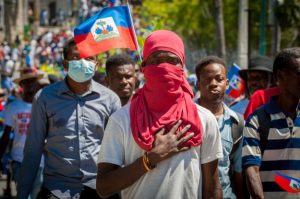
Recent protests in Haiti have largely focused on the problems brought by the peacekeepers. Not surprisingly, the Security Council visit last week brought on a new wave of such protests—one of the ways Haitian people have expressed their ongoing frustration with the UN “occupiers” as they are called. One in ten MINUSTAH peacekeepers worldwide are currently stationed in a country the size of Massachusetts, a country where there is no war. Even so, the UN continues to spend more than $2 million a day on the peacekeeping operation. In my own conversations with MINUSTAH personnel, they expressed boredom and difficulty communicating with Haitians, but never mentioned war or peace. They admitted that it is unclear how much security forces can do for Haiti. Haitians, for their part, are calling for justice. They are demanding accountability. They know the UN is responsible for so much pain they have suffered, and they are asking for compensation.
AQ's coverage and post-trip analysis of the President's May 2-4 visit.