
![]() |
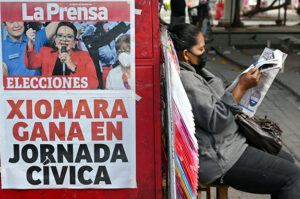
Porfirio Lobo will be Honduras’s next President. Consistent with recent polls, Lobo, the National Party candidate, won a resounding victory over Liberal Party candidate Elvin Santos. The results were unambiguous, and Santos quickly conceded victory while Lobo and the National Party celebrated their victory. This sharply contrasts with the 2005 elections, when doubts remained about the results for over a week and speculation about vote-rigging abounded. In 2009, conversely, the question is not who won, but how many people voted. The turnout question will now become the centerpiece of the debate on the election.
After rampant speculation regarding possible Election Day protests and violence, Sunday’s elections took place under relative tranquility. The military and police were out in full force on Sunday to protect the elections, and security concerns were high enough to warrant canceling flights from the United States. There was some reported repression of protesters in San Pedro Sula, raids on pro-Zelaya groups’ offices, and temporary jamming of pro-Zelaya media. Generally, however, Honduras was quiet, and those that opposed the elections stayed at home instead of risking arrest by protesting. By mid-afternoon, the capital was a ghost town, with political propaganda everywhere but virtually no one on the streets and few cars on the road.
Soon after the polls closed, the presidential results were clear. Porfirio Lobo won well over 50 percent of the vote, while Elvin Santos received less than 40 percent. This result was predictable. Though significantly more Hondurans self-identify as Liberals, the June coup and ensuing political crisis have deeply fractured the Liberal Party. Many Liberals who identified with the deposed president, Manuel Zelaya, vowed to stay away from the polls. As one Liberal Party poll worker in Tegucigalpa, Miriam DeVicente, explained on Sunday afternoon, once the polls were virtually empty, “I think that from the Liberal Party many people have stayed away.” Meanwhile, other voters punished the Liberal Party for the political crisis that took place on its watch.
![]() |
Even in the best of times, under Democratic and Republican Administrations and Congresses alike, Washington’s appetite for things Latin American is limited. On occasion, a crisis breaks through the public consciousness and attracts top-level attention for a period of time, but the ability to sustain a policy that does more than just lurch from crisis to crisis really doesn’t exist. When such crisis does occur, however, Washington becomes fixated on the issue and almost completely neglects other issues in the hemisphere.
Such is the case right now. Since June 28, Washington’s primary focus on the region has been on Honduras. Even the confirmation of the U.S. ambassador-designate for Brazil, Tom Shannon, has been held up by the Senate over dissatisfaction of U.S. policy actions to sanction the government of de facto Honduran President Roberto Micheletti. The Senate hold on Tom Shannon, a highly-regarded career diplomat who has served both Democratic and Republican administrations with distinction, was placed back in the summer, even before the September 3 State Department announcement that pre-emptively sought to delegitimize Honduras’ scheduled November 29 elections. Since then, Washington has become even more polarized, so it’s unclear why a hold that was placed before the September 3 announcement would be lifted after the announcement without some compromise on the issues. (Full disclosure: I’ve known Tom for over 15 years and worked with him in the White House, and I consider him to be a personal friend.)
But the practical implications of this stalemate mean that the United States has no ambassador in the largest Latin American country, and may not for some time—even though the issues surrounding Brazil's emergence on the global scene are compelling—all because we continue to wrap ourselves around the axle on Honduras. It’s all so depressingly familiar, particularly for those who went through the 1980s. In fact, some of the Washington players are exactly the same ones who were involved in the 1980s disputes, from both sides. But 2009 is not 1982; and the shape of the hemisphere has changed dramatically. The longer we focus on Honduras, the longer we unilaterally decrease our footprint even further in the rest of Latin America, creating even more of a vacuum for others to fill.
![]() |
Three months before Honduras’ scheduled elections, tensions remain high in Tegucigalpa. Walls and campaign propaganda are covered with pro-Zelaya graffiti; explosives have destroyed several fast food establishments and targeted certain media outlets; and a bomb scare took place near the airport this week. The military remains positioned at strategic locations in the city, closing streets without prior notice. While most people’s lives have returned to relative normalcy, groups supporting President Manuel Zelaya and de facto President Roberto Micheletti take to the streets daily. Schools remain closed from Monday through Wednesday each week, as the teachers unions have allied with other organizations to confront the de facto government.
Despite these disruptions to daily life, leaders of both major parties support the de facto government, and no governmental institution supports Zelaya’s return. In Tegucigalpa, most people seem to think that Zelaya’s return is impossible and that elections in November are the only way to end this relajo—the mess that has consumed the country since the end of June.
But the elections may not resolve this crisis. On the one hand, supporters of Micheletti’s government note that the elections were organized before the coup—with the candidates, chief among them Elvin Santos (Liberal Party, victor in last year’s primary against Micheletti) and Porfirio “Pepe” Lobo (National Party, loser by a slim margin to Zelaya in 2005)—already determined. They add that the Supreme Electoral Tribunal remains independent of the Executive, so the elections will still be free and fair. On the other hand, the Organization of American States (OAS) will likely vote this week—after further sanctions from the United States and Mexico, among others—to declare that the elections will be illegitimate unless they are preceded by Zelaya’s return.
AQ's coverage and post-trip analysis of the President's May 2-4 visit.