
![]() |
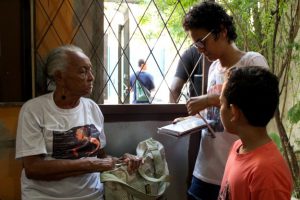
When I first met Raull Santiago, 23, and Nathalia Menezes, 24, my initial charmed impression was that these were two young people who felt no shame of their penchant for playing on their cell phones. By the time we left our first meeting, they had friended me on Facebook, tweeted about our meeting and ‘checked in’ the time and place of our interview.
What made all of this more than just another day in the life of social-medialite is where the spirited pair live: The community of favelas called the Complexo do Alemão, for years the scene of intense trafficker-police confrontations. Residents long feared the police that forcefully entered “pé na porta” to inspect their homes with a blanket judicial order. Outsiders feared that area was “off limits,” controlled by armed traffickers who famously killed a journalist who went undercover to investigate child sexual abuse in baile funk parties. Now Nathália and Raull were cautiously hopeful. The military had invaded the favela after an intense week of urban mayhem, in which scores of vehicles were robbed and lit on fire across the city, in what the government billed as a proactive response to retake territory key to traffickers.
News watchers across Rio saw the site of dozens of traffickers in boardshorts fleeing with rifles on foot through the jungle and of tanks toppling the iron barricades once mounted to prevent police vehicles from entering.
![]() |

A newly released report by Brazil’s Instituto Brasileiro de Geografía e Estadísticas (IBGE)—the state agency responsible for conducting the country’s census—found that the total number of Brazilians living in favelas has nearly doubled in the last five years to 11.4 million. The trend belies common perceptions that high GDP growth has alleviated widespread poverty in South America’s largest economy.
The report found that the 6,329 favelas nationwide in 2010 are home to approximately 6.0 percent of Brazil’s total population. Nearly half of the shantytowns are located in southeastern Brazil—a region responsible for generating the vast majority of the country’s total economic output.
Reducing poverty and increasing social inclusion in Brazil have been pillars of public policy over the course of the last three presidential administrations. From 1995 to 2005 federal social spending increased by 74 percent in real terms. The IBGE report confirms that despite progress, urban poverty persists even in Brazil’s biggest cities.
In addition, policies to combat violence in favelas through community policing initiatives and law enforcement operations are front-and-center in Brazil. These policies are seen as crucial to the success of the 2014 World Cup and 2016 summer Olympic Games.
AQ's coverage and post-trip analysis of the President's May 2-4 visit.