
btn_subscribe-top
btn_give-a-gift
btn_login
btn_signup
btn_rss

Jorge Videla, a Sinister Argentine Dictator, Dies

May 17, 2013

by Juan Cruz Díaz

I was born in June 1976, only weeks after Argentina’s most violent dictatorship began. Early in the morning on a sad March day before I was born, my father was taken away by the military regime. He didn’t meet me for the first time until almost a year later.

I was lucky; thousands of children never saw their parents again. More than 30,000 individuals—Argentines and foreigners, students and workers, people with or without university degrees, politicians and non-politicians, activists and non-activists, even priests and nuns—were tortured, abused, raped, killed, and disappeared by a self-appointed dictatorship that launched a “national reorganization process.” In many cases, the captors would wait until captured pregnant women had their babies before they kidnapped the newborns and killed and hid the bodies of the mothers. 

The leader of the 1976 military junta, Jorge Rafael Videla, died this morning at 87 years old.

I grew up watching my country go through a bumpy transition from dictatorship to democracy. I have a clear memory of the madness of the Malvinas War in 1982, the hope and happiness of the democratic restoration in 1983 and the Juicio a las Juntas (Trial of the Juntas) in 1985. I also have a vivid memory of the anguish created both by President Raúl Alfonsín’s Ley de Punto Final (“full stop”) and Ley de Obediencia Debida (“due obedience”) amnesty laws, and President Carlos Menem’s pardons that, in my view, ruined the progress made in the Trial of the Juntas.

Read More

Tags: Argentina, Jorge Rafael Videla, Argentine dictatorship

Maduro Begins South American Tour amid Venezuela Election Audit

May 7, 2013

by AQ Online

Venezuelan President Nicolás Maduro embarked today on a three-day tour of Argentina, Brazil and Uruguay, all members of Mercosur (The Common Market of the South). Following Paraguay’s suspension from the free-trade group, Venezuela joined Mercosur last year and will assume the bloc’s temporary presidency for the first time on June 28 during a summit in Montevideo.

During a ceremony on Sunday to commemorate the two-month anniversary of the death of Venezuelan President Hugo Chávez,  Maduro announced that he would visit the other Mercosur countries to “continue bringing forward a perfect equation of financial, energy, cultural and political integration.”

In Uruguay, Maduro will meet with Uruguayan President José Mujica, as well as former Uruguayan President Tabaré Vázquez, union leaders and the electrical transformer company Urutransfor.  Members of the Uruguayan opposition have criticized Maduro’s visit as “tactless and inconvenient” because of the current political tensions that exist in Venezuela. Later this week, Maduro will meet Argentine President Cristina Fernández de Kirchner in Buenos Aires and Brazilian President Dilma Rousseff in Brasilia to discuss the next steps for the regional bloc.

Read More

Tags: Venezuela, Nicolás Maduro, Mercosur, Uruguay, Brazil, Argentina

Monday Memo: Paraguayan Elections – Ríos Montt Trial – Argentine Protests – Guantánamo Hunger Strike – Venezuela

April 22, 2013

by AQ Online

Top stories this week are likely to include: Horacio Cartes will be Paraguay’s new president; Guatemala’s Constitutional Court will decide whether Efraín Ríos Montt’s genocide trial can continue; Argentines protested Cristina Fernández de Kirchner’s government; Guantánamo prisoners’ hunger strike grows; the Venezuelan election audit process will take a month.

Horacio Cartes Wins Presidential Election in Paraguay: Tobacco magnate and soccer club president Horacio Cartes will be the next president of Paraguay after voters elected him with 46 percent of the vote on Sunday. Cartes’ main rival, Efraín Alegre of the Radical Liberal Party, captured 37 percent of the vote. Cartes’ victory marks the return of Paraguay’s Colorado Party to power and the likely normalization of Paraguay’s status with its Mercosur and UNASUR neighbors. The Colorados ruled Paraguay for 61 years before the election of former Paraguayan President Fernando Lugo in 2008.

Guatemala Awaits Fate of Rios Montt Trial: Guatemala’s Constitutional Court will determine whether or not the genocide trial of former dictator Efraín Ríos Montt will go forward.   On Friday, Judge Yasmin Barrios declared that a decision to annul the trial by Judge Carol Patricia Flores was illegal. Judge Flores ruled on Thursday that all testimony since November 2011 had been invalid, a decision protested by human rights groups and victims of Guatemala’s internal conflict. Read more about the trial in an AQ blog post by Nic Wirtz.

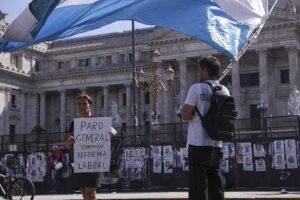
 Argentines Protest Government: Thousands of Argentines gathered in the streets on Friday in countrywide protests against a proposed judicial reform bill that would allow voters to elect magistrates that appoint and remove judges. Argentine legislators will vote on the judicial reform bill on Wednesday. Protesters, many from the political opposition and critical of Argentine President Cristina Fernández de Kirchner, also expressed a general dissatisfaction with Argentina’s crime and high inflation.

Over Half of Guantánamo Prisoners on Hunger Strike: A U.S. military spokesperson said on Sunday that 84 prisoners being held at the Guantánamo Bay military prison are now on hunger strike, and that 17 are being force-fed through tubes. Some of the detainees have been striking since early February, protesting abuse and searches that the prisoners say are invasive. Many of the detainees have been in the prison for over a decade without any charges.

Audit of Venezuelan Elections will take a Month: Venezuela’s Consejo Nacional Electoral (National Electoral Council—CNE) said it will take a month to carry out an audit of the April 14 presidential election results, and said that the results of the audit will not alter the election’s outcome. The CNE has said that president-elect Nicolás Maduro defeated rival candidate Henrique Capriles by 1.8 percentage points. Maduro was sworn in as president on Friday, but the U.S. government has not yet recognized him as Venezuela’s new president. Meanwhile, Maduro has begun to appoint his cabinet members.

Tags: Argentina, Guatemala, Guantanamo, Venezuela

Hope and Change from the Americas

March 20, 2013

by John Parisella

Like most observers, both Catholic and non-Catholic, I was surprised to see Cardinal Jorge Mario Bergoglio from Argentina chosen as the new Pope. He was nowhere to be seen in the pre-conclave media hype. We in Canada saw Cardinal Quellet from La Motte, Quebec as a serious frontrunner. Yet we are observing since Bergoglio’s election and installation as Pope the signal that this new sovereign pontiff could surprise us and become an agent of change.  Already, some media have labeled him the “People’s  Pope.”

Most would agree, however, that on issues such as contraception, abortion and priest celibacy, little will likely change in this papacy.  Many cardinals made this fairly clear in the hours following the election of Pope Francis.  This being said, the need for change will not go away because this pope is more accessible and appears closer to his flock.  For instance, issues regarding women in the church will have to be addressed.  Dealing with the child abuse scandal must also be the object of stronger actions by the new Vatican administration, and must certainly be handled with greater compassion.  Failure to deal with these matters will further marginalize the church as a moral authority in the world.

Yet, change in the Vatican can also come in different ways.  While many reform-minded Catholics wish this new pope would be more forthcoming in modernizing some of the tenets of dogma, suffice it to say that Pope Francis has, in a few days, changed the style and the tone in the Vatican City.  The choice of Francis as Bergoglio’s papal name was not a quick accident of fate. Photos displaying his care for the poor are both sincere and heartwarming. As we have seen every day since his election, the values attributed to St. Francis of Assisi are already evident in this new pope.

Read More

Tags: Pope Francis, Argentina

Francisco, el político

March 19, 2013

by Jenny Manrique

En total, 31 jefes de Estado, 11 jefes de gobierno, 132 delegaciones de todo el mundo y de diferentes congregaciones religiosas, asistieron este martes al comienzo oficial del pontificado del papa Francisco, el primer latinoamericano en llegar a la cabeza de la Iglesia Católica que congrega a 1.200 millones de fieles, la mitad de ellos en la región. Todo fue histórico en este día en el Vaticano: desde la presencia del presidente de Taiwan, Ma Ying-jeou  hasta la del líder de la Iglesia Ortodoxa, Bartolomé, pasando por el celebrado hecho de que la curia romana haya escogido a un arzobispo no europeo, jesuita, (que no figuraba en el sonajero de los papables) para reemplazar a un pontífice, Benedicto XVI, quien también por primera vez en la historia renuncia.

Y en medio de todo ese simbolismo hay algo todavía más relevante: el significado para la Argentina de tamaña decisión en momentos en que la curia y el oficialismo están más enfrentados que nunca. Este lunes cuando Francisco recibió a la mandataria de Argentina Cristina Kirchner, en ese escenario cálido en el que intercambiaron regalos y bromearon ante las cámaras, en realidad estaban sentadas en el Vaticano, frente a frente, dos visiones de país.

La presidente le pidió al Pontífice que intercediera ante Gran Bretaña por el reclamo de soberanía de las Islas Malvinas, recordando la labor que ejerció Juan Pablo II cuando intermedió en el conflicto entre Chile y Argentina por el canal de Beagle que amenazaba con desestabilizar el Cono Sur en 1978. Pero aunque Francisco también cree que las Malvinas son argentinas, -lo que, dicho sea de paso, no lo califica como un mediador neutral- el epicentro del asunto es que Roma tiene su propio conflicto con la Iglesia Anglicana hace 500 años, que reconoce a la reina de Inglaterra como la exclusiva jefe de su iglesia.

Read More

Tags: Argentina, Cristina Fernandez de Kirchner, Pope Francis

What Greece Can Learn from Argentina

March 19, 2013

by Samuel George

Given the similarities between millennium-era Argentina and today’s Greece, some wonder if a Greek default and currency exit might not be the worst option for Athens.  However, Argentina’s “recovery” would not easily be replicated and the Argentine model should not be considered a blueprint for Greece.

Europe has much to learn from the Argentine default of 2001, but the soundest takeaways are often not the most obvious.

In 2001, Argentina suffered the proverbial “messy default.” To the tune of protesters banging pots and pans throughout the streets of Buenos Aires, the government was forced to disband the currency board that had pegged one peso to one U.S. dollar.

Many of the deepest fears forecasters share over a chaotic Grexit occurred in Argentina. The newly untethered peso plummeted to a quarter of its pegged value, representing massive losses for Argentines who owed debt in dollars. Political instability led to a revolving door in the Executive office. Confrontations in the streets left scores dead as Argentines famously chanted “Que se vayan todos!” (“Everybody out!”) at their government.

Read More

Tags: Argentina, Greece, Argentina Debt Default

The New Argentine Pope

March 14, 2013

by Eric Farnsworth

News that Argentina’s Jorge Bergoglio was elected pope yesterday set off wild celebrations in Argentina and give further support to the oft-cited sentiment that God is Argentine.  How could He be otherwise? 

Having come from seemingly out of the mix, new Pope Francis was not unknown but neither was he apparently a front-runner in the election to succeed Benedict.  Of course, if you believe that the election was the pre-ordained manifestation of God’s sovereign will, then it hardly matters whether he was well-known or not. 

What’s interesting from the Latin American perspective is that, as I pointed out in my blog post of February 13, the region is now not just a recipient of missionaries but a significant source of missionaries worldwide—both Catholic and Protestant—and arguably the most vibrant, growing region for the Christian faith. 

That the new pope was drawn from the Americas is a recognition of these demographic trends, and acknowledgement that a new, non-European perspective would be valuable in addressing the concerns of the modern Catholic Church. 

Read More

Tags: Pope, Argentina, Religion

A Historic Vote in the Falkland/Malvinas Islands

March 13, 2013

by Juan Manuel Henao

Far south of the South American continent and east of Argentina and Chile is an archipelago known as the Falkland Islands, or Islas Malvinas in Spanish. With a thriving economy and unparalleled natural views and sea life, what some consider inhospitable land is actually home to hundreds of families who live in one of the safest and most beautiful regions of the world. 

Unfortunately, the islands are not primarily known for their natural beauty or safety.  Instead, the islands evoke animosity between Britain and Argentina.  Disagreement over control of the islands erupted in war in 1982, causing hundreds of deaths. The situation continues to be emotionally charged for the islands’ 3,000 inhabitants.

In response to the continued international disagreement, local elected officials called for a referendum to determine the islands’ political status. The referendum question voted on March 10 and 11 asked: “Do you wish the Falkland Islands to retain their current political status as an Overseas Territory of the United Kingdom?"

Extensive preparations took place ahead of the vote.  Local authorities held town hall meetings to determine the wording of the referendum question, and passed a number of referendum codes designed to ensure the vote meets internationally accepted standards of transparency and efficiency.  In this light, international observers were invited to supervise the vote.  Brad Smith of California and I led the international observation team made up of political and civil society leaders and technical experts from all over Latin America.  Observers from as far as New Zealand joined Mexico, Uruguay, Chile, Canada, and the U.S. for the vote.

Read More

Tags: Falkland Islands, Malvinas, Argentina, Britain

Argentine Bergoglio will be the Next Pope

March 13, 2013

by AQ Online

Argentine Cardinal Jorge Mario Bergoglio will be the 266th pontiff of the Roman Catholic Church after the 115 cardinals gathered in the Sistine Chapel elected him in a fourth round of voting on Wednesday. He is the first-ever Latin American pope.

Bergoglio, 76, who will take the name Francis I, was the second most-voted papal candidate in the 2005 conclave that eventually elected Pope Benedict XVI, but he was not generally favored to be elected over his countryman, Leandro Sandri. The pope has suffered from physical limitations after losing a lung at age 21.

The papal conclave first convened yesterday to elect Benedict XVI’s successor, but the day ended in a billow of black smoke, signaling that the cardinals had not yet reached a two-thirds consensus to select the next pope. Today, spectators gathered in the rain at the Vatican to continue awaiting an announcement, but after three rounds of voting, no pope had been elected. It wasn’t until the fourth round of voting that the crowd sighted white smoke coming out of the Sistine Chapel chimney, announcing the election of a new pope.

The former pope, Benedict XVI, shocked the world on February 11, when he announced his retirement after eight years as pope, saying he could no longer perform his job. He was the first pope to step down in nearly 600 years. Top contenders for the papacy included Angelo Scola of Italy, Marc Ouellet of Canada, Odilo Scherer of Brazil, Sandri of Argentina, and Peter Turkson of Ghana.

Tags: Bergoglio, Argentina, Pope

By an Overwhelming Vote, Falklands/Malvinas Choose to Remain British

March 12, 2013

by AQ Online

As widely anticipated, 99.8 percent of the Falkland (Malvinas) Islands’ population voted “Yes” in a referendum on March 10 and 11, expressing their willingness to maintain the current political status as a British Overseas Territory. Of the 1,517 votes cast in the two-day electoral process, only three “No” votes were cast. The results were announced late Monday evening by the Falklands electoral authorities, and were celebrated by local residents in the town hall of the capital city of Stanley.

Argentina considers the archipelago—which it calls Las Malvinas—as part of its territory, which was occupied by Britain more than 180 years ago. Following the vote, the chairman of the Falklands Legislative Assembly, Gavin Short, asked Argentine President Cristina Fernández de Kirchner to respect the islands’ decision. British Prime Minister David Cameron also called on Argentina to respect the almost unanimous vote which represents “the clearest possible result” and expression of the islanders’ sovereignty.

Despite the results and a 92 percent voter turnout, Argentine officials dismissed the referendum as a British publicity scheme with no legal validity. The Argentine government has tried for years to incorporate the islands to its territory, due to their strategic relevance for international trade and the presence of natural resources such as oil. The results of the referendum confirm that the islands’ 2,841 inhabitants—most of which are British by birth—prefer to retain their British nationality. The Argentine Senate will vote this week on a motion to reject the referendum.

Tags: Falklands, Malvinas, Referendum, Argentina

Pages


Connect with AQ


Twitter YouTube Itunes App Store


Issues in Depth: President Obama's travel to Mexico, Costa Rica

AQ's coverage and post-trip analysis of the President's May 2-4 visit.

» Read more.


WEB EXCLUSIVES

Most Popular

MOST POPULAR ON AQ ONLINE

  • Most Viewed
  • Past:
  • 1 day
  • 1 week
  • 1 month
  • 1 year

NOW ON AS/COA ONLINE

Loading...

AQ MEDIA PARTNER

Loading...