
btn_subscribe-top
btn_give-a-gift
btn_login
btn_signup
btn_rss

Britain and Ecuador Discuss Solutions to Assange Case; Diplomatic Stalemate Continues

June 18, 2013

by AQ Online

British Foreign Secretary William Hague and his Ecuadorian counterpart, Ricardo Patiño, met in London on Monday to discuss the unresolved asylum case of the Australian journalist and founder of WikiLeaks, Julian Assange. One year ago, Assange, 41, sought refuge in the Ecuadorian embassy in London to avoid extradition to Sweden, where he faces allegations of sexual assault and rape. Assange denies the charges and says that he fears he will be extradited to the United States to face additional charges for publishing thousands of confidential government documents on his website.

Patiño confirmed that the Ecuadorian government will continue to provide refuge to Assange inside the embassy. According to a press release from the British Foreign Office, Hague and Patiño “agreed to keep channels of communication open, but made no breakthrough on Julian Assange.” Any solution would have to fall within the laws of the United Kingdom. The British government has repeatedly said that Assange will be arrested if he decides to leave the building, and has spent almost $5 million dollars in around-the-clock guarding of the embassy.

During his visit to London, Patiño also met with Assange at the Ecuadorian embassy, where Patiño declared to the press that there will be no changes in the refugee’s circumstances. Ecuador granted protection to Assange last August, saying that the government feared for Assange’s safety because the journalist believes he might face the death penalty in the U.S. if he is extradited.

According to Patiño, Assange is willing to stay inside the Ecuadorean embassy for five more years. Patiño added that Ecuador would also consider granting asylum to Edward Snowden, the 29-year-old computer analyst who provided The Guardian with top-secret National Security Agency (NSA) documents. “If he applies to our government, then of course we shall analyze the situation,” Patiño said.

Tags: Julian Assange, Ecuador, Ricardo Patiño. William Hague, United Kingdom

El candidato de Ecuador para la CIDH: La otra vía del debilitamiento de la Comisión

June 4, 2013

by Nelson Camilo Sanchez

El control de la función pública es una tarea molesta, pero necesaria en toda democracia. Muchos gobiernos que han discrepado de las decisiones de órganos de control han encontrado dos maneras para eliminar dicho control. Una de ellas es oponerse públicamente a las decisiones o incluso alterar las competencias del órgano que las emite. La otra es tomarse el órgano, garantizando que quienes lo integren decidan en favor a sus intereses, o que sean tan incompetentes que el órgano o tribunal pierda cualquier relevancia. 

Varios gobiernos de la región usan actualmente ambas vías para limitar a la Comisión Interamericana de Derechos Humanos (CIDH). Llevan más de dos años en un proceso para reformar sus competencias en donde no han alcanzado todo lo que se han propuesto, pero en donde no desfallecen.

Ahora, en la Asamblea General de la Organización de los Estados Americanos (OEA) que se celebra esta semana en Antigua, Guatemala, se puso en marcha el plan B: la cooptación de la CIDH a partir de incluir figuras que garanticen que las decisiones estén en la línea de lo que esperan estos gobiernos.

La oportunidad está más que dada. De siete miembros que componen este órgano, tres serán elegidos en Guatemala. La punta de lanza de los países del grupo ALBA (Alianza Bolivariana para los Pueblos de Nuestra América) es el abogado Erick Roberts Garcés, candidato de Ecuador, que ya ha recibido el apoyo público de Uruguay, y en privado se rumora el inminente apoyo de otro número de estados.  

Read More

Tags: Ecuador, CIDH, OAS General Assembly, IACHR Reform, Erick Roberts Garcés

Correa Favored in Polls as Ecuador’s Presidential Campaigns Kick Off

January 4, 2013

by AQ Online

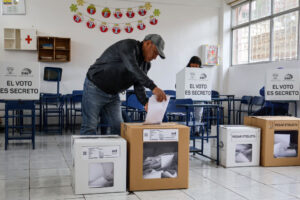
Election season got under way today in Ecuador as eight presidential candidates took to the streets and rallied supporters to campaign for the February 17 presidential and congressional elections.

President Rafael Correa, who has held office since 2007 and is running for a third term next month after being re-elected in 2009, overwhelmingly leads the polls over his rivals, who include businessman Guillermo Lasso, former Ecuadorian president Lucio Gutiérrez, millionaire Alvaro Noboa, and evangelical pastor Néstor Zavala.

A December survey conducted by polling company Perfiles de Opinión found that 60.6 percent of Ecuadorian voters polled signaled an intention to re-elect Correa. A distant 11.2 percent of voters said that they backed Lasso, Correa’s nearest competitor.

The poll by Perfiles de Opinión also found that more Ecuadorian voters signaled an intention to submit blank or nullified ballots than to vote for any presidential candidate other than Correa or Lasso.

Correa launched his presidential campaign early this morning in southern Quito, where he convened a caravan to the coastal city of Portoviejo to hold his first presidential campaign rally today. On January 2, Congress officially granted Correa a month’s leave from January 15 to February 14 in order to focus on his campaign, making Vice President Lenín Moreno Ecuador’s temporary head of state during that period.

When Ecuador’s 11.5 million voters go to the polls on February 17, they will be casting ballots for the president, vice-president, and members of the national assembly, who will all serve until 2017.

Tags: Rafael Correa, Ecuador, Presidential elections

Ecuador’s Correa Receives Press Freedom Award in Argentina

December 4, 2012

by AQ Online

Ecuadorian President Rafael Correa traveled to Argentina on Monday to receive an award from the Universidad de la Plata in La Plata, Argentina, recognizing his contributions to freedom of expression in Ecuador.

The U.S. government has long criticized Correa’s record on freedom of speech, and granted political asylum to the Ecuadorian journalist Emilio Palacio in August after he faced a three-year prison sentence and a $40 million fine for referring to Correa as a “dictator” in El Universo.

Facing pressure from press freedom groups, Correa eventually pardoned Palacio and other executives who had received prison sentences. The U.S. offered asylum to Palacio just 24 hours after Ecuador granted asylum to WikiLeaks founder Julian Assange at its embassy in London, who published a series of classified U.S. government cables on his website.

Receipt of the award prompted the Ecuadorian president to again defend his record with the press. “It turns out that there’s such a lack of free expression in Ecuador that one of the most important universities in Latin America has awarded the president a prize for fighting for true freedom of expression and democratization of the media,” Correa said on Saturday.

The award, in the category “Presidente Latinoamericano por la Comunicación Popular” (Latin American President for Popular Communication), will be delivered Tuesday at the Facultad de Periodismo y Comunicación. It is not the first controversial prize that the Universidad de la Plata has awarded to a Latin American head of state: in 2011, Venezuelan President Hugo Chávez collected the same award.

Tags: Rafael Correa, Ecuador, Press Freedom

Monday Memo: Elections in the United States – Puerto Rico Votes on Status – Haiti Rebuilds After Sandy – and more

November 5, 2012

by AQ Online

Top stories this week are likely to include: the United States heads to the polls; Puerto Rico decides on status; Michel Martelly requests emergency aid; and Rafael Correa gets re-nominated for president.

Elections in the United States: On Tuesday, voters across the United States will go to the polls to vote for the next president as well as all congressional representatives and select governors and senators. A poll of polls from Real Clear Politics has President Barack Obama maintaining a razor-thin edge—0.5 percentage points—over Governor Mitt Romney. The difference-maker could be the turnout of Latinos, a demographic that supports Obama by 52 percentage points over his Republican challenger according to a poll released last week by Latino Decisions. AQ Senior Editor Jason Marczak observes: “The question is the degree to which Latino political preferences will translate into votes, especially in battleground states. Beyond Election Day, Latino turnout tomorrow will shape the extent to which their concerns will factor into policymaking in the next four years.”

Puerto Rico's Referendum: Voters in Puerto Rico will decide on Tuesday about the future of the island’s status. Currently it is a semi-autonomous “unincorporated territory” of the United States that—since it is not a state—plays no role in the U.S. presidential general election. Puerto Ricans will decide whether they want the island to gain more autonomy as a “sovereign free association,” or whether Puerto Rico should become a U.S. state or independent altogether. Tuesday’s vote will be the fourth time in 45 years that Puerto Ricans have formally weighed in at the ballot box on the status of the island. A poll last month found that a slim majority—51 percent—want to keep the island’s current status intact, according to AS/COA Online. “This is probably the most complicated ballot used for a referendum on Puerto Rico’s status and will likely split the vote for those opposing the commonwealth’s status quo,” observes AQ Editor-in-Chief Christopher Sabatini.

Haiti Rebuilds After Superstorm Sandy: Sandy, which took on many forms including tropical storm, hurricane and post-tropical storm, left much damage in its wake—including in Cuba, Jamaica, the Dominican Republic, Puerto Rico, the Bahamas, and the United States. But a country that appears to have suffered the most long-term damage is Haiti. According to the Associated Press, 70 percent of crops in the south of the country were destroyed and livestock killed—significantly damaging the agricultural industry. President Michel Martelly is appealing to the international community for emergency aid as his country adds the superstorm damage to the loss inflicted by a devastating earthquake outside of Port-au-Prince in 2010. Will Martelly’s request be granted this week?

Correa to be Nominated at Party Convention: Ahead of Ecuador’s presidential election in February, the Alianza País incumbent party will hold its convention on Saturday and re-nominate President Rafael Correa to represent the party on the ballot. Foreign Minister Ricardo Patiño affirmed this past Wednesday that Correa, first elected in December 2006, will run for another full term. If he wins, the populist leader will remain in power into 2017. Early polls show Correa with a huge advantage over potential challengers, bringing in 56 percent of votes versus Guillermo Lasso, an ex-banker of the opposition who garners 23 percent.

Tags: Barack Obama, Ecuador, Haiti, Michel Martelly, Mitt Romney, Puerto Rico, Rafael Correa

Ecuador Shuts Down 26 Foreign NGOs

September 6, 2012

by AQ Online

Earlier this week, Ecuador’s Secretaría Técnica de Cooperación Internacional (Technical Secretariat for International Cooperation—SETECI) revoked operations permits for 26 foreign NGOs in the country, effective immediately. SETECI announced the changes in a bulletin, which also mandated that 16 other NGOs subscribe to new operating agreements within 15 days. According to a spokesperson for SETECI, “those who do not complete the requirements will not be able to continue operating.”

In a July 2011 executive decree, all foreign NGOs operating in Ecuador were required to sign new agreements with the state that would permit greater government oversight over their operations and finances.  Some of the new restrictions prohibit NGOs whose activities threaten “the public peace” or that carry out “lucrative labor, of a political or proselytizing nature.” The decree also stated that foreign NGOs whose activities appear to be different than their stated goals would be shut down.

Last year, Ecuadorian President Rafael Correa said that certain NGOs operating in Ecuador were “extremely right-wing” and attempting to “replace the governments and impose their politics.” In the past, the Ecuadorian government has also shut down NGOs that were accused of supporting Indigenous protests against mining projects or suspected of ties to the guerrilla Fuerzas Armadas Revolucionarias de Colombia (Revolutionary Armed Forces of Colombia—FARC).

Several of the NGOs on the SETECI list appear to be linked to religious organizations, such as the Christian Reformed World Relief Committee in the U.S. and the Catholic Institute of International Relations in the United Kingdom, which provide a variety of health, environmental and social services in Ecuador. Nine of the 26 NGOs are based in the U.S.

The Ecuadorian decree is not the first of its kind. In 2010, neighboring Venezuela banned foreign funding for NGOs in the country, citing concerns that foreign agencies like USAID were intervening in Venezuelan politics by providing millions of dollars to organizations that claimed to promote democracy.

Tags: Ecuador, SETECI, foreign intervention, NGOs

Ecuador, United Kingdom in Standoff over Assange Affair

August 17, 2012

by AQ Online

Although the Ecuadorian government granted political asylum to WikiLeaks founder Julian Assange yesterday morning, the British government has refused to allow him safe passage out of the country. The UK Foreign Office said that it would remain committed to extraditing Assange to Sweden, where he is accused of sexual crimes. British Foreign Secretary William Hague said in a statement, “Under our law, with Mr. Assange having exhausted all options of appeal, the British authorities are under a binding obligation to extradite him to Sweden. We must carry out that obligation and of course we fully intend to do so.”

Tensions began escalating on Wednesday ahead of yesterday’s announcement, when the UK Foreign Office cautioned that it had legal standing to lift the embassy’s diplomatic status under Britain’s Diplomatic and Consular Premises Act and arrest Arrange. Ecuador, in turn, accused the UK of threatening to “assault” the embassy—a charge that the UK denied. Ecuadorian Foreign Minister Ricardo Patino upbraided the warning, calling it an “explicit type of blackmail.” Hague replied that the act of harboring Assange, an alleged criminal, is not “a permitted function under the Vienna Convention.”

View Patiño's announcement yesterday morning on the Assange case.

Assange, who has been at the Ecuadorian Embassy in London since June 19, called yesterday’s decision a “significant victory.” Assange fears that, should he be extradited to Sweden, the Swedish authorities will turn him over to the United States where he is wanted for charges related to WikiLeaks’ publication of State Department cables.

Tags: Ecuador, Wikileaks, Julian Assange, United Kingdom

Congress Postpones Vote on Media Law in Ecuador

July 20, 2012

by AQ Online

Yesterday the president of Ecuador’s National Assembly, Fernando Cordero, announced via Twitter that voting on communications legislation advanced by the government would be postponed indefinitely, due to a lack of quorum. “The 124 assembly members are not all present, so I would prefer to convene another day,” Cordero said.

The legislation to be voted on, known as the Ley de Comunicación, would substantially reduce the percentage of radio and television outlets distributed among the private and public sectors. Voting was previously postponed on April 11, 2012. Under the terms of the proposed legislation, 34 percent of radio and TV frequencies would be allocated to community media, 33 percent to public media, and 33 percent to the private sector—which currently controls 85 percent of radio frequencies and 71 percent of TV frequencies, according to the State Superintendent of Telecommunications. The legislation also creates a five-member regulatory board with authority to place penalties on media sources that refuse to modify published information.

César Rodríguez, an opposition member of Congress, said in a statement to the press, “They do not have the votes to censor freedom of expression in Ecuador,” referring to the 63 votes that the ruling Alianza País would need to pass the legislation. (The coalition currently controls 53 seats in the National Assembly.)

Further criticism came from legislator Tomás Zevallos, who presented a motion (accepted in April) to vote on each of the bill's 128 articles individually, arguing that the law has ambiguous sections and accusing the administration of using the media to advance the political agenda of the government. María Paula Romo, founding member and political activist of the “Ruptura de los 25,” a progressive political movement, submitted observations on the text of the law in which she questioned whether it would determine certain ethical principles that fall outside the scope of legal regulation.

Tags: Ecuador, Media policy

Monday Memo: AQ’s Top Expected Stories for the Week of June 25

June 25, 2012

by AQ Online

Top stories this week are likely to include: effect of Fernando Lugo’s impeachment; Supreme Court verdict on Arizona’s immigration law; Mexico elects a new government; Julian Assange’s asylum request to Ecuador; and Mercosur summit in Argentina.

Backlash to Lugo’s Ouster: After former Paraguayan President Fernando Lugo was impeached last Friday by the opposition-dominated legislature in a 39-4 vote, his vice president, Federico Franco, was sworn in later that evening as the country’s new head of state. Lugo, while accepting the decision of Congress, likened the move to a “parliamentary coup.” Franco belongs to the same coalition—the Patriotic Alliance for Change—as Lugo, who was ousted due to his handling of deadly land clashes the week prior that killed at least 17 people. In response, Brazil, Chile, Uruguay, and Venezuela removed their ambassadors to Paraguay while other countries such as Colombia recalled its ambassador in Asunción for consultations. According to CNN, the governments in Venezuela, Argentina, Bolivia, Ecuador, and the Dominican Republic said they will not recognize Franco as the legitimate leader of Paraguay. It was just announced this morning that Paraguay will be suspended from this week’s Mercosur summit in Mendoza, Argentina, although Lugo will still attend. However, pay attention for any official declarations from Mercosur later this week on the Paraguay situation. Notes AQ Editor-in-Chief Christopher Sabatini, “As we saw in the case of Honduras in 2009, democratic institutions and rules—when weak—can be manipulated to undemocratic ends. In both cases, presidents were denied fundamental rights of due process. I fully expect that at the Mercosur summit member governments will take action to threaten punishment of the post-Lugo government. UNASUR will likely do the same. The question is: Will anyone care if the OAS does?”

Supreme Court Verdict on SB 1070: The U.S. Supreme Court verdict on Arizona’s restrictive immigration legislation—SB 1070—was delivered this morning, which invalidated three of the four controversial provisions of the law but did uphold the “papers please” provision, which permits police officers to ask for documentation from anyone they suspect of being in Arizona illegally. This ruling could have ripple effects in other U.S. states that have adopted similar legislation, such as Utah, Indiana, Alabama, Georgia, and South Carolina. AQ Senior Editor Jason Marczak observes: “Today’s ruling is a partial victory for the rights of immigrants and for any American who may appear to be an immigrant. By blocking three of the four provisions, including the section that would have allowed police officers to arrest anyone if there was probable cause of their being in the U.S. without authorization, the Court by and large held firm that federal regulations must supersede the growing  patchwork of state-level immigration laws. It is unfortunate that the Court upheld the bill’s provision whereby police officers can conduct status checks, but it did severely restrict when and how those checks can be applied.”

Mexico Elections on Sunday: Aside from the presidency, all 628 seats in the Mexican legislature (500 in the Chamber of Deputies, 128 in the Senate) are up for grabs in the nationwide election on Sunday, July 1. In addition, the executive and legislative branches of the Federal District government will be chosen as well as the governorships in the states of Guanajuato, Jalisco and Morelos. While Partido Revolucionario Institucional (Institutional Revolutionary Party—PRI) presidential candidate Enrique Peña Nieto looks poised for victory as he has led the polls for months, a Barclays Capital analysis predicts a PRI win in Congress.

Assange’s Asylum Request: WikiLeaks founder Julian Assange broke terms of his house arrest in London last week when he sought refuge in Ecuador’s embassy to the United Kingdom, claiming asylum under the UN Declaration on Human Rights. Sweden is seeking Assange’s extradition from the UK based on sexual assault charges; Assange fears that Sweden will turn him over to the United States. Ecuadorian Foreign Minister Ricardo Patiño has said that Ecuador is considering the request, based on Assange’s account that he is being persecuted. Sabatini says that an agreement from Ecuador to take in Assange “would be said because he would effectively be given asylum for rape charges, not as a martyr for freedom of expression.”

Mercosur Assembly in Mendoza: An annual meeting of Mercosur members and observers is taking place this week in Mendoza, as Argentina holds the rotating presidency of the trade bloc. Higher-level meetings will occur on Thursday and Friday. While this summit has been planned for months, Friday’s news of Lugo’s ouster—Paraguay is a founding member of Mercosur—has thrown Paraguay’s future status in the alliance under speculation. A statement this morning from the Argentine foreign ministry, signed by all Mercosur nations, “energetically condemns the rupture of the democratic order in the Republic of Paraguay for not having respected the right to due process.” Observes Sabatini, “Watch for the member governments to take formal action to isolate the post-Lugo government.”

Tags: Mexico, Mercosur, Arizona, Ecuador, Paraguay, SB 1070, Fernando Lugo, Enrique Peña Nieto, Ricardo Patiño, Federico Franco

Monday Memo: AQ’s Top Expected Stories for the Week of June 4

June 4, 2012

by AQ Online

Top stories this week are likely to include: proposed OAS human rights commission reform; OAS meeting underway in Bolivia; Pacific Alliance meeting on Wednesday; Peru-Chile relations; and no end in sight to the anti-mining protests in Peru.

OAS Human Rights Reform Considered: Organization of American States (OAS) member states such as Ecuador and Venezuela are calling for reforms to the Inter-American Commission on Human Rights (IACHR), the independent human rights organ of the regional body. Ecuadorian Foreign Minister Ricardo Patiño called for changes such as cutting funding for the OAS special rapporteur on press freedom, warning that the OAS “will disappear” otherwise, which earned the endorsement of Venezuela. Insulza has further called for renegotiation of the IACHR’s statute and procedures including allowing governments to decide how the IACHR monitors them. Last Friday, the Washington Post editorial board responded to these proposals, writing, “It’s not surprising that Venezuela and its allies would push for noxious initiatives, or that Mr. Insulza would serve as their frontman […] Canada and the United States… and their democratic allies should work to ensure that the Insulza proposals are rejected—and that the OAS is perserved as an institution committed to democracy and human rights.”

AQ Editor-in-Chief Christopher Sabatini concurs: “The reasoning behind the proposals that Insulza is bringing to the General Assembly is unclear. What is clear is that their effect would be to whittle away at much of the independent voice of the Commission—the most effective office in the OAS—and he’s doing it by making common cause with some suspect governments."

Developments at the OAS General Assembly: Representatives from the 35 OAS member states are in Cochabamba, Bolivia, from June 3 to 5 for the organization’s 42nd General Assembly. In addition to the IACHR reforms, other issues on the table include Bolivian President Evo Morales’ desire for forward movement in regard to his country’s lack of access to the Pacific Ocean, a longstanding dispute with Chile. Argentina’s leadership wishes to rally hemispheric consensus around its claim to the Falkland (Malvinas) Islands. OAS Secretary-General José Miguel Insulza briefed the assembly that Latin America is still far from achieving the UN’s Millennium Development Goals (MDGs). The UN has set 2015 as its target date for achievement of the MDGs. But expectations for concrete results are not high, notes Sabatini: "The OAS general assembly has become a theater for overreach and meaningless debate." 

Read More

Tags: Chile, Peru, Bolivia, Jose Miguel Insulza, Organization of American States, Venezuela, Ecuador, Inter-American Commission on Human Rights, Sebastian Piñera, Ollanta Humala

Pages


Connect with AQ


Twitter YouTube Itunes App Store


WEB EXCLUSIVES

Most Popular

MOST POPULAR ON AQ ONLINE

  • Most Viewed
  • Past:
  • 1 day
  • 1 week
  • 1 month
  • 1 year

NOW ON AS/COA ONLINE

Loading...

AQ MEDIA PARTNER

Loading...