
btn_subscribe-top
btn_give-a-gift
btn_login
btn_signup
btn_rss

Obama Discusses Trade and Economic Cooperation with Enrique Peña Nieto

May 3, 2013

by AQ Online

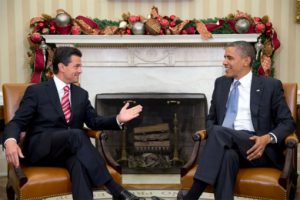
U.S. President Barack Obama met with his Mexican counterpart, President Enrique Peña Nieto, in Mexico’s Palacio Nacional on Thursday to discuss trade and economic partnership between the two countries. This was Obama’s fourth trip to Mexico but his first under Peña Nieto’s tenure.

Both heads of state agreed to form a high-level working group to expand the countries’ trade agreements with Asia because of its fast-growing import and export market. “By working closely together to upgrade and revamp our trade relationship, we're also in a position to project outward and start selling more goods and services around the world,” Obama said. “And that means more jobs and more businesses that are successful in Mexico and in the United States.”

Both the U.S. and Mexico had estimated trade of up to $500 billion in 2012, are members of the North American Free Trade Agreement (NAFTA) with Canada, and are participating in the Trans-Pacific Partnership (TPP) negotiations that Japan has recently joined.

Obama briefly mentioned the U.S.’ effort  to overhaul its immigration system and said that he was “optimistic that we’re finally going to get comprehensive immigration reform passed.”   Obama said that the bill contains elements that he approves of, but that the bill is likely to be amended before it is passed. Peña Nieto responded by saying that “Mexico understands this is a domestic affair for the United States.”

Today, before meeting with Costa Rican President Laura Chinchilla, Obama is scheduled to make a speech at the Museo Nacional de Antropología (National Anthropology Museum) in Mexico City and meet with young people to highlight the importance of the historical and cultural ties between the U.S. and Mexico. On Saturday, Obama will meet with other Latin American leaders from the Sistema de la Integración Centroamericana  (Central American Integration System—SICA), including leaders from Nicaragua, Belize, Panama, Guatemala, El Salvador, Honduras, and the Dominican Republic.

For further coverage of Obama’s visit to Latin America, visit AQ’s in-depth page.

Tags: Barack Obama, Enrique Peña Nieto

Mexico’s First Lady among the best dressed… and that’s about it for now

March 22, 2013

by Arjan Shahani

In a recent online article, Vanity Fair mentioned Angélica Rivera –wife of Mexican President Enrique Peña Nieto–among the top-10 best dressed first ladies in the world. The piece was innocent enough and not unlike the lighthearted articles usually included in this publication. And yet, the article caught wildfire and was highlighted in Mexico’s mainstream media and newspapers, as if making the list was an incredible achievement and a coveted award. 

Why is this? My best guess is that since Ms. Rivera has been out of the spotlight since she married and campaigned with Peña Nieto, the President’s PR team grabbed ahold of what they could to give her some sort of national print exposure. If this is the case, staying true to her past as a telenovela star, it seems the most we should expect from her in the coming years will be a pretty face in a pretty dress and a lovely TV smile.

The first 100 days of Peña Nieto’s presidency have come and gone and any political analyst would likely conclude that, whether you agree with his politics or not, the President’s team is doing a good job of portraying him as a hands-on leader who gets the job done. In recent weeks he’s made headlines by pushing forward a much-needed Education Reform, a Victims Protection Law and new Telecom policies.  Getting rid of Elba Esther Gordillo, the leader of the Sindicato Nacional de Trabajadores de la Educación (National Teachers Union—SNTE), certainly boosted Peña Nieto’s numbers as well.  And while I would not argue that the first lady’s role should be as relevant as the elected official’s, a look back at Rivera’s track record after the first 100 days in the Presidential residence of Los Pinos, reveals a blank slate and missed opportunities.

Traditionally, Mexico’s first lady is awarded the honorary position of president of the Sistema Nacional para el Desarrollo Integral de la Familia México (Integral Family Development National System Advisory Board—DIF).  Rivera accepted the role just a couple of weeks ago, having remained in the shadows up until then.

Read More

Tags: Enrique Peña Nieto, Angélica Rivera

Peña Nieto Launches Life Insurance Program

March 14, 2013

by AQ Online

Mexican President Enrique Peña Nieto followed through on a campaign promise yesterday by launching an innovative life insurance  program designed for single, female-headed households. The program, titled Seguro de Vida para Madres Jefas de Familia (Life Insurance for Female Heads of Family), will be overseen by the Secretariat of Social Development (Sedesol) and the Family Development Agency (DIF) with an initial budget of 400 million pesos ($32 million).

With a goal of universal coverage, the program will first be targeted at the 1.7 million women living in rural areas that suffer from high levels of poverty—which includes about 400 municipalities—before it moves into urban areas. To qualify for the insurance, mothers cannot exceed a monthly income of 2,130 pesos ($171). Each child will be entitled to 850,000 pesos ($68) a month if the mother becomes deceased to allow the child to be able to continue professional studies and not be forced to drop out to earn money.

Peña Nieto asserted that the measure is "an act of justice" as one in four households is led by a single mother. As part of the program, children of the deceased mother are under the care and protection of the state until they reach the age of 23 to ensure the completion of their professional education. Peña Nieto declared that this insurance is one layer of a larger social initiative program centered on promoting reproductive health, reducing maternal mortality rates and preventing violence and crime.

Present at the launch ceremony was the representative of the United Nations Fund for Children (UNICEF) in Mexico, Isabel Crowley, who said that this program "has great significance to ensure progress in the rights of children,” and that this is an “historic opportunity to improve the conditions of children and adolescents in the country who have suffered serious loss of their parents.”

Tags: Enrique Peña Nieto, Social inclusion

Mexico’s New Government Faces Ongoing Security Problems

March 4, 2013

by Nathaniel Parish Flannery

Early last month, Mexico’s new government published its first report on the drug-cartel related violence that continues to affect the lives of residents in many parts of the country. The report explains that during the first two months of Enrique Peña Nieto’s presidency, Mexico experienced more than 2,000 organized crime-related murders. The country tallied 1,139 in December, including 17 mutilated bodies dumped near the Texas border in the state of Tamaulipas and 1,104 in January, including 12 machine gun carrying suspects who were killed in a stand-off with federal agents in the northern state of Zacatecas.

Under Peña Nieto’s watch, government forces have battled cartel gunmen and have pushed forward with former President Felipe Calderón’s crop eradication program, destroying 201 hectares of marijuana crops and 795 hectares of poppy seed plants. Still, in many cities and towns, residents continue to complain about criminal activity and a local absence of rule of law.  

So far, the strategy inherited from Calderón has yielded mixed results. Under Calderón’s leadership, Mexico’s government succeeded in pushing drug ferrying planes off its airstrips and into airfields in Guatemala and Honduras. Calderón’s forces also captured and killed a number of high profile cartel leaders. But after more than six years of continuous anti-cartel operations, the traditional strongholds of the embattled organized crime groups have become the most violent and least stable parts of the country.

In the state of Guerrero, as cartel leaders such as the Beltran Leyva brothers and La Barbie were killed or captured, a destabilizing sequence of inter-cartel competition has led to a string of disturbing violent incidents as well as complaints about robbery and extortion. Mexico-focused security analyst Sylvia Longmire says that “there are at least two or three major TCOs [transnational criminal organizations] and several smaller criminal gangs operating there…fighting for control.”  

A string of arrests has led to infighting among the criminal groups in these states, but has not deterred criminals from engaging in extortion, kidnapping, and grisly killings. Violence in Acapulco continues even after Peña Nieto sent in an additional 500 soldiers to bolster security. In February, elected officials in Guerrero state struggled to explain how, under their watch, six Spanish tourists were raped during a home invasion. The breakdown of public security in Guerrero has become even more complicated after the emergence of armed citizens groups who are taking responsibility for meting out justice to suspected cartel members and have even shot at visiting tourists.

Read More

Tags: Enrique Peña Nieto, Drug Cartel

Mexico’s Crusade against Hunger

January 29, 2013

by Juan Manuel Henao

Mexican President Enrique Peña Nieto, inaugurated to a new sexenio last month, is doing everything in his administration’s power to abate a problem that affects close to 52 million poverty-stricken Mexicans: hunger. 

Well before becoming president, Peña Nieto promised mothers, children and the poorest of communities that he would work to end poverty, inequality and hunger.  During his inaugural speech on December 2, he issued an executive order directing his new social development secretary to implement a program to eradicate hunger across the country. Some 50 days later, he traveled to Las Margaritas, Chiapas, to unveil an ambitious national plan known as La Cruzada Nacional contra el Hambre (National Crusade against Hunger).

The program coordinates the ministries for social development, education and defense to work in 400 of the poorest municipalities across Mexico to provide wholesome nutrition, eradicate childhood malnutrition, educate farmers, minimize post-harvest losses, and implement community hunger eradication programs.

Peña Nieto’s order also creates the Sistema Nacional contra el Hambre (National System against Hunger), which serves as the legal, administrative and bureaucratic manual for dialogue, agreements and action between government agencies, states and municipalities. The program and executive order, however, are not the first to appear in a country which has historically tolerated hunger amongst the ranks. Progressive programs from different presidents and land reforms have given Indigenous and disadvantaged groups crops and food, but a large portion of the population remains unimpacted by such efforts.       

Read More

Tags: Enrique Peña Nieto, poverty, hunger

La Oposición Política en México

January 15, 2013

by Rodrigo Borja

Muchos analistas políticos mencionan que el gobierno de Enrique Peña Nieto y el Partido Revolucionario Institucional (PRI) deberán enfrentarse a una fuerte oposición política y que eso les obligará a negociar para concretar las reformas estructurales que proponen para el país.

Pero la realidad es muy distinta. Si la principal amenaza para la presidencia de Peña Nieto son los partidos políticos de oposición, ya puede dormir tranquilo.

Con la renuncia de Andrés Manuel López Obrador, el Partido de la Revolución Democrática (PRD) tiene pocas esperanzas de mantener una votación aceptable en las elecciones legislativas de 2015, pues la mayor parte de sus votos desde las elecciones del año 2000 provenían del llamado “efecto Peje” (sobrenombre del político tabasqueño), y sus actuales dirigentes poco o nada podrán hacer para revertir los efectos negativos que la conversión de Morena (Movimiento Regeneración Nacional) en partido político traerá al suyo. Por otro lado, el enfrentamiento entre las llamadas “tribus” perredistas, especialmente los “chuchos” (dirigidos por Jesús Ortega y Jesús Zambrano) y los “bejaranos” (dirigidos por René Bejarano), ha mostrado claramente las debilidades de este partido político. Los votantes de izquierda difícilmente volverán a apoyarlos tras su clara alianza con los últimos gobiernos, lo que provocó la queja y la renuncia de muchos de sus militantes que ahora apuestan por Morena. Poca fuerza tendría así para oponerse al gobierno, aunque lo quisiera. Sólo le quedan dos caminos: recuperar la dignidad perdida convirtiéndose en oposición real aunque le cueste perder algunas prerrogativas, o continuar buscando el apoyo del gobierno en turno a cambio de sus votos en el Congreso.

Read More

Tags: Enrique Peña Nieto, Mexico

El Nuevo Gobierno Mexicano

December 18, 2012

by Rodrigo Borja

A principios de mes, Enrique Peña Nieto tomó posesión de la Presidencia de México en medio de graves protestas callejeras que tuvieron su principal fuerza de choque en la capital. Diferentes grupos como Yosoy132, Morena, sindicatos independientes y otros colectivos campesinos y urbanos protagonizaron duros enfrentamientos contra la policía que duraron más de siete horas y se saldaron con más de 100 heridos. Un día antes, Enrique Peña Nieto hizo la presentación oficial de su gabinete y de un programa de gobierno de 13 puntos.

Por lo que respecta al gabinete, algunos nombres ya se esperaban. Tal es el caso de Miguel Ángel Osorio (Gobernación), Jesús Murillo (Procuraduría General de la República), Joaquín Codwell (Energía), Enrique Martínez (Agricultura), Emilio Chuayffet (Educación Pública), Alfonso Navarrete (Trabajo) y Jorge Carlos Ramírez (Reforma Agraria).

Otros nombres sorprenden pero no extrañan. Tal es el caso de Manuel Mondragón (subsecretario de Seguridad Pública) quien proviene del gobierno de la ciudad de México; Rosario Robles (Desarrollo Social), exgobernadora de la capital del país y expresidenta del Partido de la Revolución Democrática; y José Antonio Meade (Relaciones Exteriores), exsecretario de hacienda del gobierno de Felipe Calderón. Sin embargo, pocos son gente realmente cercana a él, como Luis Videgaray (Hacienda), Gerardo Ruiz (Comunicaciones) y Alfonso Navarrete, lo que nos indica el grado de subordinación que el nuevo presidente tiene respecto al grupo encabezado por Carlos Salinas de Gortari. Incluso una sobrina de éste figura como nueva secretaria de Turismo (Claudia Ruiz Massieu Salinas). Desaparecen también dos secretarías (Seguridad Pública y Función Pública), cuyas atribuciones regresan a la de Gobernación.

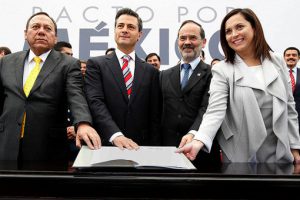
Se presentó también un Programa de 13 Puntos y se firmó el Pacto por México entre los principales partidos políticos, por los que se comprometen a diversas acciones de gobierno y reformas legislativas orientadas a cinco objetivos fundamentales: gobernabilidad democrática; crecimiento económico, empleo y competitividad; ejercicio pleno de derechos sociales y libertades; seguridad y justicia, así como transparencia, rendición de cuentas y combate a la corrupción. Lo que no se dijo es cómo se va a lograr, cuándo y de qué forma. Promesas fáciles de incumplir, tal y como lo hemos visto en los últimos cuarenta años.

La duda es si con el mismo modelo económico que ha hundido al país y con los personajes públicos y privados que lo motivaron, el nuevo inquilino de Los Pinos y su gabinete concretarán todo lo que han prometido. Para financiar los proyectos contenidos en ambos documentos, de acuerdo con Carlos Fernández Vega, harían falta 250 mil millones de pesos (casi 20 mil millones de dólares). Por otro lado, en el presupuesto del gobierno, 90 centavos de cada peso ya están comprometidos y no pueden tocarse (pago de deuda, de sueldos, etc.), por lo que sólo quedan 10 centavos por peso (de acuerdo a la Cámara de Diputados). El secretario de Hacienda, Videgaray, ya dijo que no habrá aumento de impuestos en 2013, pero de acuerdo con Carlos González Barragán, director del Centro de Investigación Económica y Presupuestaria, para solventar los compromisos ofrecidos hace falta una reforma fiscal y hacendaria. ¿De dónde sacarán el dinero entonces?

En otro tema, la seguridad pública, las cosas parece que no van a cambiar mucho, pues el nuevo presidente ya anunció que el ejército seguirá en las calles mientras se prepara un nuevo plan de seguridad. Y con el cambio de sexenio, las muertes no han cesado.

Como bien señala Guillermo Knochenhauer, Calderón deja el gobierno en tan malas condiciones que a Peña no le será difícil mejorar aunque sea un poco cualquiera de las políticas del gobierno anterior. Además, éste contará con un conjunto bien disciplinado de medios electrónicos e impresos que encubrirán cualquier fracaso y magnificarán cualquier éxito.

Tags: Mexico, Enrique Peña Nieto

Monday Memo: Mercosur Considers Ecuador and Bolivia – Peña Nieto in the Presidency – Colombia, FARC Continue Talks – Peru, Chile at The Hague – and more

December 3, 2012

by AQ Online

Top stories this week are likely to include: Mercosur convenes; first week of Enrique Peña Nieto’s presidency; FARC peace negotiations resume; Peru, Chile dispute their border at The Hague; and Rousseff’s oil royalties veto makes waves in Brazil.

Mercosur Considers Ecuador and Bolivia: When Mercosur’s member nations convene on Friday in Brasilia, they will consider upgrading Bolivia and Ecuador—currently associate members—to full membership. Brazilian Foreign Minister Antonio Patriota cites a desire to deepen South American integration. AQ Editor-in-Chief Christopher Sabatini notes that “with each new addition to Mercosur the original intent of the customs union is becoming diluted. The additions may be economic benefits to Brazil and serve a broader political end, but with Venezuela and now potentially Bolivia and Ecuador the task of coordinating a common external tariff and ensuring that monetary policy doesn't interfere with internal trade is nearly impossible.”

Peña Nieto in the Presidency: After announcing his cabinet on Friday and transitioning into power the following day, Mexican President Enrique Peña Nieto undergoes his first full week in Mexico’s highest office. Yesterday, the main domestic political parties announced the Pacto por México (Pact for Mexico) that outlines desired political reforms for Peña Nieto’s term. The reforms center on three areas: strengthening the state; economic and political modernization; and expansion of social rights. As AQ Senior Editor Jason Marczak observes, “the show of unity with the joint signing of the Pacto por México is an important accomplishment for Peña Nieto but the specifics of how to implement these reforms will be the real challenge especially with PRD legislators already threatening to block them.”  

Peru, Chile at The Hague: Beginning today, the International Court of Justice will hear a lawsuit by Peru brought against Chile over an unclear maritime border. In the lead-up, however, both Chilean President Sebastián Piñera and his Peruvian counterpart Ollanta Humala have discouraged their respective citizens from being belligerently nationalistic. Piñera wrote against “exacerbated nationalism, which poisons the soul of the people,” while Humala urged for both countries to consider the outcome of the lawsuit as “the end point of a dispute between brother countries.”

Colombia, FARC Continue Talks: Both sides will resume peace negotiations in Havana on Wednesday. The Colombian government’s chief negotiator, Humberto de la Calle, has stressed “a stable and enduring peace” as the desired outcome of the talks; President Juan Manuel Santos recently announced that he has designated November 2013 as the deadline for an agreement. 

Impact of Dilma’s Partial Veto: Brazilian President Dilma Rousseff was absent at last Friday’s Unasur meeting in Lima due to “domestic engagements.” The issue in question was whether she would sign into law a controversial law on oil royalties, which would spread the nation’s resource wealth to non-producing states. According to Reuters, Dilma’s veto “changes the bill so that producer states continue to receive royalties on output from existing oil concessions. She signed most of the rest of the bill passed [in early November] by Congress, redistributing royalties from all future oil concessions so that non-producing states get a greater share.” The oil-producing states had threatened to take their case to the Supreme Court, which would have dragged out the case amid Brazil’s preparations for the 2014 and 2016 sporting mega-events. Pay attention this week to see further reactions within Brazil to Dilma’s partial veto.

Tags: Mercosur, The Hague, FARC, Enrique Peña Nieto, Juan Manuel Santos, Dilma Rousseff

Mexico’s President-elect Hits the Ground Running

November 30, 2012

by Juan Manuel Henao

In the lead-up to tomorrow’s inauguration, Enrique Peña Nieto and his Partido Revolucionario Institucional (Institutional Revolutionary Party—PRI) have crafted a number of legislative proposals they hope will set the tone for his six years in Mexico’s highest office.  Three key initiatives are now pending debate before the lower chamber.

First is an initiative to fold the nation’s Secretaría de Seguridad Pública (Public Security Secretariat—SSP) into the interior ministry.  Second is a move to strengthen the nation’s Instituto Federal de Acceso a la Información(Federal Institute for Access to Public Information—IFAI).  And third is an initiative to create a national anti-corruption commission.

According to Peña Nieto’s transition team, national security and public safety need higher central authority.  Analysts note that under Presidents Vicente Fox (2000-2006) and Felipe Calderón (2006-2012), SSP ran roughshod over the government, many times trampling over the attorney general and ignoring human and procedural rights.  Examples often cited are the televised capture of French kidnapper Florence Cassez, which caused a deluge of human rights complains against the SSP and strained Mexico’s relationship with France, and the unexplained September shooting of two U.S. Central Intelligence Agency agents outside Mexico City by Mexican Federal Police.

Read More

Tags: Enrique Peña Nieto, Partido Revolucionario Institucional

Mexican President-Elect Peña Nieto to Name Cabinet

November 30, 2012

by AQ Online

The president-elect of Mexico, Enrique Peña Nieto, will be inaugurated this Saturday with new cabinet members to be revealed today.

As of Thursday, evening two appointments have been confirmed. The current executive secretary of the Economic Commission for Latin America and the Caribbean (ECLAC), Alicia Bárcena Ibarra, will head the Ministry of Foreign Affairs (Secretaría de Relaciones Exteriores-SRE), replacing Patricia Espinosa Cantellano. And Eduardo Medina Mora Thomas, former head of the Center for Investigation and National Security (Centro de Investigación y Seguridad Nacional -Cisen) and the Attorney General's Office (Procuraduría General de la República-PGR) and current Ambassador of Mexico to the United Kingdom of Great Britain and Northern Ireland, will occupy the Mexican embassy in Washington.

Currently, Mexico’s congress does not have a dominant political party, so Peña Nieto and the Institutional Revolutionary Party (Partido Revolucionario Institucional—PRI) will have to seek consensus after gaining power for the first time in 12 years. A source close to Peña Nieto said that while addressing violence, kidnappings and extortion are demanding issues, the country faces other pressing concerns.

Mexico's incoming president will need to address the alarming unemployment figure of 8 million young adults that are out of the work, despite the fact that Mexico is the second-strongest economy in Latin America, behind Brazil. The pursuit of free-trade agreements between Mexico and the BRICs (Brazil, Russia, India, and China) has been discussed for decades, but these initiatives have been stagnant. Mexico is the seventh-largest producer of crude oil in the world, but the country needs more private investors to take advantage of the Mexican economy’s projected 3 to 4 percent growth. Although it is fundamental to create incentives for private investors for the exploration and production of crude oil, there are limits, since most of the resources are state-owned.

Updated (November 30, 4:30p.m.): Enrique Peña Nieto's cabinet was introduced. Here is a complete list of the names with their government posts

Read More

Tags: Enrique Peña Nieto, Inauguration

Pages


Connect with AQ


Twitter YouTube Itunes App Store


Issues in Depth: President Obama's travel to Mexico, Costa Rica

AQ's coverage and post-trip analysis of the President's May 2-4 visit.

» Read more.


WEB EXCLUSIVES

Most Popular

MOST POPULAR ON AQ ONLINE

  • Most Viewed
  • Past:
  • 1 day
  • 1 week
  • 1 month
  • 1 year

NOW ON AS/COA ONLINE

Loading...

AQ MEDIA PARTNER

Loading...