
btn_subscribe-top
btn_give-a-gift
btn_login
btn_signup
btn_rss

Obama’s Visit to Costa Rica: Lessons for an Improved Partnership

May 6, 2013

by Mariano Batalla

President Obama’s recent visit to Costa Rica focused on enhancing competitiveness and deepening economic ties with the Central American Integration System (SICA) through a U.S.-SICA partnership based on human and economic development. The visit also served as a pressing reminder of the need to improve integration efforts within the region.

For this partnership to succeed, the countries involved should recognize that most regional challenges arise in part because of poverty. Young men and women don't see a brighter future ahead and institutions are not working for their people.

President Obama’s trip provided a renewed perspective on the relationship between the U.S. and Central America—especially for a region more used to talking about its problems than coming up with solutions and more used to asking for assistance than offering mutual cooperation. In that spirit, here are the three main themes that Central American leaders must follow up on after this visit.

Read More

Tags: Costa Rica, SICA, President Barack Obama

New AQ Looks at Latin America’s Global Presence as Obama Heads to Mexico, Costa Rica

May 2, 2013

by AQ Online

Today, as U.S. President Barack Obama kicks off his sixth visit to Latin America, Americas Quarterly releases its Spring issue, Latin America Goes Global, in which, among other articles on the region’s increasing role in global affairs, Assistant Secretary of State for the Western Hemisphere Roberta Jacobson reveals 10 generally unknown initiatives that are advancing U.S-Latin American relations. 

In “10 Things You Didn’t Know about U.S.–Latin America Relations,” Jacobson looks at both long-standing and nascent efforts to promote many of the broader issues President Obama will discuss during his meetings with Latin American leaders in Mexico and Costa Rica. The president departs for Mexico this morning and will be visiting the two countries from May 2–4.

Economic and trade relations, security and cooperation will be top agenda items. And Jacobson points to local efforts already in place to connect small entrepreneurs and bolster education and opportunities in the region.  From bicultural centers throughout the region that offer education in English and technology, among other subjects, to the Small Business Network of the Americas (SBNA), the hemispheric collaboration Obama seeks to expand has firm roots in place, Jacobson notes.  On a larger scale, Jacobson notes multilateral alliances like the Tran-Pacific Partnership (TPP)—also explored in the Spring AQ—and its potential to deepen economic ties and opportunities.

President Obama has committed to discussing efforts to coordinate the hemispheric energy supply and demand and to launch new environmental partnerships, and Jacobson details existing efforts to collaborate on environment and energy issues.  Local initiatives are raising environmental awareness and furthering initiatives to connect Latin America’s private sector entrepreneurs to U.S. clean energy companies.

The Spring AQ explores many other aspects of Latin America’s increasing global presence that will, in part, guide the issues Obama discusses and the initiatives he puts forth.

Tags: Mexico, Costa Rica, President Barack Obama

President Obama Offers Wide-Ranging Interview Prior to Latin America Trip

April 30, 2013

by AQ Online

In anticipation of his May 2-4 trip to Mexico and Costa Rica, U.S. President Barack Obama laid out his perspectives on how regional cooperation can help to advance growth and prosperity in the Americas. In an exclusive interview for Americas Quarterly, Obama said that his sixth trip to the region will be an opportunity to consolidate joint efforts on citizen security, increase trade and investment, launch clean energy partnerships, and expand exchanges between citizens across the hemisphere.

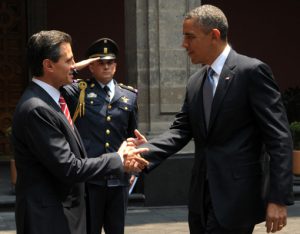
On Thursday, Obama will travel to Mexico, where he will discuss a range of bilateral and regional issues with Mexican President Enrique Peña Nieto. “Building on Mexico’s presidency of the G20 last year, we’ll continue working to sustain the global economic recovery, promote global development and address climate change,” Obama told AQ. The president also highlighted Mexico’s “growing leadership in the region and on the world stage," and praised Mexico’s role in the negotiations around the Trans-Pacific Partnership (TPP), which he expects to be completed by the end of this year. He emphasized that TPP would bring “rewards [that] would be substantial for all our countries.”

On Friday, Obama will travel to Costa Rica, where he will meet President Laura Chinchilla and other Centro American leaders at the Central American Integration System (Sistema de Integración Centroamericana—SICA) summit in San José. During this meeting, Obama will draw attention to the importance of finding new ways to involve governments, the private sector and civil society in reducing crime and violence, as well as encourage regional partners to address citizen security from a more holistic perspective. Energy security and cooperation to provide clean and affordable energy also will be on the agenda.

Immigration will be a backdrop to the president’s discussions given the large number of Central American and Mexican migrants in the United States. Here, Obama reaffirmed his commitment to pass bipartisan comprehensive immigration reform as soon as possible to take advantage of the significant contributions that immigrants make to the U.S. economy. “We need to fix our broken immigration system to make sure that every business and every worker in the United States is playing by the same set of rules,” he said.

Read President Obama’s exclusive interview for Americas Quarterly here.

Tags: President Barack Obama, Latin America, Mexico, Costa Rica, SICA

North American Leaders Discuss Trade, Security at Summit

April 3, 2012

by AQ Online

President Barack Obama hosted Canadian Prime Minister Stephen Harper and Mexican President Felipe Calderón for the sixth annual North American Leaders summit at the White House on Monday. The summit featured a two-hour, closed-door meeting and a joint press conference where the three heads of state issued a joint statement outlining their plans.

Trade between the three countries, which exceeded $1 trillion for the first time last year, topped the agenda. President Obama said North American trade is an important driver of job creation, and said the three leaders agreed to “simplify and eliminate more regulations that will make our joint economies stronger.” Prime Minister Harper, who will travel to Chile later this month, said that Canada seeks to improve trade relations with the U.S. and Mexico, as well as other Latin American countries.

The three heads of state also discussed regional issues, such as crime, energy, immigration, and the drug war. In his statement to the press, President Calderón once again called on the U.S. Congress to stem the illegal flow of American weapons into Mexico. “The expiration of the assault weapons ban in the year 2004 coincided almost exactly with the beginning of the harshest period of violence we’ve ever seen,” said Calderón.

President Obama responded by saying that while the U.S. is actively preventing illegal gun trafficking, but more can be done to stop the violence plaguing Mexico. Absent from the press conference was any mention of the controversial Keystone XL pipeline that would transport oil from Canada’s oil sands to the United States. Obama tabled the issue last November, which drew criticism from Prime Minister Harper.

The three heads of state will meet again at the Summit of the Americas in Cartagena, Colombia on April 14 and 15.

Tags: President Felipe Calderon, Prime Minister Stephen Harper, President Barack Obama, North American Summit, Three Amigos Summit, North American Trade, Arms Trafficking

Weekly Roundup from Across the Americas

March 22, 2012

by AS-COA Online

From Americas Society/Council of the Americas. AS/COA Online's news brief examines the major—as well as some of the overlooked—events and stories occurring across the Americas. Check back every Wednesday for the weekly roundup.

Strong Earthquake Rocks Mexico

The largest earthquake since 1985 rocked Mexico on Tuesday, with the U.S. Geological Survey placing the epicenter near the border between the southern states of Oaxaca and Guerrero, and giving it a 7.4 rating on the Richter scale. Compared to the 8-point earthquake in 1985, which killed at least 10,000 people and destroyed parts of the capital, Tuesday’s earthquake resulted in no reported deaths and light damage. Officials attributed the lack of destruction to stronger building standards set after the 1985 quake. Mexican daily El Universal offers images and video of damage resulting from yesterday’s quake.

Mexico and Cuba Prepare for Six-Day Papal Visit

On Friday, Pope Benedict XVI arrives in Mexico, for a three-day visit before going to Cuba until March 28. While the Vatican says the visit is purely for religious aims, the pope could play a political role in both countries. The Washington Post reports that, in Mexico, where presidential campaigning officially begins next week, the visit could bring support to President Felipe Calderón’s National Action Party, which is close to the Church. In Cuba, the pope may look to expand the Church’s role following a religious opening in the 1990s. “Now the Church is an umbrella for many groups who seek more space for social action. This pope will try to strengthen this space, to try to position the Church to play a strong role in Cuba,” said Eduardo Barranco, a Catholicism specialist at the Center for Religious Studies in Mexico.

Read an AS/COA Online News Analysis about the pope’s upcoming visit to the region.

Ruling-Party Candidate Drops Five Points in Mexican Polls

A recent poll by GEA/ISA registered a 5-point drop for Mexican National Action Party (PAN) candidate Josefina Vázquez Mota, decreasing from 36 percent to 31 percent of expected votes. The poll widens the gap between Vázquez Mota and frontrunner Enrique Peña Nieto of the Institutional Revolutionary Party (PRI), whose lead grew from 43 to 48 percent. The third major candidate in the campaign, the Party of the Democratic Revolution’s (PRD) Andrés Manuel López Obrador, retained 21 percent. The decline for Vázquez Mota comes after her poorly attended inauguration as the PAN’s candidate, which took place in a stadium where crowds left due to delays. 

Mexico to Be World’s Seventh-Largest Economy by 2020

A recent report by Goldman Sachs predicts that Mexico will become the world’s seventh-largest economy by 2020. By that year, Mexico should contribute 7.8 percent to global GDP, more than India or Russia, two of the so-called BRICS countries. Goldman Sachs, which created the concept of the BRICS, said it previously excluded Mexico from the BRICS because it was not growing at the same rate as countries like Brazil or China. This year, Mexico’s GDP should grow by 3.6 percent—equal to Brazil’s expected growth. 

Read More

Tags: President Barack Obama, Keystone XL pipeline, Mexico Earthquake, Papal Visit, Mexican Elections

Obama Makes Rare Presidential Visit to Puerto Rico

June 14, 2011

by AQ Online

President Barack Obama arrived in Puerto Rico today, marking the first time in 50 years that a current U.S. president has visited the island. The five-hour trip kicked off with a brief speech in San Juan where the president supported a referendum for Puerto Rico residents to decide their political status—the options being statehood, independence or remaining a commonwealth. He will deliver a longer address during a visit with Puerto Rican Governor Luis Fortuño at the governor’s mansion where he is expected to discuss the $7 billion stimulus package granted to Puerto Rico and its effect on the island’s 16 percent unemployment rate.

According to the Cecilia Muñoz, White House director of intergovernmental affairs, the visit demonstrates that the Obama administration has prioritized Puerto Rico’s economic and political affairs. Shortly after taking office, Obama expanded a presidential task force on Puerto Rico’s political status created by former President Clinton in 2000 and chaired by Ms. Muñoz.

Following trips to North Carolina and Florida where jobs and the economy were the topics of interest, today’s trip to Puerto Rico is also a sign that the President is gearing up for the 2012 campaign. Though Puerto Ricans who live on the island cannot vote in the presidential election, frequent migration and strong ties between Puerto Rico and U.S. cities like New York and Florida give the president an audience that extends far beyond the residents of San Juan. 4.5 million Puerto Ricans live in the mainland United States.

Today’s visit is a chance for the president to address the booming Latino electorate on the mainland. He will no doubt remind his audience that he has appointed more Latinos to his presidential cabinet than any other president in American history, along with Supreme Court Justice Sonya Sotomayor.

Tags: Immigration, Puerto Rico, President Barack Obama, 2012 Presidential Campaign, Hispanic Voters

Weekly Roundup from Across the Americas

May 13, 2011

by AS-COA Online

From Americas Society/Council of the Americas. AS/COA Online's news brief examines the major—as well as some of the overlooked—events and stories occurring across the Americas. Check back every Wednesday for the weekly roundup.

Sign up to receive the Weekly Roundup via email.

Calderón on NorthAm Integration, Clinton on Hemispheric Cooperation

U.S. Secretary of State Hillary Clinton offered her views on U.S. collaboration with Latin America in a new era at the 41st Annual Washington Conference on the Americas, saying: “We are interdependent, and we have to deal with the real questions that interdependence poses.” The secretary talked on a range of hemispheric issues, from the near-term goal of approving Colombian and Panamanian trade deals to academic exchange, institution building, and security pacts. Mexican President Felipe Calderón closed the conference by talking about the need to deepen North American integration, and said: “The closer we are, the more competitive we will be, and the faster we will grow.” Calderón called the current U.S. immigration system “broken” and described it as a “bottleneck for growth and prosperity.” He also called for U.S. leadership on climate change and bilateral security issues, pointing out that winning Mexico’s fight against organized crime required Washington’s collaboration to tackle arms trafficking, money laundering, and drug consumption in the United States.

Other speakers at the conference included Salvadoran President Mauricio Funes, U.S. Senator John McCain, and U.S. Secretary of the Interior Ken Salazar. Get complete coverage at AS/COA Online

Obama Steps up Call for Immigration Reform

President Barack Obama gave a major speech in El Paso on May 10, calling for comprehensive immigration reform that would include a path to citizenship for the country’s estimated 11 million undocumented immigrants. It was the fourth major event over the last three weeks in which Obama continued his push for reform, though he did not clarify when legislation will come or how he will win over opponents in the Republican-controlled House of Representatives. 

Read an AQ blog post by Senior Editor Jason Marczak about the renewed call for immigration reform. 

Read More

Tags: Hillary Clinton, President Zelaya, President Felipe Calderon, President Barack Obama, DREAM Act, President Alfonso Portillo

Weekly Roundup from Across the Americas

March 16, 2011

by AS-COA Online

From the Americas Society/Council of the Americas. AS/COA Online's news brief examines the major—as well as some of the overlooked—events and stories occurring across the Americas. Check back every Wednesday for the weekly roundup.

Sign up to receive the Weekly Roundup via email.

Previewing Obama’s Latin America Trip

A March 15 White House press gaggle with U.S. Deputy National Security Advisor for International Economic Affairs Mike Froman offered a preview of President Barack Obama’s trip to Brazil, Chile, and El Salvador from March 19 to 23. Froman focused on Latin America’s economic strides, saying: “[T]his trip fundamentally is about the U.S. recovery, U.S. exports, and the critical relationship that Latin America plays in our economic future and jobs here in the United States.” He also indicated that energy, infrastructure, and trade would serve as focus areas during the tour and that a CEO Forum will be held in Brasilia during Obama’s stop there. Several U.S. secretaries will join Obama for the Brazil portion of the trip, including Treasury Secretary Timothy Geithner, Commerce Secretary Gary Locke, and Energy Secretary Steven Chu.

In a follow-up White House press conference on March 16, Deputy National Security Advisor Ben Rhodes confirmed that Obama will deliver a speech spelling out the administration’s “approach on Latin America” while in Santiago on Monday. According to the Associated Press, Rhodes suggested “Obama will highlight the democratic transitions that swept through Latin America as a model for Middle Eastern countries that are facing challenges to their autocratic regimes.”

In preparation for the trip, the Obama administration also released two fact sheets, one on U.S. relations with Central and South America and the second focused on economic ties with Brazil

Visit AS/COA Online ahead of and during the president’s trip to Latin America for ongoing coverage. AmericasQuarterly.org carries an “Issues in Depth” page on the Obama tour. Also follow AS/COA on Twitter (@ascoa) and Facebook.

Brazil’s Ex-ForeignMin Makes Case for UN Security Council Seat

Celso Amorim, who served as Brazil’s foreign minister during the Luiz Inácio “Lula” da Silva administration, called upon President Obama to support Brazil’s inclusion in a reformed U.N. Security Council. “It would be a disappointment if Obama does not endorse our drive for a permanent seat on the world’s premier international security body,” Amorim writes for Foreign Policy. “Not just because Brazil deserves a seat but because the council’s very legitimacy depends on the inclusion of emerging powers.”

Funes’ Agenda for Obama’s Visit

Diana Villers Negroponte, a Brookings Institution senior fellow, outlines what to expect when U.S. President Barack Obama stops in San Salvador next week during his Latin American tour. She writes that Salvadoran President Mauricio Funes will seek Washington’s partnership on recognizing poverty-eradication efforts, combating organized crime, providing equipment and training for an El Salvador-based security plan, supporting an IMF plan to offset effects of the economic crisis, and increasing U.S. private investment in the energy sector. “By his visit, Obama is signaling assurance in the Funes government’s capacity to rebuild the economy, distribute wealth, and contain the violence,” says Negroponte. “We must hope that foreign investors will build upon this assurance to develop manufacturing plants, alternative energy production and agro-industrial businesses.”

Read More

Tags: Hispanics, President Barack Obama, Haitian Elections

The Rising Importance of Major Cities

October 6, 2010

by John Parisella

Last week, the chief of staff to President Obama, Rahm Emanuel, chose to leave arguably the second most powerful position in the U.S. government to run for mayor of Chicago. Quite a development but one that shows the lure of a major city to someone as powerful as Mr. Emanuel.

But this is not that surprising when we recall how New York Mayor Rudy Giuliani captured the mood of America after 9/11, and how the influence of a mayor can occasionally transcend the actual city he leads. When Mayor Bloomberg recently exercised a leadership moment on the controversy regarding the mosque at Ground Zero, he ended up framing the national debate on this sensitive and controversial subject. Like it or not, cities and their first administrators are being called upon to play a greater role on issues affecting more than their actual jurisdictions and this is a welcome development.
 
Whether it has to do with climate change and other environmental concerns, it is obvious that large cities have a greater responsibility because of the density of their populations and their jurisdiction over local public transportation. If the issue revolves around employment, cities can play a pivotal role in keeping and in creating jobs by virtue of the quality of life they offer and their receptivity to businesses. When it comes to security and crime, city officials are the best guarantee for the needed security to enhance community life. And when we search for creativity and cultural expression, increasingly we see the inspiration and leadership coming from cities and their artistic communities.
 
Just last week the Mayor of Montréal Gérald Tremblay visited New York City on a trade mission with a special emphasis on creativity and as part of the city’s delegation to Advertising Week. To different and prestigious audiences, he articulated the many ways that Montréal and New York City have so much in common and how they have and can continue to cooperate in the future. The mayor’s enthusiasm extended to supporting a high-speed rail link between these two diverse and creative cities that are only 370 miles apart. We can expect more talk of common purpose in the months ahead from other mayors. Why, then, should we pay so much attention to cities?

Read More

Tags: President Barack Obama, Rahm Emanuel, Rudy Guiliani, Mayor Bloomberg, Gérald Tremblay, C40 Large Cities Climate Leadership Group, The International Cities of Peace

Honduran President Tours U.S.

April 28, 2010

by AQ Online

President Porfirio Lobo arrived early this week on his first visit to the United States since he won Honduras’ presidential elections in November 2009. On Tuesday, he spoke at the University of Miami, which followed earlier stops in New Orleans to meet with business leaders and build relationships with local universities.

High on the president’s foreign policy agenda are the reinstatement of Honduras in the Organization of American States (OAS) and greater diplomatic recognition of his administration’s legitimacy by other Latin American countries. He is also preparing for the start next week of a truth commission, which will investigate events surrounding the 2009 coup that ousted former President Manuel Zelaya.

Reports surfaced Monday that President Barack Obama had for the first time phoned President Lobo to discuss the situation in Honduras. President Obama commended Mr. Lobo for his "leadership in his first months in office in promoting national reconciliation and restoring democratic and constitutional order in Honduras," according to a White House statement. Mr. Lobo’s message to his U.S. audiences: ``My duty and my mandate are clear: to unite my people. And I will do it,'' Lobo says, ``I will get everybody who was fighting in 2009 to hug. They will. It's important for them to reconcile.''

Tags: President Porfirio Lobo, President Barack Obama, Honduras truth commission


Connect with AQ


Twitter YouTube Itunes App Store


Issues in Depth: President Obama's travel to Mexico, Costa Rica

AQ's coverage and post-trip analysis of the President's May 2-4 visit.

» Read more.


WEB EXCLUSIVES

Most Popular

MOST POPULAR ON AQ ONLINE

  • Most Viewed
  • Past:
  • 1 day
  • 1 week
  • 1 month
  • 1 year

NOW ON AS/COA ONLINE

Loading...

AQ MEDIA PARTNER

Loading...