
btn_subscribe-top
btn_give-a-gift
btn_login
btn_signup
btn_rss

Facundo Cabral Murder Revisited in Nicaraguan Trial

August 23, 2012

by AQ Online


A Nicaraguan court began the trial Wednesday of Henry Fariñas, the Nicaraguan businessman who was accompanying Argentine folksinger Facundo Cabral to the Guatemala City airport on July 9, 2011, when Cabral was shot and killed by assailants. The trial of Fariñas could shed some light on the motivations behind the murder of Cabral, who was touring in Guatemala at the time of his death at age 74.

Guatemalan authorities said that Fariñas was the intended target of the July 2011 assassination, allegedly masterminded by Costa Rican Alejandro Jiménez. Both Jiménez and Fariñas have been accused of trafficking drugs from Costa Rica to Nicaragua for the “Los Charros” gang, which is linked to Colombian and Mexican drug cartels.

Jiménez allegedly ordered the attack on Fariñas in retaliation for a supposed betrayal, but Cabral, known as a voice of popular resistance during the 1976-1983 Argentine dictatorship, was killed instead.

Fariñas will stand trial with 23 other defendants, including members of his family and Julio César Osuna, an ex-magistrate for the Supreme Electoral Council of Nicaragua, for collaborating with drug cartels in various Latin American countries and for laundering more than $1 billion in drug money in Nicaragua. Jiménez, jailed in Guatemala, is being tried in Nicaragua in absentia.

Carlos Javier Chavarría, Fariñas’ lawyer, has said that charges against his client are false, arguing that Fariñas was not in fact the owner of a night club known as “Club Nocturno Elite” that is central in his supposed dispute with Jiménez. Jiménez allegedly sought to kill Fariñas because he refused to sell him the club, although there are other versions of what motivated the assassination attempt.

Nicaraguan judge Adela Cardoza will preside over the trial, which began Wednesday in Managua.

Tags: Nicaragua, Drug Trafficking, Facundo Cabral, Henry Fariñas

Recasting the Security Policy in Central America

May 10, 2012

by José Miguel Cruz

In the mid-1990s, the Inter-American Development Bank published various reports indicating that El Salvador and Guatemala had the highest homicide rates in Latin America. Fast-forward sixteen years later and these two countries form, along with neighboring Honduras, the most violent region in the world by all accounts.

With a combined population of 28 million, Guatemala, Honduras, and El Salvador constitute the northern triangle of Central America; a sub-region that has experienced almost twice-as-much violence as Mexico has since 2006, when Calderon’s war on drugs started. According to official data, approximately 50 thousand people have been killed in Mexico since 2006. In contrast, the northern triangle, with a population four times smaller than Mexico, has endured nearly 90,000 murders during that same period. But while Mexico, with an annual homicide rate of 18 deaths per one hundred thousand inhabitants, is a tragedy, the northern triangle, with average homicide rates surpassing 60 per one hundred thousand, is a catastrophe.

Many believe that the appalling rates of violence in the sub-region are the result of the penetration of Mexican and Colombian drug cartels.  According to this argument, in their effort to control the drug routes from South America to the United States, criminal organizations are not only bringing unparalleled violence to Central America, but also taking over highly fragile public institutions.  The logical extension of this argument then is that this relentless assault of transnational gangs can only be addressed with greater police and military force.

Although the presence of criminal cartels has undeniably contributed to the skyrocketing violence in the northern triangle, the fundamental problem of security in Central America does not have to do merely with drug traffickers—or social conditions, for that matter. It has to do with government institutions.  It has to do with local political and criminal-justice organizations that are extremely corrupt. It has to do with institutions that have been historically pervaded by local criminal lords, death squads, crooked politicians, and vicious paramilitaries who were present long before the Mexican Zetas or the Colombian syndicates began crowding the illegal enterprises of the region. 

Read More

Tags: Central America, El Salvador, Mexico, Nicaragua, Honduras, Guatemala, Los Zetas, Crime and Security, Otto Perez Molina

Chile Most Inclusive Country in Hemisphere, Says AQ Study

April 26, 2012

by AQ Online

With today’s release of its Spring 2012 issue, Americas Quarterly has unveiled a new index that measures social inclusion in the Americas. This ranking evaluates 15 different indicators and compares them across 11 countries in the hemisphere. The variables include a country’s economic competitiveness, percent of national GDP spent on social programs, level of political and civil freedoms, and citizen perception of personal empowerment and government responsiveness in that country.

Out of a maximum of 100, Chile came out on top with a score of 71.9, while Guatemala ranked lowest at 7.5. The index praises Chile’s “consistently high rankings across almost all indicators” and cites “severe inequalities by race and ethnicity” in the case of Guatemala, adding that “Indigenous and Afro-Guatemalans lag far behind” socioeconomically. Uruguay and Brazil ranked second and third, respectively.

For four variables—enrollment in secondary school, percent of population living on more than $4 per day, access to adequate housing, and percent of population with access to a formal job—Americas Quarterly uses data collected by the World Bank in household surveys and disaggregated by race and gender.

According to the index, social inclusion is defined as “the concept that a citizen has the ability to participate in the basic political, economic and social functioning of his or her society. It includes not just economic empowerment, but also access to basic social services, access to infrastructure (physical and institutional), access to the formal labor market, civil and political participation and voice, and the absence of legally sanctioned discrimination based on race, ethnicity or gender.”

Access the full results of—and methodology behind—AQ’s social inclusion index.

Tags: Chile, Peru, Brazil, Bolivia, Mexico, Colombia, Nicaragua, Guatemala, Social inclusion, poverty, Ecuador, Uruguay, Paraguay

DC Water Cooler: Hold Drops and Ambassador Swaps

April 11, 2012

by Liz Harper

On March 29, the U.S. Senate confirmed several of President Obama’s diplomatic nominations, many of whom were tapped to serve in the State Department’s Bureau of Western Hemisphere Affairs (WHA). Here’s a brief rundown of the confirmed WHA officials and their new positions: Roberta Jacobson, Assistant Secretary of State for Western Hemisphere Affairs; Larry Palmer, Ambassador to Barbados; Pamela White, Ambassador to Haiti; Phyllis Powers, Ambassador to Nicaragua; Jonathan Farrar, Ambassador to Panama; and Julissa Reynoso, Ambassador to Uruguay.    

Not only do these confirmations provide a celebratory sense of relief, as many of these officials waited months for their nominations to proceed through the Senate, but the timing could not be better as the U.S. delegation prepares to depart for Cartagena, Colombia, to attend this weekend’s Sixth Summit of the Americas.

Jacobson was nominated in late September after becoming acting assistant secretary in July 2011 when her predecessor, Arturo Valenzuela, returned to academia. It’s both notable and laudable that a woman is leading WHA for the first time.  

Jacobson’s candidature was challenged by Cuban-American Senator Marco Rubio (R-FL), who placed a hold on her nomination last November with a call to the Obama administration to “review abuses in the people-to-people Cuba travel policy.” Rubio dropped his hold on March 22 following guarantees from the State Department that it would require “applicants to demonstrate how their itineraries constitute purposeful travel that would support civil society in Cuba and help promote their independence from Cuban authorities,” according to the senator’s news release.

Read More

Tags: Bolivia, Panama, Venezuela, Barbados, Nicaragua, Ecuador, Haiti, U.S. Department of State, Roberta Jacobson

Monday Memo: AQ’s Top-Five Expected Stories for the Week of March 12-16

March 12, 2012

by AQ Online

Top stories this week are likely to include: U.S. congressional interest in Iranian activity in Latin America; Brazil responds to low 2011 growth numbers; Hugo Chávez returns from Cuba; drug legalization to be a topic of debate at the Summit of the Americas; and Costa Rica and Nicaragua agree to cooperate on their shared border.

Congress To Demand Iran Knowledge: The Foreign Affairs Committee of the U.S. House of Representatives last week passed H.R. 3783, also known as the “Countering Iran in the Western Hemisphere Act.” The bill, which will advance to consideration by the full House in the near future, requests that the State Department provide Congress with a detailed report of the activities that Iranian agents and proxy organizations Hezbollah and Hamas are undertaking in the Western Hemisphere. AQ Editor-in-Chief Christopher Sabatini said in The Washington Times that the legislation “smacks of Cold War backyardism” because Iran’s presence in Latin America is the only Latin America-related issue that is being discussed in the 2012 presidential campaign rather than, say, the rise of Brazil.

Brazil Adjusts to Low 2011 Growth: After the Instituto Brasileiro de Georgrafia e Estatística (Brazilian Institute of Geography and Statistics) reported a 2.7-percentage GDP growth in 2011, Brazil’s central bank cut the key Selic interest rate by 75 basis points last Thursday to 9.75 percent. What does this mean going forward? AQ Senior Editor Jason Marczak observes: “Although economic growth in 2011 was 5 percentage points below that of 2010, this must be looked at in context with the global situation and the fact that 2010 growth was the highest in 25 years; plus, these latest numbers also show that Brazil overtook the United Kingdom to become the world’s sixth biggest economy. Still, expect the rolling out of various measures to boost growth before voters head to the polls in October’s municipal elections.”

Chávez Returns Home: Venezuelan President Hugo Chávez will return home this week after recovering from another surgery in Cuba to remove a malignant lesion. Colombian President Juan Manuel Santos confirmed the news after traveling to Havana last week. Cubadebate reports that Chávez will immediately begin his electoral campaign for president ahead of the October elections. Expect the populist leader to be publicly energetic while the Venezuelan electorate remains highly skeptical over his long-term health.

Drug Legalization at the Summit: The number-one topic of debate during U.S. Vice President’s visit to Mexico and Honduras last week, drug legalization will be an agenda item at the Sixth Summit of the Americas next month in Cartagena, Colombia. Marczak says: “U.S. willingness to discuss drug legalization shows that the Obama administration is listening to the frustrations of various countries that are seeing legalization as a possible way to reduce the violence inflicted by the narcotics trade. Still, opening it up to discussion does not mean that the U.S. has shifted in its rejection of legalization.”

Nicaraguan–Costa Rican Coordination: The announcement last week that Nicaragua and Costa Rica would jointly coordinate on security matters related to their shared border is welcome news amid their longstanding border dispute over the island of Calero. The Calero incident “was a sharp reminder that border conflicts persist in the region. While this one looks fortunately to be resolved, there are at least a half-dozen others that could flare given the political differences in the region,” notes Sabatini.

Tags: Summit of the Americas, Costa Rica, Cuba, Brazil, Colombia, Venezuela, Nicaragua, Hugo Chavez, Juan Manuel Santos, Iran

Ahmadinejad and Chávez Hold Bilateral Meetings in Caracas Today

January 9, 2012

by AQ Online

Iranian President Mahmoud Ahmadinejad arrived in Venezuela yesterday afternoon to kick off his four-country tour of Latin America that will also include stops in Nicaragua, Cuba and Ecuador. The Iranian head of state may also attend the January 14 inauguration of Guatemalan President-elect Otto Pérez Molina. Ahmadinejad is accompanied by several members of his cabinet, including the ministers of foreign affairs, economy, industry, and energy.

Ahmadinejad was greeted at the airport yesterday by Venezuelan Vice President Elías Jaua and will meet today with President Hugo Chávez—who was in the eastern city of Puerto La Cruz filming Aló Presidente yesterday. At a critical juncture when Iran faces global concern over its nuclear program, including tough UN sanctions and even tougher additional U.S.- and EU-led sanctions, Washington worries that Venezuela will undermine those restrictions by sending oil and money to Ahmadinejad’s embattled regime. The U.S. already placed sanctions on PDVSA, Venezuela’s state-run oil company, in May 2011 for doing business with Iran.

Over their years-long friendship, Chávez and Ahmadinejad have signed roughly 270 accords on issues like trade, construction, energy, and banking. In addition to Venezuela, Nicaragua, Cuba and Ecuador make up part of the Chávez-inspired Bolivarian Alliance for the Americas—the so-called “anti-imperialist” bloc of eight Latin American and Caribbean nations. Guatemala also plays an important role in global governance; it was recently awarded a temporary, two-year seat on the UN Security Council.

Ahmadinejad originally planned to visit Venezuela last September after the UN General Assembly, but cancelled at the last minute due to Chávez’ chemotherapy treatments in his recovery from cancer. Both Ahmadinejad and Chávez will fly tomorrow to Nicaragua to attend Nicaraguan President Daniel Ortega’s inauguration for a second consecutive term—an event that Chávez cites as the “central purpose” of Ahmadinejad’s Latin American tour.

View a video of Ahmadinejad's arrival in Caracas:

Tags: Cuba, Venezuela, Nicaragua, Guatemala, Ecuador, Hugo Chavez, Daniel Ortega, Iran, Mahmoud Ahmadinejad

Guatemala, Nicaragua Decide in Presidential Election

November 7, 2011

by AQ Online

Guatemala and Nicaragua went to the polls yesterday to (re)elect their presidents; Otto Pérez Molina was declared the victor in Guatemala, while Nicaragua is still tabulating its votes. Pérez Molina, of the Partido Patriota (Patriot Party–PP) defeated Manuel Baldizón of the Libertad Democrática Renovada (Renewed Democratic Freedom–LIDER) party in Guatemala’s runoff election. Neither candidate had secured a majority vote in the September 11 primary.

Guatemala’s election authority, the Tribuno Supremo Electoral, notes that the PP got 53.8 percent of the vote and LIDER 46.2 percent. Pérez Molina, a former army general, has pledged to tackle Guatemala’s widespread crime and insecurity with a mano dura (firm hand), partly through hiring and training roughly 10,000 additional police officers and 2500 more soldiers.

This year’s election was historic for Guatemala because a woman—Roxana Baldetti—will assume the vice-presidency for the first time. Baldetti, a sitting congresswoman, has been a driving force in the PP calling for transparency in Guatemalan politics. She and Pérez Molina have campaigned on the promise to continue the inclusive, pro-poor programs of Sandra Torres, Guatemala’s first lady, which are highly popular. 

In Nicaragua, President Daniel Ortega and his Frente Sandinista de Liberación Nacional (Sandinista Front of National Liberation—FSLN) are leading in the vote count. Nicaraguan daily La Prensa is reporting that, with 38.8 percent of ballots counted, the FSLN is winning with 63.95 percent, compared to 29.09 percent for its nearest rival, Fabio Gadea of the Partido Liberal Independiente (Liberal Independent Party–PLI). Ortega, who served as president from 1985-1990 and again from 2007 through the present, is widely expected to prevail and assume a third term. Yesterday Ortega’s wife and spokeswoman, Rosario Murillo, proclaimed, “This is the victory of Christianity, socialism and solidarity.”

Tags: Nicaragua, Guatemala, Daniel Ortega, Otto Perez Molina, Roxana Baldetti, Manuel Baldizon

Ortega Leads Polls as Nicaragua Campaign Kicks Off

August 22, 2011

by AQ Online

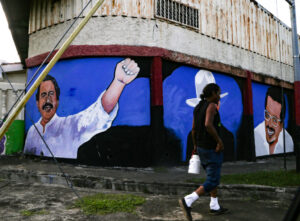
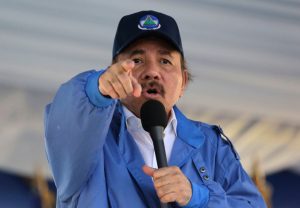
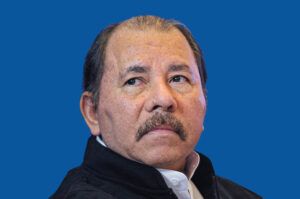
Nicaraguan President Daniel Ortega is the frontrunner candidate in a nationwide presidential campaign that officially began on Saturday in Managua. Mr. Ortega is running for his second consecutive five-year term following a 2009 Supreme Court ruling that overturned a legal prohibition on consecutive reelection. He is facing a fragmented opposition represented by four presidential candidates.

A recent CID-Gallup poll showed Ortega leading the field with 41 percent of voters voicing support for him, while Liberal Constitutional Party candidate Fabio Gadea got 34 percent and former president Arnoldo Aleman won 11 percent. To win the election outright in the first round, the winning candidate must win either 40 percent of the vote or at least 35 percent and a lead of 5 points over the runner up.

Mr. Ortega’s candidacy in this year’s elections has been called unconstitutional by Nicaraguan legal scholars and opposition candidates. Ortega first held the presidency from 1984 to 1990 and began his second term in 2007. He was the only presidential candidate of the Frente Sandinista de Liberacion Nacional (FSLN) party in national elections that took place in 1984, 1990, 1996, 2001, 2006, and now 2011. Nicaraguans will head to the polls on November 6 to determine their country’s future leadership.

Tags: Nicaragua, Daniel Ortega

DC Water Cooler: Vacant Slots at State Reflect Policy Shortcomings

August 18, 2011

by Liz Harper

The tweeting Georgetown academic, former Assistant Secretary of State for Western Hemisphere Affairs Arturo Valenzuela, announced his departure in early May. Four months later, the United States still does not have a nominee. 

Of course, several well-qualified people have been bandied about as Valenzuela’s possible replacement. 

Here’s a brief rundown of who’s been mentioned:

First, there is Kristie Kenney, a highly regarded career Foreign Service officer, a former ambassador to Ecuador, and, as of January, ambassador to Thailand. She is well-known for her social media smarts. There is also William Brownfield who is Kenney’s husband and equally as charismatic and talented as his wife. He is a former ambassador to Colombia, Venezuela and Chile, and became assistant secretary of state for international narcotics and law enforcement affairs in January. And there is Anne Patterson, a career foreign service officer with extensive and varied experience in Latin America. She has proven herself adept at dealing with tough issues especially in her current post as the ambassador to Egypt.

Read More

Tags: Cuba, Nicaragua, Ecuador, State Department, Rafael Correa, Arturo Valenzuela

Ortega Proposes U.S. Compensation for Damages in Civil War

July 20, 2011

by AQ Online

Nicaraguan President Daniel Ortega proposed a referendum on Tuesday that would demand that the U.S. government pay $17 billion in damages to Nicaragua for its role in that country’s civil war in the 1980s. President Ortega made the announcement during a political rally in Managua to celebrate the anniversary of the 1979 ouster of dictator Anastasio Somoza by the Frente Sandinista de Liberación Nacional (FSLN).

The claim of due damages originated in 1986, when the International Court of Justice ruled that the U.S. had violated international law by “training, arming, equipping, financing and supplying the contra forces.” It did not specify an amount for the indemnity. The administration of then-President Ronald Reagan blocked the ruling from being implemented through its power of veto on the UN Security Council. The charge was later dropped by former Nicaraguan President Violeta Chamorro in 1992, and Nicaragua never received compensation.

While Ortega’s proposed referendum drew support from a left-leaning crowd at the rally, Francisco Aguirre Sacasa, an opposition deputy, called the proposal “absurd” and said it would amount to nothing.

President Ortega, who has been in power since 2006, proposed the referendum amid the lead-up to November’s presidential elections, in which he plans to seek a third term.

Tags: Nicaragua, Daniel Ortega, Referendum, International Court of Justice, Contras

Pages


Connect with AQ


Twitter YouTube Itunes App Store


Issues in Depth: President Obama's travel to Mexico, Costa Rica

AQ's coverage and post-trip analysis of the President's May 2-4 visit.

» Read more.


WEB EXCLUSIVES

Most Popular

MOST POPULAR ON AQ ONLINE

  • Most Viewed
  • Past:
  • 1 day
  • 1 week
  • 1 month
  • 1 year

NOW ON AS/COA ONLINE

Loading...

AQ MEDIA PARTNER

Loading...