
![]() |
Thousands of fervent fans will converge in Charlotte, North Carolina today for two games of the much anticipated CONCACAF Gold Cup soccer tournament, which gives national teams from North America, Central America and the Caribbean an early chance to further their World Cup ambitions. Although Charlotte is not widely known as a Hispanic soccer hub and the city has never hosted such an important tournament, millions of viewers from across the hemisphere will tune in tonight as Costa Rica battles El Salvador, and Cuba takes on the Mexico’s national team.
Charlotte first attracted the attention of Gold Cup organizers in 2010 when nearly 65,000 fans packed Bank of America Stadium to watch an exhibition match between Mexico and Iceland. Although soccer has struggled to take hold in much of the United States, support for the sport in Charlotte has been buoyed by Latino immigrants. North Carolina is home to an estimated 410,000 Mexicans, and more than 50,000 Cubans, Costa Ricans and Salvadorans, according to the 2010 census.
Charlotte residents are optimistic that the Gold Cup will boost the local economy. According to the Charlotte Regional Visitor’s Authority, last year’s exhibition brought in $11.6 million, largely from tourists travelling from other states. For today’s games, local Spanish-language radio stations La Voz de Charlotte and La Raza have helped generate hype by giving away free tickets and jerseys and by taking countless calls from soccer enthusiasts.
Since the Gold Cup’s creation in 1991, Mexico has won the tournament five times and the United States, four. But history doesn’t temper the support of fans for underdogs like Costa Rica, El Salvador and Cuba, who have never won. This year’s champion will earn a place in the 2013 FIFA Confederations Cup, a crucial stop on the long road to Rio de Janeiro, Brazil in 2014.
![]() |
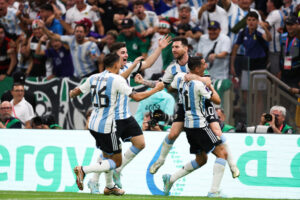
After barely qualifying to play in the FIFA World Cup in South Africa this year, Argentina breezed through group play yesterday defeating Greece, 2-0 and securing a spot in the knockout round of the tournament. The Albicelestes allowed only one goal in group play by the South Korean team, who will accompany the Argentines into the next phase of the tournament.
Argentina’s performance is a turn around for a team whose entry into the tournament wasn’t secured until their last match in the World Cup qualifiers. Stars like Lionel Messi, Carlos Tévez, and Javier Mascherano, have regained their form and have thus far fulfilled expectations.
Arguably, however, Argentina faced no major challengers in group play. The next round will present tougher competitors like Mexico, where there will be no room for errors or slow starts. Overall, Latin America has performed better than most other regions, with six of seven teams either already advancing, or with good odds of advancing in the coming days.
![]() |
The 2010 World Cup may be just months away (June 11 kick-off), but futbol fanatics in Latin America can hardly wait. Impatience is understandable. In Latin America, soccer is more than a sport; it is the sport.
The World Cup generates a nationalist soccer fervor that brews for four years and culminates in a month-long frenzy. Infused with a sense of national pride and collective culture, people rally around their country’s flag, setting aside differences to support their team. It is hard to believe a sports tournament could be a respite from some of the deep political and cultural rifts in Latin America, yet the World Cup always manages to unite people in a phenomenal way.
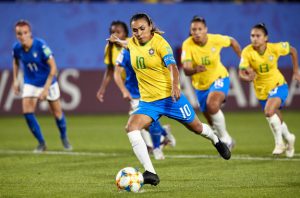
Unfortunately, not every Latin American country can watch their team participate; the qualification round eliminated all but seven nations from the competition. The seven qualified teams represent a broad spectrum of talent; Brazil, the region’s best team, ranks second in the world, while the weakest of the seven, Honduras, is number 34.
How do the Latin American teams as a whole stack up against the other 25 teams, and what are the chances that one of them will hoist the golden trophy?
![]() |
Honduras' soccer win in San Salvador on October 14, guaranteeing a World Cup berth for the Catrachos in South Africa in 2010, has potentially muddled negotiations to resolve the political crisis that erupted on June 28. As I noted in this space last week and also in Sports Illustrated, the prospect of a Honduran berth in the World Cup would provide the de facto government with the opportunity to use the result to rally the population around the flag, potentially providing an excuse to remain intransigent in the face of immense international pressure.
Indeed, with the declaration of yesterday as a national holiday, that is exactly what the Micheletti government did. But wait, it gets even more cynical, because just as the determining game was getting underway in San Salvador, a Micheletti spokesman was walking away from an apparent agreement in principal that had been struck by the opposing parties earlier in the day to resolve the crisis. The calculation now appears to be that the Honduran win will buy additional time for the de facto government in its efforts to keep the deposed president Zelaya holed up in the Brazilian Embassy.
Micheletti’s gambit is only the latest example of a well-worn path in Latin America of attempting to transfer good feelings resulting from international sporting victories to support the government in power. One need only think of the World Cup in Argentina in 1978, for example. More broadly, former Eastern Bloc nations routinely used sport to promote the legitimacy and superiority of their systems internationally, and Cuba continues to do so to this day, though with less overt success. It may be cynical and heavy-handed, but it apparently still works.
![]() |
This Saturday the eyes of much of the hemisphere will be on
In soccer terms, the game is important because a victory by the
A valid case can be made that the game should be played at a Central American venue outside Honduras (or even in the United States: to be honest, the last time Honduras played in the United States it was a virtual home game for los catrachos given the number of national supporters in the stands). Be that as it may, the key now will first and foremost be to ensure the safety of the players and spectators. It will also be to ensure that the excitement surrounding the game remains self-contained. As the brief "soccer war" between Honduras and El Salvador showed in 1969 (also in a World Cup qualifier prior to the 1970 World Cup finals held in Mexico City), soccer games have the potential to ignite passions that simmer over other issues, causing an eruption of popular emotion that could potentially get out of control if not adequately contained. Anyone seeking to stir things up in Honduras—from within or without—might-well attempt to use the passions surrounding the game as a way to provoke an over-reaction by the security forces, which will quickly be condemned by the international community and give the de facto Micheletti government yet another black eye while deepening the crisis further.
![]() |
What is it about South American leaders and public gifts to President Obama? In April, we were treated to the spectacle of Venezuelan President Hugo Chávez giving a copy of Eduardo Galeano’s Open Veins to the U.S. President at the Summit of the Americas in Trinidad—a disingenuous publicity stunt that backfired and stole the headlines from other, more substantive and important issues. And now we have Brazilian President Luiz Inácio Lula da Silva at the G8 summit in Italy giving Obama a soccer jersey signed by all the members of the Brazilian national soccer team.
Now, as a soccer head myself, I can think of no better gift to receive from the Brazilian President than a signed jersey. I certainly hope that it is displayed properly in the White House, and even though there is no record of the First Family having any particular interest in or affinity to soccer, nonetheless this is quite a cool gift. No complaints there. Except one. It was barely a week ago that the United States and Brazil played the championship game of the Confederations Cup in South Africa, the 2010 World Cup host. This was the first time in history that the United States men’s soccer team made it to the final of an extra-regional international soccer tournament. For Brazil, this was old hat, a big yawn, which paled in comparison to their five (yes, five) World Cup Championships. But for the upstart Americans, this was a big deal.