
![]() |
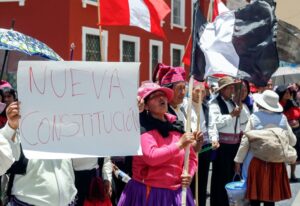
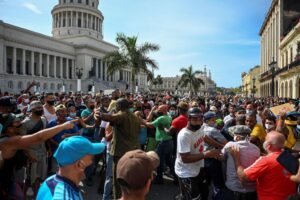
Thousands of Indigenous protestors have mobilized in the highland city of Puno, Peru, this week over fears that a Canadian-led silver mining operation will contaminate water supplies in the area. The protests, which began on Thursday, have largely cut off the city of 120,000 from the rest of Peru, stranded hundreds of foreign tourists who use the town as a staging point for tours of Lake Titicaca, and shut down a nearby border crossing to Bolivia.
According to local reports, these latest protests, which come less than 10 days before Peru’s scheduled second-round presidential elections on June 5, have been accompanied by sporadic violence. "They've started to loot public and private institutions, banks and shopping centers," police officer William Anda said on local radio. In response, President Alan Garcia has authorized the army to prevent escalation, but it has thus far not acted to put down the protests by force.
In a statement, Andrew Swarthout, CEO of the mining firm Bear Creek, which holds the concessions over the areas in dispute, attributed the protests to pre-election political tension, "which have arisen from communities distant from and unaffected by the Santa Ana Project." Hernán Cauna, a protest leader, declared: "We will defend our land until the very end, even though the state is causing pressure by mobilizing their armed forces and police.”
![]() |
In advance of world leaders coming to Toronto and Huntsville, Ontario, on June 25, Canadian police have displayed the security measures that will be used to deter protesters, which will include thousands of federal, provincial and municipal police officers on horseback and motorcycles as well as officers in riot gear with SWAT and police snipers on high alert.
Police also have purchased Long Range Acoustic Devices, also known as sound cannons, to control the anticipated crowds. These are similar to those used at the last G20 summit held in Pittsburgh last year. Preparations in Toronto—the site of this month’s G20 summit—have included adding 77 closed circuit security cameras in downtown Toronto as an additional safety measure.
Some members of the Liberal party as well as of the New Democratic Party have called for an investigation into thee cost of security for the G20 summit. Slated to be the most expensive security operation in Canadian history, Auditor General Sheila Fraser will investigate the $800 million and rising price tag for the summit. Costs are estimated to reach nearly $1 billion at the summit’s conclusion.
Previous G20 meetings have each been expensive but have varied widely in cost depending on location. Security for last year’s summit held in London cost $30 million while the summit held in Japan two years ago cost closer to $300 million. Security expenses for this year’s summit increased when Canada agreed to host both the G20 and the G8 summit (in Huntsville).
![]() |
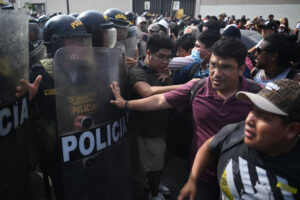
The southern province of Abancay in Peru’s Apurímac region, known for copper and iron mines, is under police and military control to prevent further disruption from protesters who demand a greater share of the region’s budget. The state of emergency, declared Wednesday, will last for 60 days. Civil liberties have been suspended and public transportation is restricted in Abancay City, the region’s capital.
Protesters accuse David Salazar, president of the seven provinces in the Apurímac region, of allocating half of the region’s funds to the province of Andahuaylas, which has a historical rivalry with Abancay province.
On Nov. 20, clashes between police and union members who had gone on strike demanding the resignation of Salazar left 87 people injured. The Peruvian government fears the strikes and protests could effect mining operations in the region that are heavily backed by foreign capital. Total investment in Peru’s mines amounts to around $20 billion.
Peru's President of the Council of Ministers, Javier Velásquez Quesquén, said the protests are politically motivated. “We are not cutting the budget for Apurimac region. In fact it is increasing. The issue is the distribution, but even so, this is a political issue," he said.
![]() |
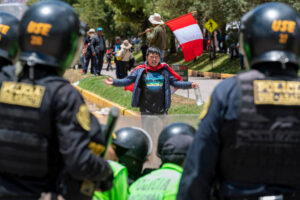
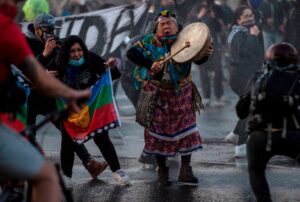
Nearly 50 wounded protestors may be sent to jail as soon as they are released by doctors, according to AIDESEP, Peru’s main Amazon Indian confederation. Santiago Manuin, the prominent Awajun Indian leader, is among them and will be jailed and tried on charges of inciting murder once he recovers from injuries suffered from police bullets during a June 5 demonstration over the government’s plan to allow development on traditional indigenous lands in the Amazon.
According to the UN special envoy on indigenous rights, James Anaya, it will be difficult to resolve the dispute, which involves some 350,000 members of the Amazon indigenous community, if the government treats the protest leaders as criminals.
Many other Peruvian indigenous wounded in the protests have not sought out medical attention because of fears that they too will be arrested. Three officials of AIDESEP, including its top leader Alberto Pizango, have taken asylum in Nicaragua to avoid sedition and rebellion charges.
![]() |
An Ipsos Apoyo survey published yesterday by El Comercio reported that President Alan García’s popularity had reached 27 percent by mid-July, a 6 percent increase from last month. The survey, conducted from July 15-17, also revealed that only 20 percent of the population supports the naming of Javier Velásquez Quesquén as prime minister—a contrast with the 41 percent that supported the previous prime minister, Yehude Simon, when he took the post last October.
García’s higher approval ratings may be a result of his decision to reshuffle the cabinet after indigenous protests turned deadly in early June. The protests revolved around a set of decrees that protesters said violated their ancestral claims on land and resources in the region. Infringement on indigenous land rights is a concern in Peru and in other countries where “territories have not been properly delimited,” according to Katya Salazar and Javier La Rosa in their article for the Summer issue of Americas Quarterly released today.
![]() |
Calls for better infrastructure and government services have intensified after an elderly woman died of respiratory failure yesterday, which reports indicate was the result of police use of tear gas against protestors in the province of Santiago. Colonel Jesus Cordero Parderes, the regional police spokesman, denied accusations that the police used tear gas and rejected linking the woman's death with police actions. During another protest last Friday in Los Guandules in southwest Santiago, a young man was injured with a bullet and five people were detained in a demonstration calling for road improvements and demanding greater attention to the recent power shortages.
The Broad Front for the Popular Struggle (FALPO) organized protests across Santiago province to demand better public services. Victor Breton, a leader of FALPO, said that the protests are calling for an end to the blackouts, better access to drinking water, improvements in local roads, and better security for the residents, among other demands.
There has been a history of clashes between FALPO and the police in the Dominican Republic and accusations of police misconduct, particularly during protests at the time of the economic crisis in 2003 and previous power shortages. In 2004, during a demonstration in Navarrete, Santiago, a member of FALPO was fatally shot by a police officer, and in 2007, a spokesman for FALPO was also killed.
AQ's coverage and post-trip analysis of the President's May 2-4 visit.