
btn_subscribe-top
btn_give-a-gift
btn_login
btn_signup
btn_rss

Chilean State Sued Over Prohibition of Same-Sex Marriage

September 4, 2012

by AQ Online

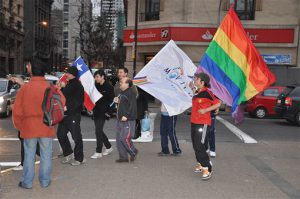
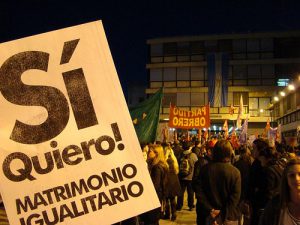
The Chilean Movement for Sexual Minorities (Movimiento de Integración y Liberación Homosexual—Movilh) filed a lawsuit against the Chilean State to the Inter-American Court of Human Rights (IACHR) on Monday. The action followed the Supreme Court’s rejection of a protection claim presented by three gay couples that were denied the possibility to get married. The Chilean Congress is the only organ that can modify the law, which currently authorizes heterosexual unions only.

Rolando Jiménez, head of Movilh, claims that Chile violates at least five articles in the American Convention of Human Rights by prohibiting same sex marriages in the country. Aiming to pressure for legalization, this is the first lawsuit of its kind to be presented to the regional body. The action was filed by renowned lawyers Ciro Colombara and Branislav Marelic, along with Hunter T. Carter, same-sex marriage activist in the United States.

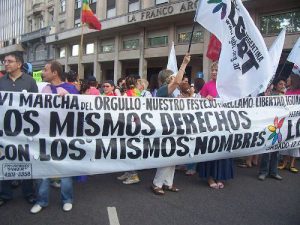
The debate on gay rights in Chile is not new. Recent acts of violence and international pressure have revealed the pressing need for lawmaking in support of LGBT rights in Chile. A recent study by Radio Cooperativa showed that 54.9 percent of Chileans support same-sex marriage, and in 2011 President Sebastián Piñera sent a proposal to Congress seeking to legalize same-sex civil unions.

Despite these and other achievements in countries like Mexico and Argentina, discrimination towards gay populations still exists in the Americas, particularly in the political arena. Watch an AQ and Efecto Naim joint report on LGBT rights in the region.

Tags: Chile, Gay Rights, Gay Marriage, LGBT Rights in Latin America

A Case for Gay Rights in Chile

April 26, 2012

by Eduardo Ayala

Recent acts of violence alongside pending legislation and international pressure have brought to light the pressing need for lawmaking in support of LGBT rights in Chile. Together with protests for reforms in the education system, the public seems to be increasingly impatient about what the government is doing to protect LGBT rights. These demands are important beyond the scope of gay rights, because they have brought attention to the need for Chile to recognize, accept and protect the human rights of an evolving, heterogeneous culture as a fundamental prerequisite for continued prosperity.

The passage of an antidiscrimination law, which remained unresolved for over seven years, by a close 58-56 vote in the Chamber of Deputies this month was a basic necessity for the country. The Chilean Movement for Sexual Minorities (MOVILH) notes that in 2011 gay, lesbian and transgender Chileans were increasingly outspoken in reporting abuse and discrimination based on sexual orientation and gender identity. However, this recently passed antidiscrimination law does not deal with hate crimes per se, but rather defines illegal discrimination. Furthermore, certain passages have yet to be finalized in a mixed commission of Senators and Deputies on May 2. The recent death of gay youth Daniel Zamudio points to precisely why legislating solely on discrimination does not suffice in this case, serving as an exceptionally violent example as to why hate crimes require specific punishment under the law. 

Zamudio received not only the public’s sympathy, but also worldwide attention including a briefing note from the UN Office of the High Commissioner for Human Rights’ spokesman, Rupert Colville, urging Chile to enact hate crime legislation. In this regard, the MOVILH also argues that Chilean society is not opposed to legislating on issues of gay rights and antidiscrimination in its entirety, but there is a lack of bravery and willingness within Congress to approach these pending issues. The recent Inter-American Court of Human Rights’ overturning of a Chilean court ruling against lesbian Judge Karen Atala, who lost custody of her children because of her same-sex relationship, is further international pressure for Chile to meet requirements stipulated by international agreements it has signed onto. 

Chile’s gay rights deficit is worrying as the country continues to be viewed as an example for continued economic growth despite global market volatility. President Sebastian Piñera’s administration is cautious about giving into all public demands, as Chile’s Minister of Finance Felipe Larraín recently said: “If we surrender to the temptation of appeasing demands by giving in to all of them, we will never get to our final goal [development].” However, most gay rights issues rely merely on political willingness rather than investment for social welfare. Furthermore, acting on gay rights is not the investment equivalent of reforming a public education system.

Read More

Tags: Chile, Sebastian Piñera, Gay Rights, LGBT Rights

Caribbean Lags Behind U.S. in Broadening Sexual Rights

January 24, 2012

by Jaevion Nelson

Any piece of legislation that addresses the issue of sex is bound to be met with controversy. This is only magnified in countries that promote policies that run against LGBT (lesbian, gay, bisexual, transgender) members of their population. Stakeholders like the Church, for instance, police morality by prohibiting any form of same-sex intimacy.

Today, terms like “sex” and “rape” are only viewed in the heterosexual prism—that is, only men and women legally engage in sexual activity. When these definitions were conceptualized, our awareness of the many ways in which people exercise their sexual freedom was perhaps very limited. But in 2012, despite cultural awareness to the contrary, much legislation does not deviate from conventional paradigms.

Rape Definitions in the Caribbean

Beginning in 1927 in the United States, rape was defined as the “carnal knowledge of a woman, forcibly and against her will.” The Obama administration, however, expanded that definition to include more forms of sexual assault such as rape of men and oral or anal sex. According to Vice President Biden, "this long-awaited change to the definition of rape is a victory for women and men across the country whose suffering has gone unaccounted for over 80 years."

Tags: Barbados, Antigua, LGBT, Jamaica, Gay Rights, Trinidad & Tobago

Jamaica’s New Prime Minister Brings Hope for the LGBT Agenda

January 6, 2012

by Jaevion Nelson

This was a historic week in Jamaica. On Thursday, Portia Simpson-Miller was sworn in as prime minister following the victory of her People’s National Party (PNP) in the December 2011 parliamentary election. If the campaign is any indication of the policies that are to come, the new prime minister may be a much-needed advocate for bringing greater equality to Jamaica’s advancing LGBT (lesbian, gay, bisexual, and transgender) community.

During the campaign, PNP pushed back against homophobic sentiments and accusations doubting Simpson-Miller’s intellect. Many of these charges were levied by the outgoing Jamaica Labour Party (JLP) and its young-professional arm, Generation 2000 (G2K), which in the end lost the election by a two-to-one margin.

Some LGBT advocates feared that PNP’s pro-gay stance and openness to revisit the “anti-buggery law”—which criminalizes acts of homosexuality or bisexuality—would reduce its prospects for victory. In Jamaica, pro-gay support, although never uttered in a political campaign, has been seen as tantamount to political suicide, especially given Jamaica’s traditional exclusion of homosexuals. However, the PNP's victory could quite possibly silence this marginalization. In Jamaica’s criminal code, for example, Article 76—the Offences against the Person Act—equates homosexual sex with bestiality: “Whosoever shall be convicted of the abominable crime of buggery, committed either with mankind or with any animal, shall be liable to be imprisoned and kept to hard labour for a term not exceeding ten years.”

Tags: Jamaica, Gay Rights, Portia Simpson-Miller

AQ Video: Gay Rights Activism in the Caribbean

December 22, 2011

by Jaevion Nelson

Gay rights activist Colin Robinson, from the Coalition Advocating for the Inclusion of Sexual Orientation (CAISO) in Trinidad & Tobago, talks about advocating for greater lesbian, gay, bisexual and transgender (LGBT) rights in the Caribbean.

Tags: Trinidad and Tobago, Social inclusion, LGBT, Gay Rights

Pentagon to Certify End to “Don’t Ask, Don’t Tell”

July 22, 2011

by AQ Online

Today marks a victory for homosexuals who wish to serve openly in the U.S. military. The Pentagon is scheduled to announce that that the military is ready to repeal “Don’t Ask, Don’t Tell,” the Clinton-era policy banning gay men and women from openly serving in the military, without having an adverse effect on readiness. An estimated 13,000 people have been discharged from the military under the policy since it was enacted  in 1993. Congress voted to repeal the law last December, but delayed ending enforcement of the ban until top military officials could verify that the military was prepared for the change. President Obama now has to sign a certification of the repeal; if he does so in the next few days, the policy will end 60 days after that, with the repeal becoming effective in late September.

Servicemembers United, an organization that represents gay and lesbian military personnel and veterans, praised the decision, as service members will no longer be obligated to serve in silence. "We are glad to see that just three weeks into his tenure as secretary of defense, [Leon Panetta] is already confident that this policy change can take place with little or no disruption to military readiness," said J. Alexander Nicholson III, the executive director. Nicholson was referring to the fact that repeal of the policy will be one of Panetta’s first major acts since assuming the office of Secretary of Defense earlier this month.

While this is a momentous occasion, a few hurdles lie ahead. The military still has to figure out what services and benefits it would offer to same-sex couples. While it can now extend family support to same-sex partners of deployed service members, federal law will  prohibit it from providing same-sex couples with the full range of health, housing and education services it grants heterosexual couples.

Tags: Gay Rights, gays in the military

LGBT Activists Rally in Mexico City

July 11, 2011

by Isabelle Schäfer

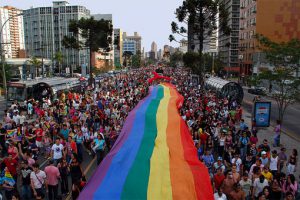
Thousands convened along the Paseo de la Reforma to participate in Mexico City’s 33rd Gay Pride Parade recently. Adorned in colorful flags and angel costumes and chanting loudly amid peals of music, people of lesbian, gay, bisexual, and transgender (LGBT) orientation marched and danced in demand of respect for sexual diversity in Mexico.

The motto this year was “Laws without Discrimination for the Whole Nation”—referring to the drive to take the progressive LGBT policies that exist in Mexico City (Distrito Federal—D.F.) and expand them across all of Mexico. In December 2009, the Asamblea Legislativa del Distrito Federal (Legislative Assembly of Mexico City) permitted gay marriage in Mexico City, making it the first city in Latin America to do so. The policy has been in effect since March 2010.

“We want the entire Mexican Republic to have all the advances that have been won in the D.F.,” said Octavio Perez, 26, of the Gay Pride Parade’s organizing committee. “That is basically the essence of the march.”

Although the Mexican capital has made venerable progress with regard to LGBT rights, homophobia within the country remains virulent. Between 1995 and 2008, the nongovernmental organization Letra S has documented 628 registered homicides connected to homophobia, as quoted by the Mexican National Commission of Human Rights. Moreover, 52 percent of Mexican lesbians, gays and bisexuals consider discrimination one of the main problems they face, according to a recent survey conducted by the National Council to Prevent Discrimination (CONAPRED). The same survey also notes that homosexuals and bisexuals admit that they encounter the most intolerance from the police and religious groups.

Read More

Tags: Mexico, Gay Rights

Hundreds March Against Homophobia in Havana

May 17, 2011

by AQ Online

Hundreds of people took to the streets of Havana last weekend to march in support of gay rights in Cuba. The demonstrations, which attracted numerous high-profile participants including well-known poet and playwright Norge Espinosa and Cuban President Raúl Castro’s daughter Mariela Castro, concluded at the Pavilion Cuba in central Havana. The demonstrations were sponsored by Cuba’s National Center for Sexual Education (CENESEX), which Ms. Castro directs, and were timed to precede the May 17 International Day Against Homophobia.

The Cuban government’s decision to allow these demonstrations stands in stark contrast to decades of official persecution of Cuban homosexuals under former President Fidel Castro. In a 2010 interview in the Mexican newspaper La Jornada, the elder Castro admitted his government had treated gays poorly and had not "paid enough attention" to the problem of homophobia on the island. Since that time, the government has largely reversed its position on the issue.

The fourth Cuban Campaign Against Homophobia runs through May 17 with events in at least 10 of 15 provinces and will culminate in the eastern city of Santiago de Cuba later today. Other events are scheduled to take place throughout Latin America—a region that is achieving significant progress in the area of LGBT rights.

Tags: Cuba, Gay Rights

A Gay Rights Revolution in Latin America

May 17, 2011

by Omar Encarnación

This month’s historic decision by the Brazilian Supreme Court to legalize same-sex civil unions continued a string of stunning victories for gays in Latin America.

In fact, as I point out in “Latin America’s Gay Rights Revolution” (Journal of Democracy, April 2011), since the early 2000s the region has emerged as surprisingly fertile ground for gay rights. Within the last five years alone, Uruguay lifted all legal barriers preventing gay men and women from serving openly in the military, Colombia’s Constitutional Court granted gay couples full rights of insurance, inheritance, immigration and social security, Mexico City legalized gay marriage and gay adoptions, and Argentina became only the eighth country in the world to legalize gay marriage.

A cocktail of social and political factors accounts for this surge of gay rights in what historically has been one of the most homophobic areas of the globe. This includes the growing secularization of the Latin American public—a trend made possible by the fading of Catholicism. In addition, the region has seen the advent of gay-friendly national governments in Argentina, Brazil and Uruguay, and municipal governments in São Paulo, Buenos Aires, Mexico City, and Bogotá. These inroads follow the examples set by Latin America’s closely tied European counterparts. In 2005, Spain became the first Catholic-majority nation to legalize gay marriage and Portugal followed soon thereafter. In an act of transnational policy crosspollination, Spain’s marriage bill served as the blueprint for the Argentine one.

Read More

Tags: Gay Rights

Peruvian Presidential Candidates Debate Same-Sex Marriage

February 2, 2011

by AQ Online

With just over two months to go before voting in Peru’s presidential elections on April 10, candidates are now devoting their attention to a social concern that has not been a front-and-center issue in national politics.  The focus on same-sex marriage comes on the heels of disparaging remarks made on January 24 by Bishop Emeritus of Chimbote Luis Bambarén that were directed at the gay community.  He also stated that discussion on “useless things like gay marriage” was a ploy by politicians to garner more votes. 

Currently leading in polls, former president Alejandro Toledo of the Perú Posible party has made statements suggesting that he is open to civil unions and working “toward an inclusive society.”  Pedro Pablo Kuczynski of Alianza por el Gran Cambio and Keiko Fujimori of Fuerza 2011 have both declared themselves in favor of civil unions as well.  According to recent CPI and Datum polls, Toledo is in the lead by only a few percentage points over Luis Castañeda of Solidaridad Nacional with Keiko Fujimori in third place.  Similar statements have been made by Manuel Rodríguez Cuadros of Fuerza Social.  Mr. Cuadros has declared that he is in favor of reforming Peru’s laws to allow for same-sex marriages.  Other candidates have not gone as far.  Among them, Catañeda has proposed inheritance benefits while calling changing current laws to permit same-sex unions “a crazy… idea.” 

Political analysts in Peru note that the gay vote played a key role in the recent election of Susana Villarán as mayor of Lima and so will now play a similar role in the presidential election.  According to Fernando Vivas of BBC Mundo, the increasing role of the gay vote in Peru has helped to raise the issue of gay rights above other topics like illiteracy and poverty eradication in the election debate. 

Tags: Peru, same-sex couples, Gay Rights, 2011 Peru Elections

Pages


Connect with AQ


Twitter YouTube Itunes App Store


Issues in Depth: President Obama's travel to Mexico, Costa Rica

AQ's coverage and post-trip analysis of the President's May 2-4 visit.

» Read more.


WEB EXCLUSIVES

Most Popular

MOST POPULAR ON AQ ONLINE

  • Most Viewed
  • Past:
  • 1 day
  • 1 week
  • 1 month
  • 1 year

NOW ON AS/COA ONLINE

Loading...

AQ MEDIA PARTNER

Loading...