

![]() |
For a country that abhors political dynasties, the announcement by Justin Trudeau on October 2, 2012, that he would vie for the leadership of the Canadian Liberal Party drew a stream of comments and analysis. Surely, former Prime Minister Pierre Trudeau (1968-1979, 1980-1984) would have been proud of his son’s decision, but he would undoubtedly have known that the expectations would be high. The response in Canada’s English language media ranged from skepticism to nostalgia to hope and excitement. In Québec’s French language media, the response was more tepid, with a mixture of indifference, amusement and curiosity.
Trudeau’s main claim to fame outside of his illustrious name is his ability to have been elected in a Montréal riding that once belonged to the separatist Bloc Québécois in 2008 and resisting the New Democratic Party (NDP) wave in 2011. Lately, the 40-year-old Trudeau took on a Conservative Senator in a “boxing” match for charity, and won handily. For moxie, the young Trudeau can be reminiscent of his dad at times.
This being said, the Canada of Pierre Trudeau has been transformed since the former prime minister left the scene in the 1990s. Constitutional issues involving Québec no longer dominate the political landscape. The preponderant role of Central Canada (Ontario and Québec) in Canadian politics has begun to shift toward Western Canada (Saskatchewan, Alberta and British Columbia) making Justin’s Québec credentials less significant than they were for his father.
The Liberal Party, which he wishes to lead, has also been transformed from its “natural governing party” status to that of a third party. Quite a descent for a party that governed for 75 years in the twentieth century! The progressive voice in Canadian politics is now primarily in the grasp of Tom Mulcair, official opposition leader and head of the NDP party. Becoming the leading progressive voice in the Canadian parliament will be the primary challenge for Justin Trudeau if the Liberal Party hopes to regain a semblance of its former status.
![]() |
With the Supreme Electoral Tribunal (TSE) nearing completion of its first pass through
The Results
Porfirio Lobo and the National Party won a landslide victory at every level of government. In the presidential elections, the National Party took upwards of 55 percent of votes cast, while the Liberal Party—long the numerically dominant party in
To put this trouncing in perspective: since political liberalization and civilian elections in 1981, no presidential candidate has received 54 percent of valid votes (not to speak of total votes cast). Furthermore, consider the last time that the National Party won the elections (only the second time since 1981). The winning presidential candidate, Ricardo Maduro, won with less than 50 percent of votes cast (52 percent of valid votes), and the National Party obtained neither an outright majority in Congress (it got 61 seats) nor among mayoralties (it won 148 of 298 municipalities).
In fact, after both the 2001 and 2005 elections, the winning party won only a plurality in Congress, forcing it to form coalitions to pass legislation. For the next four years, the National Party will not face this obstacle. This could further marginalize the three smaller parties (Democratic Unification party—UD, the Christian Democratic Party of Honduras—DC and the Innovation and Unity Party—PINU). Moreover, the UD’s very existence stands in question, given sharp internal divisions about whether to participate in the elections (the party decided to participate only a week before the election) and the party’s predictably miserable showing.
![]() |
Don’t adjust your set. Just when things were settling down on the Canadian election front, things are heating up again...
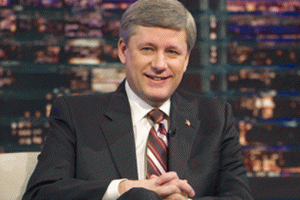
Under Michael Ignatieff’s leadership, the Liberal Party of Canada seems more determined than ever to defeat Prime Minister Stephen Harper’s minority Conservative government.
Three weeks ago, Harper survived a Liberal ways and means motion in the House of Commons with the pro-independence, Québec-based Bloc Québécois and the left-leaning New Democratic Party (NDP) as unlikely allies.
The vote not only kept the Conservatives in power but it also saved the Liberals from a likely bad showing at the polls. Undaunted, they signalled last week that they would try again to topple the Conservatives, saying the government doesn’t have the confidence of the House. But a non-confidence motion introduced in the House of Commons last week failed to win enough support.
But the trump card is in NDP Leader Jack Layton’s hands. After repeatedly calling for an election to shake out the Conservatives and after opposing their every move, Layton indicated that his party will support the government—at least until a more generous benefits package for the unemployed is passed into law.
AQ's coverage and post-trip analysis of the President's May 2-4 visit.