


From colonial times to the unfolding of democracy, the role of religion remained an important ingredient in how the U.S. and Canada chose to be governed and how the citizenry wanted its faith reflected in society. It is interesting to see how this has evolved in modern times.
In my home country of Canada, the original constitution—the British North America Act of 1867—had provisions related to religion and education. It was not until the late 1990s that a constitutional amendment eliminated the organization of Québec’s schools from kindergarten to high school along religious school boards. Yet, while religion played a part throughout Canadian history and politics in different ways and periods, no one expects religion to play much of a role in today’s electoral politics. Can the same be said about U.S. politics?
Here, in the U.S., there was an explicit amendment in the early stages of nationhood for the separation of church and state. Still, much to the bewilderment of observers north of the border, religion and a candidate’s religious beliefs are very much a part of the political discourse. It is conventional wisdom and standard practice to expect a presidential candidate to be questioned about his faith in the course of a campaign. In 2008, Barack Obama and John McCain actually had a debate just on faith and values. Lest no one forget that John F. Kennedy’s Catholicism was an issue back in 1960.
Issues such as abortion and gay rights continue to be hot-button, politically sensitive debates in the United States. Church groups weigh in heavily in these issues—while in Canada, they have generally been settled through legislation, court challenges and changing attitudes. Social conservative values are relatively marginal on the political radar screen when it comes to political choices in Canada. They do not enter the dynamics of election campaigns in any significant way. Not so in the U.S., and especially in a Republican presidential primary.
In this cycle, Mitt Romney’s religious affiliation, Newt Gingrich’s past personal conduct, and the faith affirmation campaigns of Michele Bachmann, Rick Santorum and Rick Perry go a long way in affecting the mood in the GOP race. But will a person’s faith or past personal conduct be a factor in the choice of a President in 2012?
This being said, religion or the expression of religious faith may be part of just about every presidential campaign. But it is not the deciding factor at the end of the day. True, it can condition a voter’s view of a person’s character. But it is usually issues, circumstance and temperament that carry the day—even in the more religious climate of the United States. President Obama’s roots and religion were very much a factor in the last presidential election with the Reverend Jeremiah Wright controversy. Yet, it did not prevent his rise to the highest office. His re-election will also not depend on his religious fervor or lack of it, nor will it be a factor against whom the Republicans choose.
This should be good news for both Newt Gingrich and Mitt Romney. Their success in the GOP primaries may very well depend on how the religious right perceives them. That all changes in the general election—where the focus generally shifts to political solutions and whether a candidate has the temperament to be president. Independents and the broad political mainstream do not consider religion as the determining factor in electoral politics. Even Ronald Reagan, who mobilized the religious right, was able to keep his distance. This is how America got George Washington, Abraham Lincoln, Teddy Roosevelt, Franklin D. Roosevelt and John F. Kennedy to lead the nation.
John Parisella is a guest blogger to AQ Online. He is Québec’s delegate general in New York, the province’s top ranking position in the United States.
ABOUT THE AUTHOR
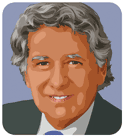
John Parisella
Reading Time: 3 minutesJohn Parisella is the former Québec delegate general in New York and currently a visiting professor at the University of Montréal’s International Relations Center. He is also a Member of the Board of Directors of The Montreal Council on Foreign Relations.