
btn_subscribe-top
btn_give-a-gift
btn_login
btn_signup
btn_rss

Panorama

Stay up-to-date with the latest trends and events from around the hemisphere with AQ's Panorama. Each issue, AQ packs its bags and offers readers travel tips on a new Americas destination.

In this issue:

La Sonoteca

AQ Online

Lima Rescues Experimental Tunes for Future Generations.


La Sonoteca audio session in Lima, Peru.

Peru has long been known for its rich indigenous and colonial history and its gastronomical culture. But the Andean country is also making waves with a flourishing experimental music scene. Riding the crest of this wave is Lima-based La Sonoteca.

La Sonoteca is a digital library of Peruvian electronic music that archives the work of over 70 artists. Planning began in 2006 when organizers of a local music festival realized that a formidable collection of music dating back to the 1960s risked destruction unless they could find a way to preserve it. In 2007, they received help from Telefónica Perú's Centro Fundación Telefónica (CFT), which was established to help support and distribute cultural expressions that use new media technologies.

Today, La Sonoteca has a large, state-of-the-art space with computers and online databases located in CFT's visitor center in central Lima. Here the public has access to the electronic library. According to Omar Lavalle, the organization's director, the center represents a "unique space to promote and distribute this type of work."

Lavalle wants to increase Sonoteca's role as a cultural resource and hopes it will create interest in Lima's experimental music culture outside Peru.

Why Lima? Lavalle points to the special traits of the city, where traditional culture and contemporary artists exist in an edgy urban balance. "Sometimes the chaos of the city can inspire the imagination," he says. Thanks to La Sonoteca, the chaos has been organized in a way that can inspire future generations of artists.

Listen to La Sonoteca Artists:

Bruno Macher
"Mono Loco"

replace this

Elegante
"Niebla humeda"

Ertiub
"Caricia mental"

Daniel Kudó
"03276951"


Juan Enrique Ahon
"Proceso 3"

La ira de Dios
"Pista 4"


Carnival in Trinidad

Matthew Aho

In the Caribbean, there’s a popular saying: “When the people of Trinidad and Tobago aren’t celebrating Carnival, they’re preparing for it.” It’s easy to believe when you see just how much planning goes into the month-long holiday, which climaxes with three days of festivities in Port of Spain just before Ash Wednesday (March 6–8 in 2011).

The party starts Monday morning with the J’ouvert (“day’s opening” in West Indies slang) parade. J’ouvert lasts from 4 a.m. to 8 a.m. Partygoers cover themselves in oil, mud or body paint and don costumes with roots in indigenous African and Indian traditions. Some dancers are adorned with spices and birds; others evoke darker themes through incarnations of Satan. Trinidad-based photographer Razor Acosta describes J’ouvert as “the embodiment of freedom and release of the Id.” “In J’ouvert,” Acosta says, “the street is yours. You go where you want, when you want. Every man is equal and allowed to be whatever his heart desires.”

The National Carnival Commission’s (NCC) official events take place on Monday and Tuesday during the day. Carnival “bands”—groups of people dressed in thematic, customized costumes—parade through the streets “playing mas,” the term used to describe dancing in costume to the accompaniment of soca, calypso and steel pan, a native Trinidadian instrument made by hammering down used oil drums. Participants pay about $500 for a costume and the right to “play mas” with their favorite band. Led by a King and Queen, whose costumes are constructed with wire or metal frames and covered in feathers, sequins and papier mâché, the bands converge on the Queen’s Park Savannah, Port of Spain’s largest open space, where they compete for band of the year.

With all the effort put into costume design, it’s no surprise that the spectacle of mas is Carnival’s biggest draw. “Just being a part of the experience is almost a requirement for Trinidadians,” says Trinidad native Levi Jordan.

Although some complain that high costs prohibit people from participating, money won’t be a barrier this year. The Ministry of Arts and Multiculturalism announced in November that it will bring out a “People’s Band” that anyone can join. “Carnival is about people enjoying themselves,” Minister Winston Peters said. “Make a mas face and come.”


Jair Oliveira's Sambazz

Matthew Aho

In an age of digital music and eBooks, Brazilian musician Jair Oliveira, 35, is making a strong case for what many believe is a bygone era: CDs and print books. His sixth album Sambazz, released in May 2010, is a tribute to the combined musical influence of samba and jazz and comes packaged with a hardcover book. The book, which Oliveira wrote himself, explains how he composes, records, produces, and arranges his music. “In Brazil, the process of making a record or CD is very mysterious,” says Oliveira. “I [tried to] make it very simple and approachable.”

This is Oliveira’s second foray into the hybrid CD-book genre. Three years ago, he wrote the musical children’s book Grandes Pequeninos for his newborn daughter Isabela, with help from friends like Seu Jorge. But Sambazz expands the concept and gives audiences a tangible record of the creative process. “I think I’ll continue to do books,” Oliveira says. “Think about how awesome it would be to have Michael Jackson’s notes about Thriller. If people know your process, they get closer to your work.”

After training at Boston’s Berklee College of Music, Oliveira, the son of Brazilian singer Jair Rodrigues, joined the ranks of second-generation musicians who followed their parents into stardom. Others include Bebel Gilberto (daugher of João) and Moreno Veloso (son of Caetano). But Oliveira is unique in an industry driven by breakout stars and viral video sensations. With three Grammy nominations, alongside ventures in acting, telenovela soundtracks and theater, Oliveira continually attracts new audiences. Oliveira will promote Sambazz in 2011 through a tour of universities, where he will offer a “workshop/demonstration” on producing  music. This personal dedication is also a throwback when most musicians today limit their contact with fans to traditional media and the Internet.


A View to Our Land

Matthew Aho

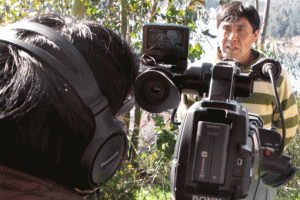
The phrase “Taiñ Azkintun” in the Mapudungun language of the Mapuche people of Chile translates into English as “our view.” It is also the name of an innovative arts training program, launched in 2010, to teach young indigenous Chileans—who constitute 4 percent of the national population—how to capture their ideas and experiences on video.

The initiative is designed to help Chile’s native youth affirm their voice in the national fabric. It is funded with a $20,000 grant from the Canadian government, along with support from local universities, and is overseen by indigenous rights watchdog Observatorio Ciudadano and the Mapuche publication Azkintuwe. Through the free program, 20 students are trained in audiovisual tools, scriptwriting, interview techniques, and editing-—skills students need to produce independent work that can be heard and seen.

“Chilean society needs to develop an intercultural dialogue,” says Paulina Acevedo, Observatorio Ciudadano’s communications director. “We should recognize we’re a country with indigenous nations as well as descendants of immigrants.”

Films now in post-production cover topics like foreign investment; social and environmental conflicts; ethno-tourism projects; language revival; and Mapuche perspectives on women’s role in society. One student group is even looking into funding for a video news project to report on indigenous rights issues.

Their projects were presented on December 10—International Human Rights Day. Organizers hope the presentation will help them continue the project with Chilean government funds and support from private foundations. If successful, they want to launch the project in Santiago to work with students from other indigenous groups, like the Aymara of the Andes and the Polynesian Rapa Nui people of Easter Island.


10 Things to Do: Puerto Williams

David Gacs

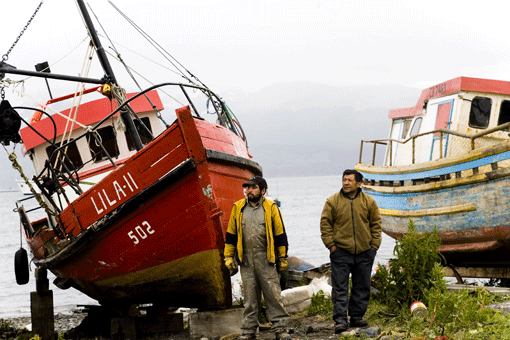
Way off the beaten path on Chile’s Navarino Island, Puerto Williams sits on the Beagle Channel in the Straits of Magellan. Surrounded by one of the world’s most pristine ecosystems, the naval town offers intrepid explorers the chance to see remote and untouched landscapes.

1.  Sail to Antarctica. Puerto Williams is becoming a popular departure port for Antarctica. Several agencies in town will help you get there. Options range from cruises to small yacht tours. Trips last from 10 days to 3 weeks.

2.  View the Mini Forests. Just outside town, El Parque Omora is known as the miniature forest of Cape Horn. It houses 5 percent of the world’s moss, lichen and liverwort species. The best way to admire the microflora is through what locals refer to as “tourism with a hand lens.” 

3.  Explore Museo Antropológico Martín Gusinde. Renovated in 2008, the museum houses artifacts from the local Yagán and Selknam peoples. Named after the anthropologist who spent 50 years studying these cultures, the museum is one of the few ways to learn about the area’s original inhabitants.

4.  Hike Dientes de Navarino. The jagged tooth-like appearance of the Dientes de Navarino mountains makes for spectacular trekking through unspoiled sub-Antarctic landscapes. The circuit goes through remote wilderness and is only recommended for experienced hikers. Hire a guide in town.

5.  Head South to Puerto Toro. Alledgedly the southernmost permanent settlement in the world, the small fishing village of Puerto Toro on the eastern shore of Navarino Island is home to a handful of permanent inhabitants. Get there on the monthly supply ferry and be sure to check out the spectacular views of the Straits of Magellan on the viewing deck.

6.  Race through the Fjords. Puerto Williams hosts the Glorias Navales Regatta in May. Over 300 sailors from around the world race through the fjords of the Straits of Magellan.

7.  Warm up at the Yacht Club. The Yacht Club Micalvi, an ex-navy supply ship docked at a local pier, is the place to meet for an evening drink in Puerto Williams. With a bar that opens after dinner, you’ll find locals and adventure-seekers alike sitting by the fire enjoying a nightcap.

8.  Taste the local specialty. Slow-cooked beaver meat is an important feature of local cuisine. Introduced to the region by furriers in the 1940s, beavers have since multiplied to the point that their pelts are worthless and they’re an environmental hazard. The meat is gamey and not for all tastes—but where better to try it?

9.  Celebrate winter. For six days at the end of July, the Fiesta de la Nieve (Snow Festival) is the town’s way of celebrating winter. Activities include winter sports, rodeos, concerts, and cultural events, culminating with the crowning of the local winter queen.

10. Discover Cape Horn. One of the world’s most pristine ecosystems, Cape Horn National Park is accessible only by sea. The striking, austere park is home to many species of protected animals and plants. Tours run in the summer months from Puerto Williams.


Instituto Culinario de México

Matthew Aho

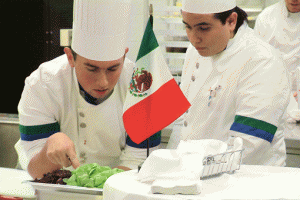
Mexico is squarely on the global map of haute cuisine thanks to the pioneering work of the Instituto Culinario de México (ICUM) in Puebla. Launched in 1994 in the home of founder Giovanna Medina, ICUM now boasts over 1,500 graduates, including some of the region’s most talented and prize-winning chefs.

Students come from all over Latin America to complete nine grueling semesters, including internships in restaurants in Mexico and abroad. But ICUM’s rigorous standards pay off. Graduates have won some of the industry’s most prestigious contests, such as Michigan’s Nation’s Cup International Culinary Competition and the French Coupe Européenne et Internationale Georges Baptiste.

Amateurs can get a taste of ICUM at one of the school’s three restaurants in Puebla and two in Monterrey, where it established a branch in 2002. Next steps include expanded collaboration with partners in Europe and North America.

At $5,000 per year, the institute isn’t cheap, but scholarships are available for some students.

The most rewarding thing, says Jose Villalvoza, General Director of ICUM-Monterrey, is that “16 years ago, ICUM was the first Mexican culinary arts school. Today, more than 60 schools are owned and operated by our former students.”


From the Think Tanks

Matthew Aho

The Western Hemisphere has the world’s most extensive network of free-trade agreements with developing and developed trade partners, concludes the report A New Trade Policy for the United States: Lessons from Latin America, published by the Latin American Program at the Woodrow Wilson International Center for Scholars. Because of its diverse free-trade relationships, Latin America has become a rich environment for examining the effects of free-trade agreements. At a time when the European Union, China, Korea, and India are all expanding their trade ties in the region, authors draw valuable lessons about things that “work” and “don’t work” in the current U.S.–Latin America trade regime.

A growing body of research looks at ways private companies can promote development through for-profit “inclusive business” models. El Consejo Empresarial Colombiano Para el Desarrollo Sostenible’s new report, Negocios Inclusivos: una Estrategia Empresarial para Reducir la Pobreza, gives readers a panoramic view of businesses in Colombia—large and small—that are tackling poverty by promoting greater social inclusion and market access but also turning a tidy profit.

The Facultad Latinoamericana de Ciencias Sociales (FLACSO) has published a series of papers on governance and democratic consolidation through Latin America. Its latest contribution, Gobernabilidad y Convivencia Democrática en América Latina y el Caribe: Jóvenes en el Mapa, takes an in-depth look at the role of young people in the region’s democracies. The report suggests that policymakers need to rethink ways to include youth in community-based decision making, encourage the participation of children in public life and boost public support for youth civic groups.


Connect with AQ


Twitter YouTube Itunes App Store


Issues in Depth: President Obama's travel to Mexico, Costa Rica

AQ's coverage and post-trip analysis of the President's May 2-4 visit.

» Read more.


WEB EXCLUSIVES

Most Popular

MOST POPULAR ON AQ ONLINE

  • Most Viewed
  • Past:
  • 1 day
  • 1 week
  • 1 month
  • 1 year

NOW ON AS/COA ONLINE

Loading...

AQ MEDIA PARTNER

Loading...